When to Go
Festival Season Travel: How to Join Without Taking Over
A resident-first framework for deciding whether to attend, understanding religious and civic boundaries, moving safely through crowds, planning access, and confirming the details that can change before a festival day.
Expanded evergreen planning guide
Start with the right premise: a festival is not staged for you
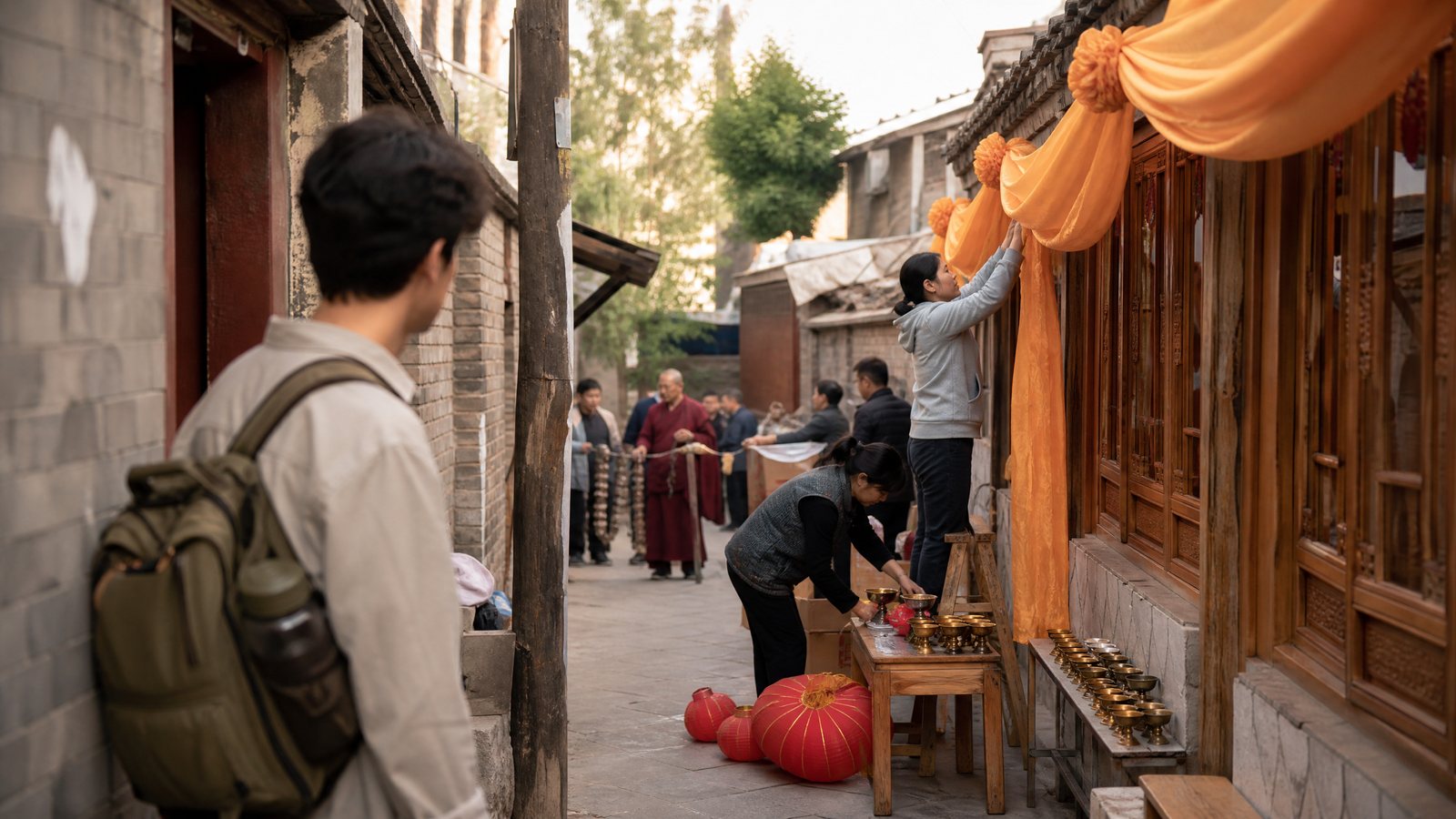
Festival travel can be generous and instructive, but it can also turn worship, memorial, harvest, political expression or family reunion into an obstacle course for the people who sustain it. The premise is simple: a living occasion is not automatically a visitor experience. Some programmes are public, some have public edges around private or sacred parts, and some are not appropriate to attend.
This is not an argument for avoiding festivals, but for taking a proportionate role. The strongest visit may mean standing at a procession’s edge, choosing an explanatory exhibition rather than a rite, or changing plans when a neighbourhood needs room. Access is a privilege shaped by community priorities, not a product acquired through travel.
The ethic behind slow travel is useful: notice who sets the pace, allow for local routines and resist treating every public moment as content. It suits travellers who value context over a complete visual record. Someone seeking a high-energy, audience-designed event may be better matched to a formally programmed performance than an intimate observance.
Use the SPACE decision framework before committing
The SPACE framework turns good intentions into a practical decision. It asks five questions: Status, Permission, Access, Capacity and Exit. Work through them in order. A weak answer early in the sequence should change the plan, rather than be compensated for by more enthusiasm or a longer journey.
Status: what kind of occasion is this?
Identify the festival’s primary purpose. An arts event, parade, religious procession, pilgrimage, memorial and neighbourhood celebration can all include music, food and crowds, yet they make different claims on visitors. A public route does not make every action on it public. Intangible cultural heritage means practices, knowledge and expressions kept alive by communities; it is not a label for unrestricted consumption.
Ask what happens before and after the headline moment. Preparation, fasting, prayer, school closures, mourning, return journeys, clean-up or family meals may matter more than the advertised peak. Treat a date as a planning lead, not a guarantee. This basic calendar literacy is especially valuable when festivals follow lunar, religious, agricultural or locally determined timetables.
Permission: where are you welcome, and on whose terms?
Look for explicit information about public observation, entry, photography, dress, bags, food and participation. Permission can be broad, conditional or absent. A steward’s direction, closed gate or instruction to move is a boundary, not a workaround. When information is incomplete, select the least intrusive option: a designated public area, a visitor-facing programme or a different plan.
Formal entry is only one layer of consent. Someone’s presence on a street does not make a close portrait, a recording of prayer, a livestream or a drone flight socially appropriate. Ask before taking a recognizable image of a person, particularly a child, a vendor at work, a worshipper or someone at a private threshold. A refusal needs no explanation. Put the device away without debate.
Access, Capacity and Exit: can you attend without creating a problem?
Access means the whole journey works for you, not merely that the destination has an entrance. Capacity means your tolerance and the space’s ability to absorb another person without compromising movement or emergency access. Exit means knowing how you will leave if conditions change.
If the route is unclear, access needs lack a specific answer, or you lack a realistic exit, choose a quieter time, a peripheral location or another activity. That is sound judgement, not a failure to “do” the festival.
Read the calendar as a community timetable
A festival is often a period, not a single day. Arriving only for the headline event can mean the busiest transit, the most restricted streets and the least spare capacity. A flexible window makes it easier to understand the atmosphere without trying to occupy its centre.
Separate durable planning from live operations. Purpose, etiquette, likely climate and geography are durable. The current date and hours, route, entry, restrictions, transport, weather response, accessibility layout and health guidance are live. Confirm the latter through the relevant local authority, official organiser, venue or transport operator, and expect change.
Going at the busiest hour can feel like the “real” choice, but it may add pressure at narrow streets and constrained services. A preparation day, earlier public segment or nearby cultural programme may offer context with less friction. The seasonal travel collection and travelling in the shoulder season can frame that choice; less busy is not automatically more appropriate.
Do not infer a complete schedule from old photographs or a generic listing. A programme may be shortened, rerouted or divided into spaces with different rules. Communities adapt traditions; outsiders should not use an imagined “authenticity” to question those choices.
Choose observation over participation when your role is unclear
Participation is not proximity. At a religious service, remembrance rite or procession, observe quietly only where observers are clearly accommodated. Do not copy chants, gestures, dress or ritual actions for amusement or an image, and do not join a moving group because there is a gap. If invited, follow the exact terms on footwear, dress, silence, food or distance.
At houses of worship and on processional routes, keep doorways, aisles, steps, curb ramps, crossings and service entrances clear. Pause conversation and image-making when prayer, a blessing, silence or a ceremony begins. Silence notifications, and avoid eating, smoking or drinking where it would interfere with an observance.
Language is part of etiquette. Call people participants, worshippers, residents, organisers or performers, not attractions. Do not declare a ceremony “authentic” because it feels unfamiliar. For more, see community-respect visitor etiquette.
Photograph less, and make consent the test
A camera changes the social space around an event. A phone held above a crowd can obstruct a shorter person’s view and delay movement. A close image can turn a private emotion into a permanent record. Ask not only whether a photo is possible, but whether it takes more than it gives.
Use a three-part test. Is recording permitted? Is a person or ritual identifiable and sensitive? Can you record without blocking, approaching, interrupting or broadcasting? If any answer is uncertain, do not record. Wide contextual views may be less intrusive than close faces, but local restrictions still govern.
Do not use flash in a religious, ceremonial or performance setting unless explicitly permitted. Do not photograph through a doorway into a private space. Do not treat a vendor’s stall, a grieving family or a child as background texture. If asked to delete an image, respond calmly and comply where possible. If an organiser prohibits recording, put the device away rather than trying to document around the rule.
Restraint creates attention. Without the pressure to collect proof, a visitor can notice how people make room and what the occasion means to participants.
Navigate a crowd as a moving system
Crowd movement can become hazardous when people compress, change direction against one another, queue at a narrow point or lose exits. Density matters as much as attendee numbers. Stalls, barriers, uneven ground, poor light and abrupt stops to film add friction to a constrained route.
Your most useful safety contribution is modest: do not become an obstacle. Keep crossings, entrances, accessible routes, platforms, kerbs and emergency lanes clear. Carry only what you can manage. Set a meeting point outside the busiest zone, where mobile service may be unreliable. Keep children close enough to move together.
Leave early when movement ceases to feel voluntary. If bodies press from several directions, flow repeatedly stops and surges, you cannot see a route outward, or companions separate, move diagonally toward a calmer edge when space permits and follow staff instructions.
Treat official announcements, stewards and changing barriers as part of the crowd-management system. Do not climb railings, walls, equipment or temporary structures. If a route is cleared, clear it promptly. A partial view preserves the movement space residents, participants and emergency responders need.
Plan health, weather and energy as shared constraints
A mass gathering is a concentration of people large enough to strain local resources. Its risks vary with duration, crowd density, venue, season, walking distance, sanitation and the physical demands of the event. A long outdoor procession in heat is a different proposition from a short indoor performance; a multi-day gathering can make rest, food, water and medication planning more consequential. Existing health conditions can also become harder to manage when standing, walking or waiting is prolonged.
Prepare for the conditions you are actually likely to meet. Wear footwear that is stable for the ground surface, clothing that meets local norms and layers that work with the forecast. Carry the personal medicines and essentials you need for the full outing, while keeping baggage compact. Eat, drink and rest at intervals that make sense for your health and for any observance you are not taking part in. Do not assume that a queue, a closed shop or a changed route will be convenient for your usual routine.
Weather can transform an event’s safety and access conditions. Heat, rain, wind, lightning, cold, smoke or flooding may alter routes, shelter options and transport. The right visitor response is not to outwait every warning for the sake of a planned view. Know the published shelter or dispersal instruction, keep enough charge for essential communication and leave when officials tell the crowd to leave. The planning principles in how far ahead weather is useful can help distinguish a seasonal expectation from a decision-day forecast.
A lower-intensity plan suits people managing fatigue, heat sensitivity, anxiety in dense environments, small children or a tight return journey. It may mean observing an earlier segment, finding a lawful quieter public location, or choosing a museum, neighbourhood walk or rest period instead. Designing rest days is relevant here: pacing is not lost time when it prevents a visit from becoming unsafe or inconsiderate.
Let resident needs shape where and how you spend
Festival demand can put extraordinary pressure on accommodation, ordinary transport, waste facilities, shops and residential streets. A visitor cannot resolve structural housing or infrastructure challenges alone, but can avoid making a concentrated period harder. Use accommodation that is lawful and clearly managed; follow quiet hours; use designated toilets and waste facilities; and never treat a residential stair, balcony, doorway or wall as a viewing platform.
Assess the whole stay, not just the room. A distant option may make a late departure difficult. A central option may place you in the middle of a residential area where people need to sleep, work and access their homes. The question is not how close you can get to the action, but whether your arrival, return and noise can be managed without leaning on neighbours’ patience. A walkable base may reduce vehicle pressure, but it is only a good choice if walking routes remain open and appropriate; walkable neighbourhood travel planning offers a wider framework.
Spend with context. Queue patiently, use businesses on their stated terms and accept that a local shop may serve regular customers or pause usual operations during its busiest period. Do not haggle aggressively over seasonal, handmade or culturally specific work. At the same time, do not claim that every purchase automatically benefits the community. Ownership, supply chains, labour arrangements and event governance differ. Respectful spending is about restraint and transparency, not a claim to have solved an economic problem.
Treat accessibility as an itinerary, not a label
An accessibility statement is a starting point, not an answer. Festivals frequently use temporary barriers, changing pedestrian routes, crowded transport and uneven outdoor surfaces. A venue that is manageable on an ordinary day can become difficult when the accessible entrance, toilet, drop-off point or viewing area shifts with the event layout. The relevant question is whether the complete route works: arrival, entry, participation, facilities, rest, departure and emergency exit.
Ask precise, current questions through the relevant organiser or authority. Which entrance is step-free? Is the route from transport continuous and free of temporary obstacles? What surface, slope and distance should be expected? Is companion seating or a lower-density viewing area available? Are there accessible toilets, a quiet place to recover from noise or crowding, and accessible emergency instructions? For deaf, blind, neurodivergent and mobility-impaired travellers, communication, sensory load and staff knowledge can matter as much as physical dimensions.
The table below converts those questions into a choice rather than a wish. It is a planning tool, not a promise that any event will provide a particular adjustment.
| Attendance approach | Preparation needed | Main trade-off | Often suits | Reconsider when |
|---|---|---|---|---|
| Main public viewing area | Confirm route, crowd expectations, toilets and exit | Closest atmosphere; highest density and least flexibility | Visitors comfortable standing and moving with a crowd | The path, sensory conditions or exit plan cannot be confirmed |
| Designated accessible or lower-density area | Ask what is available and how it is reached | May be farther from the focal point or limited in capacity | Travellers who need a predictable route, seating or reduced crowding | Access relies on an unverified temporary arrangement |
| Peripheral public observation | Choose a lawful position away from pinch points | Partial view; more context and easier departure | Families, first-time visitors and anyone uncertain about crowd tolerance | The location blocks residents, participants or circulation |
| Skip the focal event and engage elsewhere | Identify an appropriate alternative in the wider destination | Less spectacle; no claim to direct participation | People with unworkable access, health or timing constraints | The alternative itself creates pressure on a private or sacred space |
A visitor should not have to disclose a diagnosis to make a sensible decision. If clear, route-specific answers are unavailable, choose the lower-risk approach or another day’s activity. That is prudent planning, not diminished participation. For a related approach to matching pace and logistics to family needs, see slow travel with children.
Confirm live conditions, then decide again
Festival plans should have a final decision point. In the days immediately before departure, confirm the current public arrangements with the relevant official or local channel: date and timing, public access, religious or cultural restrictions, route or entrance, transport disruption, weather warnings, accessibility setup, security instructions and any health requirements. On the day, check again before leaving your accommodation and follow instructions issued on site.
This is a limitations section because information has limits. No general article can establish whether a specific ceremony welcomes observers, whether a street will be passable, whether a temporary ramp will remain usable in rain, or whether a crowd will reach a comfortable density. Organisers, municipalities, transport services and weather authorities make operational decisions for particular places and times. Their directions supersede generic advice.
Build a plan that survives a “no.” Choose a meeting point, a return route, a modest bag, charged communication, an amount of time you can comfortably stand or walk, and one nearby alternative that does not depend on forcing access. If a steward redirects you, a ceremony closes, weather changes or the crowd feels wrong, leave. An adaptable traveller does not interpret a changed plan as permission to press harder.
Compact pre-departure checklist
- Identify the occasion’s purpose and the public part you are considering.
- Confirm current access rules, route, transport and weather through relevant local or official channels.
- Decide what photography, clothing, food and conduct restrictions require from you.
- Choose a position that does not obstruct homes, entrances, crossings or accessible routes.
- Set an outside-the-crowd meeting point and a clear departure threshold.
- Check the whole accessible route, facilities and emergency plan if any access need applies.
- Carry only essential items, medication and communication power that you can manage safely.
- Accept in advance that the respectful choice may be to watch less, change course or not attend.
Take up less room, and leave the centre to the community
A good festival visit is measured less by how close you came than by whether your presence supported the occasion’s conditions: room to move, room to worship or celebrate, room for residents’ daily needs and room for staff to respond when something changes. Read the calendar beyond its headline, let permission set your role, make capacity and exit part of the plan, and confirm the live details that cannot be inferred from a guide.
The practical standard is clear. Attend only what is genuinely open to you. Observe more than you perform. Photograph less than you could. Make a smaller claim on space, services and attention. When that means choosing the edge, arriving at another time or walking away, it is not missing the point. It is understanding whose festival it is.