Slow Travel
How to Be a Temporary Neighbour: Respectful Habits for Longer Stays
A practical, evidence-led guide to sharing residential places with care: protect access and quiet, seek meaningful consent, follow local systems, and let residents’ routines take priority.
Expanded evergreen planning guide

A longer stay gives a visitor more time to notice a place, but also more opportunities to interfere with ordinary life. Ask “What do people need this neighbourhood to do while I am here?” Residents need sleep, safe passage, predictable access, work time and privacy. Protecting those conditions is the work of being a temporary neighbour.
This is a useful expression of slow travel. Slowing down does not mean collecting intimate experiences or assuming that extra time makes someone an insider. It allows time to observe, ask a proportionate question and change a habit that creates friction. International tourism ethics frames this as respect for host communities’ laws, practices and customs. Destination-management standards similarly prioritise resident feedback, access and visitor pressure.
Begin with the neighbourhood, not the accommodation
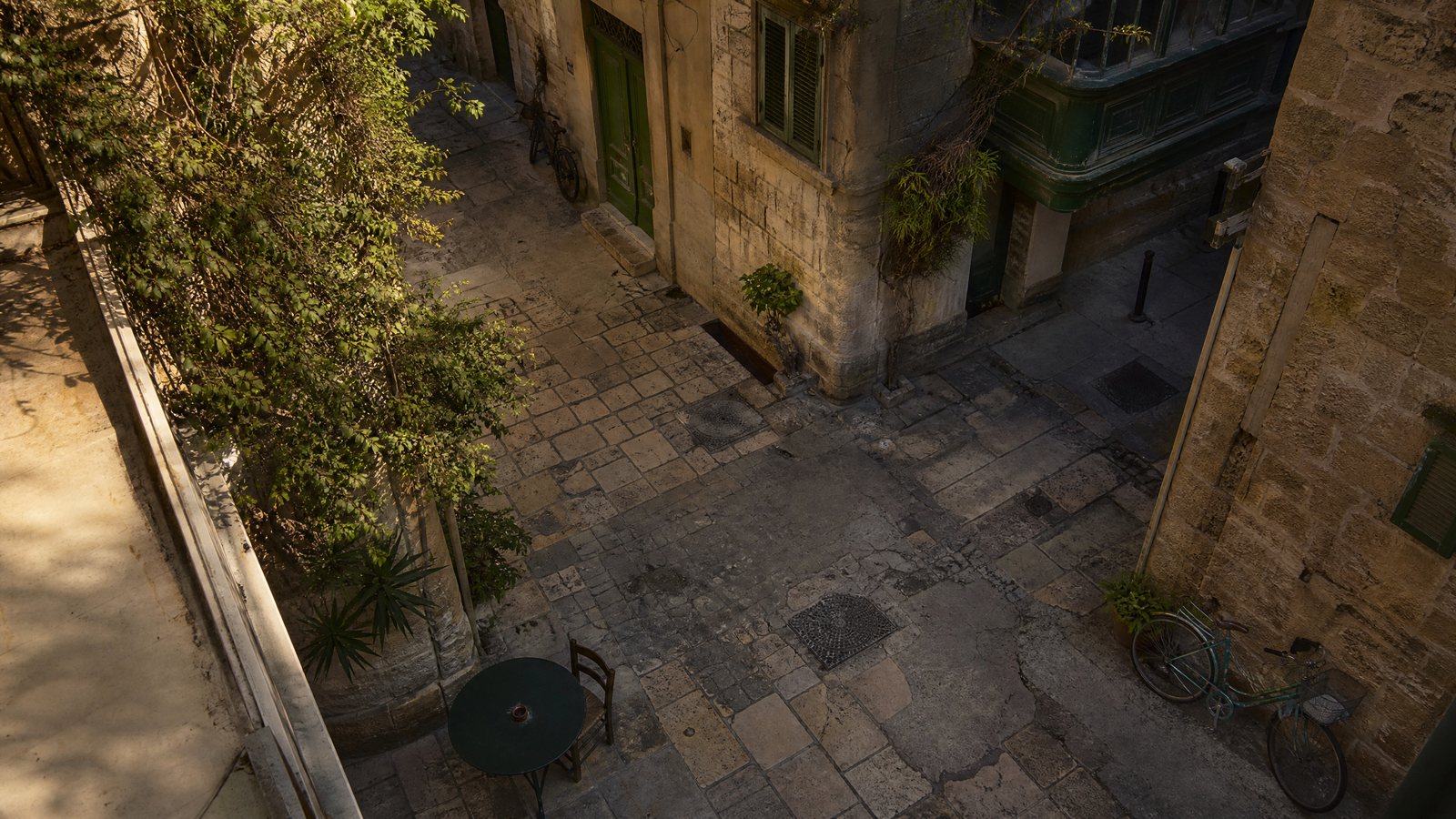
A residential street is not a hotel corridor with private homes attached. Entrances, pavements, stairwells, lifts, courtyards, laundries, cycle rooms and refuse areas are shared infrastructure: spaces used to get home, work, carry shopping, move with children, use mobility aids and rest. Visibility or an unlocked gate does not make a space a visitor amenity.
On arrival, keep luggage, shoes, pushchairs and parcels out of circulation routes. Do not wait in a doorway, block a gate while checking directions, or let a group spread across a narrow pavement. If entry fails, use the designated property contact rather than repeatedly ringing unfamiliar homes or following someone through a controlled door. Treat gardens, rooftops, docks, stair landings and courtyards as private unless their use is clearly stated. How to assess a walkable neighbourhood helps distinguish public convenience from proximity to private life.
Make a first-day orientation part of the stay
Use the first day to learn the local system before urgency encourages assumptions. Notice residential entrances, bins and posted instructions without photographing people, homes or work routines. The aim is not to decode a culture from one afternoon; it is to prevent mundane mistakes.
Ask the accommodation contact how refuse is separated, where keys and cycles belong, how to report a building problem, and about building-specific quiet expectations. Ask a site steward or relevant local authority about the site they manage. A neighbour is not responsible for a visitor’s orientation.
A local system is a procedure that works in one place: bin colours, collection points, entrance protocols, water restrictions, parking or sacred-space conduct. A familiar-looking symbol can mean something different elsewhere. Learning it prevents visitors from transferring cleanup, delay or confusion to residents and workers.
Temporary-neighbour test: If everyone on this street or in this building copied my action at once, would passage, quiet, privacy and ordinary work still be possible? If not, choose a less intrusive option.
Use the Friction–Permission–Pressure framework
When etiquette is unclear, use this article-specific three-part framework before an action touches shared life. Friction is the noise, obstruction, mess, delay or attention an action creates. Permission asks whose space, image, labour or story is involved, and whether they can freely agree. Pressure asks whether repetition—by you or many visitors—would make a place harder to live in or manage.
Each question catches a different error. A late balcony conversation can create friction without formal consent. A worker’s photograph can require permission without physical friction. Posting a quiet place’s exact location can add pressure later. If one factor is high, scale down, move, wait or do without. The framework suits independent travellers, families, remote workers and groups. It cannot answer legal questions or displace direct instructions.
| Situation | Friction: what could daily life absorb? | Permission: whose choice matters? | Pressure: what if this became common? | Lower-impact response |
|---|---|---|---|---|
| Arriving late with bags | Doors, wheels and voices can wake nearby residents. | Your party controls its arrival behaviour. | Repeated disturbance changes a building’s character. | Prepare entry details early, carry bags quietly and keep conversation for inside. |
| Using a courtyard or landing | It may block passage or turn a resting space into a gathering. | Residents or managers may control use. | Visitor groups can displace ordinary use. | Use it only when clearly designated; otherwise choose a public space intended for lingering. |
| Photographing someone at work | The act can interrupt concentration or attract attention. | The person decides whether to be pictured. | Normal work can become a spectacle. | Ask clearly, accept no, and do not retry from a distance. |
| Sharing a precise location | Immediate disturbance may be invisible. | People connected to the place may not have agreed to exposure. | Attention can concentrate in a small area. | Share the general area, or leave out location and identifying clues. |
| Sorting unfamiliar packaging | Incorrect sorting creates work and can contaminate a stream. | The system’s instructions govern disposal. | Small errors multiply across a building. | Read current instructions; if still unsure, ask the responsible contact. |
Protect access, quiet and predictable routines
Access is more than an abstract courtesy. A clear route can determine whether someone using a wheelchair, cane, pushchair or delivery trolley can move independently. Accessibility standards treat circulation routes as continuous spaces that should be free of obstructions. The everyday lesson applies widely: do not store belongings in halls, on landings, by ramps, near lifts or in narrow entrances.
Noise also accumulates. Hard stairwells, enclosed courtyards and balconies can carry voices farther than expected. Keep calls private and brief in shared areas, use headphones for media, close doors rather than letting them swing, and sort keys, bags and directions before a late arrival. A visitor travelling with children may need more space and flexibility, not less responsibility. Slow travel with children offers ways to plan pauses; the same approach reduces the chance that tiredness becomes noise or crowding.
Separate needs from entitlements
A real need can justify asking for help: a step-free route, a place to rest, allergen information or clarification of a rule. An entitlement demands that a stranger rearrange their time, home or workplace around a visitor’s preference. Someone who cannot use stairs can ask whether an accessible entrance exists; they should not assume an unmarked private entrance is available. Direct questions and a workable alternative are more respectful than persistence.
Let quiet be context-led
Formal quiet periods, construction rules, event restrictions and faith-related observances vary by locality and can change. Do not infer a universal curfew from one sign or treat every difference as a cultural puzzle. Follow posted instructions, reduce volume when unsure, and confirm current details through the relevant local or official channel. Taking a call indoors, meeting elsewhere or delaying a nonessential task is usually the lower-impact choice.
Treat waste and resources as shared responsibilities
Waste handling is where a household habit can impose work on others. Environmental authorities emphasise that recycling acceptance differs among local programs; a package symbol does not establish that an item belongs in the local stream. Food residue, batteries, electronics, chemicals and other special materials may need distinct handling. The durable principle is to follow instructions for the exact building and locality, not an assumed system from home.
Sort carefully; reduce before sorting
Buy food for realistic meals and use it before adding more. This reduces departure-day waste and overflowing bins. Flatten or rinse only when local guidance requests it; do not force items into a familiar-looking bin. Keep loose waste inside until you know the collection point and timing. Never use a neighbour’s container, an empty lot or a public bin as a substitute for the designated arrangement.
If an item is unclear, check the building instructions, ask the designated contact, or use the specified general-waste route if the system directs that outcome. Take particular care with batteries, medicines, sharps, solvents and electronics. They should not be left for cleaning staff to identify. Reducing waste does not require importing a universal zero-waste routine. It requires correctly using the system available where you are.
Use less without policing other people
Direct resource awareness at your own consumption. Take shorter showers where water is scarce or rules request restraint, turn off lights and climate control when leaving, and use shared equipment only as authorised. These habits accord with the international ethic of conserving water and energy. Do not judge residents’ household choices; focus on resources you control and current local restrictions.
Ask before you photograph, record or publish
A camera can turn ordinary life into content. Consent is the appropriate default when a person is identifiable, children are present, or a scene involves worship, care, grief, private homes or paid work. Ask before raising the camera where practical, explain what you want to make, wait for an unpressured answer and accept a refusal immediately. Do not use a longer lens, a different angle or a later attempt to override a clear no.
Photography laws and customs differ widely. Sensitive locations can include government, military, diplomatic and religious places. A lack of signage is not proof that recording is acceptable. If a site’s rule is unclear, ask the authority responsible for that site and follow its instruction. Legal permission and respectful conduct are different tests: an image may be lawful yet intrusive.
Consent has two moments
The first moment is consent to make an image; the second is consent to share it. A person who agrees to a portrait for a private memory may not agree to a public post, a publication or an image that reveals their workplace or home. State the intended use before making the image, rather than treating an agreeable nod as unlimited permission.
Children require added caution. Do not seek a child’s attention for a photograph, offer an item for a pose, or assume a nearby adult settles the question. If the situation is ambiguous, do not make the image. That may feel restrictive to a visitor seeking visual memories, but another person’s dignity and safety carry more weight.
Do not amplify a fragile place
Geotagging adds a precise location to an image or post. It can funnel attention toward a narrow lane, sacred site, small enterprise or home area not designed for it. Omit exact location data and recognisable access cues when a place is quiet, sensitive or residential. For publication decisions about place descriptions and images, the journal’s editorial policy explains the standards that guide RAAHCHAL.
Use language to cooperate, not to perform belonging
Learn greetings, thanks, apology, “excuse me,” “I do not understand,” and a polite way to ask whether another language is shared. Pronounce words modestly and use translation as support rather than a substitute for patience.
The aim is cooperation, not fluency theatre. A shop worker, driver, cleaner or neighbour is not a free cultural interpreter. Keep questions brief while the person is working. If an exchange fails, simplify it, write it down, step aside or return later.
Language matters after the conversation too. Avoid describing inhabited places as “undiscovered,” “untouched” or more “authentic” because they are less oriented to outsiders. Such labels erase residents’ full lives and imply that local value exists mainly for visitor consumption. Describe only what you can verify, distinguish observation from fact, and read RAAHCHAL’s approach to travel stories before turning a private impression into advice for others.
Spend fairly without trying to purchase access
Spending can meet a stay’s ordinary needs, but money does not create a claim on people’s time, attention, homes or beliefs. Choose transactions you genuinely need, understand what is offered before accepting it, and pay the agreed amount on time. Where prices are normally discussed, ask once, keep the exchange brief, and decline politely if it does not work for you. Pressing a worker who has less time or bargaining power is not a meaningful cultural encounter.
The idea of local economic benefit is real but conditional. Global tourism ethics call for host communities to share fairly in tourism’s economic, social and cultural benefits. Yet a visitor cannot infer where every payment ultimately goes, nor can proximity prove local ownership or fair employment. The practical standard is narrower: transact transparently, respect stated boundaries, and do not claim that an ordinary purchase has solved a community-level problem.
Do not offer money, gifts or custom in exchange for a portrait, entry to a home, a personal story, a child’s attention or access to a nonpublic celebration. An offer that seems generous can turn a power difference into pressure. A warm interaction remains valuable only if everyone can end it freely.
Manage movement, timing and attention
Visitor pressure is not only the number of people in a destination. It is also where, when and how people concentrate. Destination-management standards recommend balancing visitor activity with community, cultural-heritage, environmental and economic needs. A group lingering in a narrow passage, stopping at a school gate or arriving noisily near a place of worship can disrupt daily life even when the wider district seems uncrowded.
Choose routes that suit the purpose. Keep moving through a residential lane instead of treating it as a photo set. Pause in a park, square or other public area intended for lingering when available. Give entrances, queues, transport stops and service counters their primary users: people getting somewhere, working or accessing care. When a place feels busy, shorten the stop rather than searching for a more secluded resident-only corner.
Timing is useful but imperfect. Travelling outside a peak period can distribute demand, but it is not automatically respectful: a religious observance, harvest, school event, local emergency or infrastructure limit may matter more than seasonality. Festival-season etiquette can help visitors plan around celebrations without turning them into a spectacle. Rest days in a slower itinerary can reduce the urge to fill every hour. Flexibility suits visitors with extra time; those on fixed schedules can still choose one priority and leave the rest unclaimed.
Confirm what changes, and recognise the limits
Some principles are durable: respect consent, keep access clear, avoid unnecessary waste, obey rules, and let residents’ needs outweigh a visitor’s desire for novelty. Details are not durable. Building access procedures, waste collection, water limits, photography restrictions, transport changes, road closures, site conditions, public-health measures and event arrangements can change with little notice.
Before departure and again before a sensitive activity, confirm changeable details through the relevant local or official channel: the property contact for building arrangements, the managing authority for a site, the local authority for civic rules, or the transport operator for service conditions. Confirmation is not a one-time administrative task. Repeat it when weather, an alert, a notice, an event or a staff instruction indicates changed conditions.
This guide cannot identify the law in a particular jurisdiction, settle competing claims to a space, or predict how every resident will interpret an action. It is not a substitute for disability-specific access information, medical advice, safety instructions or an explicit rule. When guidance conflicts, follow applicable law and the direct instruction of the responsible authority. When a social question remains uncertain, choose the option that asks less of others.
Compact temporary-neighbour checklist
Before and during a longer stay, use this short check rather than trying to memorise a catalogue of customs:
- Clear: Have I kept entrances, halls, pavements and ramps clear for their normal users?
- Quiet: Could this call, conversation, arrival or gathering disturb people who did not choose it?
- Correct: Do I know the current instructions for waste, water, access and the site I am using?
- Consensual: Does a person, home, workplace, ceremony or story require a clear yes before I record, enter or share it?
- Proportionate: Am I asking for necessary help, or treating somebody’s time and space as mine to use?
- Reversible: If this creates attention or disruption, can I stop, move, delete or change course quickly?
A “no” or “not sure” is useful information. It is not a prompt to argue, seek an exception or test a boundary. Change the plan while the effect is still small.
Conclusion: leave daily life easier, not louder
The goal of a longer stay is not to become indistinguishable from a resident. That is impossible and can encourage false claims of belonging. The goal is practical: be legible as a visitor whose presence does not make ordinary life harder. Protect routes and rest, learn the local system, ask before taking or sharing, spend without demanding access, and verify rules that change.
A temporary neighbour will sometimes misunderstand a sign or need help. The meaningful response is to listen, correct the mistake and reduce the burden. The place remains a home to others after the visitor leaves.