Slow Travel
When the Train Is the Journey: Comparing Rail and Short Flights Thoughtfully
A route-specific way to compare rail and short flights through door-to-door time, disruption, access, energy and the value of arriving well.
Expanded evergreen planning guide
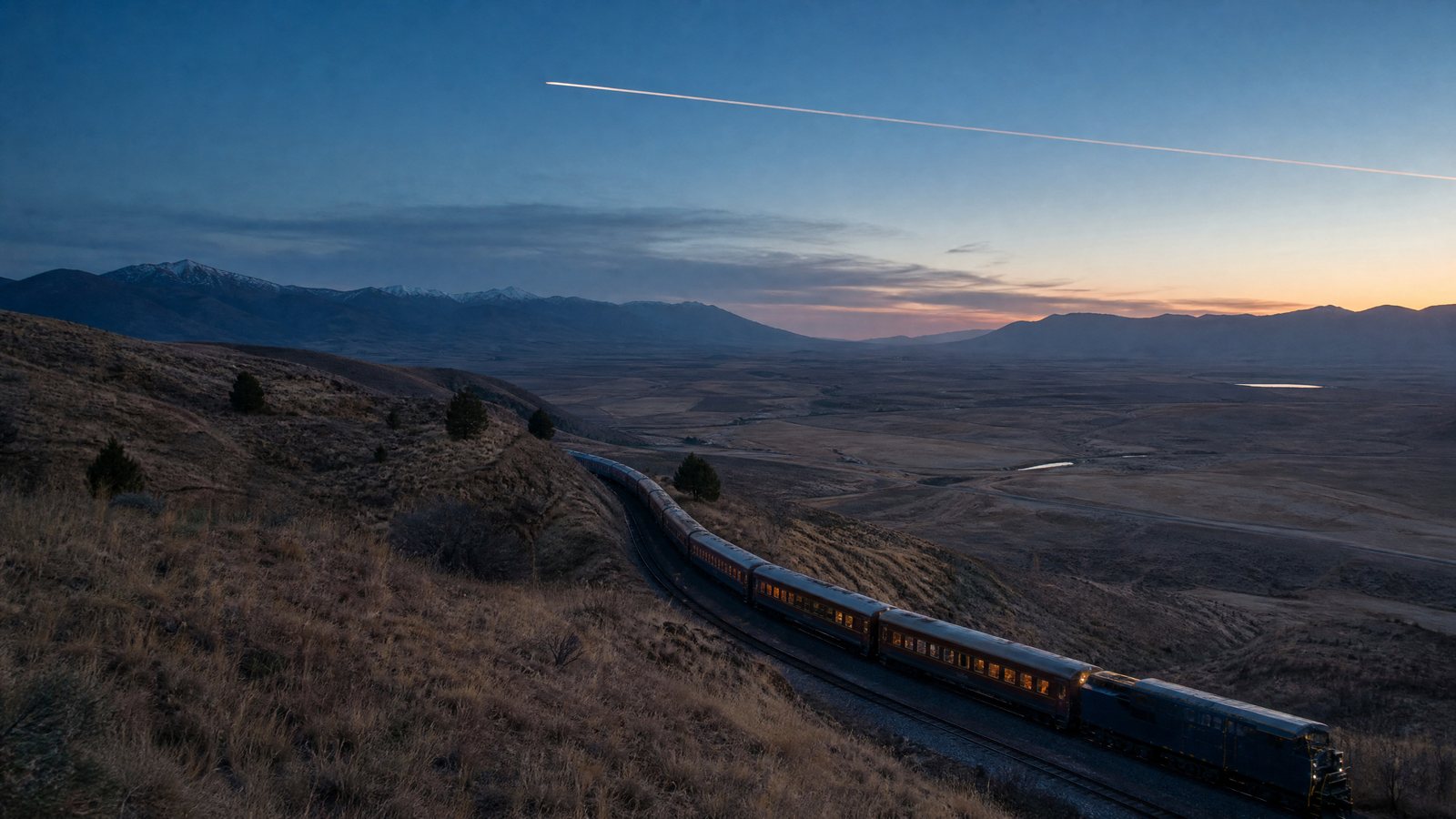
Choosing between a train and a short flight is not a contest between a scenic option and a fast one. It is a comparison between two complete itineraries with different demands on time, money, concentration, access and energy. Rail is often compelling when it connects useful city-centre stations directly. A flight can be more thoughtful when it removes a precarious chain of transfers, protects an essential arrival time or makes the journey physically manageable.
The useful question is not “which mode is better?” It is: which option lets this trip happen with the least avoidable strain and the most defensible use of resources? That leaves room for environmental responsibility without treating access needs, caring duties or an inflexible arrival as a moral failure. Slow travel is practical when time in motion supports the reason for travelling.
Start with the journey you are actually taking
A door-to-door journey begins when you leave your starting address and ends when you reach the place where you will sleep, meet someone or begin an activity. It includes the local journey to the departure point, navigation and waiting, the main leg, every change, baggage collection where relevant, and the final local leg. This is the fair basis for comparing rail with air.
Scheduled airborne time is not the duration of a flight journey, just as a train’s running time is not the duration of a rail journey. An airport may be close to home and convenient for the final address. A central station may involve a long platform change. Write down each segment rather than assuming that a hub’s label settles the matter.
The end points can reverse the obvious answer. For a two-night city visit, a direct train near lodging may make the whole day usable. For an early medical appointment at a home outside the rail network, a flight followed by a simple local ride may have fewer failure points. The mode has not changed; the trip has. This is the central principle of the slow-travel beginner’s guide: deliberate travel is not automatically slower travel.
Use a consequence-first decision framework
Minutes are easy to compare and easy to overvalue. The consequence-first framework asks what happens if an itinerary goes wrong, not only how it looks when all goes to plan. It is most useful when rail and air appear close on nominal duration.
Build two honest timelines
For each option, make a timeline from front door to final address. Mark fixed commitments, such as an event, the end of local transport, a child’s bedtime or a work shift. Add a buffer: time deliberately left between steps for ordinary delay, navigation or a queue. It is part of the itinerary, not wasted time.
Also identify transfer penalties: effort beyond the listed minutes, such as moving bags, finding a lift, crossing a border, keeping companions together or recovering from a long walk. A 15-minute change may be comfortable for one person and unrealistic for another. Count the penalty as time and energy.
Score the things that can damage the trip
Give each option 0 to 2 on the six questions below: 2 is clearly favourable, 1 is workable with care, and 0 is a material problem. This is not a scientific ranking. It makes priorities visible before the headline time takes over.
| Decision question | Rail tends to score well when | A short flight tends to score well when | What can change the result |
|---|---|---|---|
| Door-to-door time | Both stations are useful and the service is direct. | Airport access is simple and the flight replaces several rail changes. | Local transport hours, terminal distance and required arrival time. |
| Arrival consequence | A later service or on-board recovery does not defeat the trip’s purpose. | It protects a fixed appointment or avoids a late onward rail leg. | Importance of the first commitment after arrival. |
| Physical and sensory load | You can manage luggage and the train environment comfortably. | A direct flight is less demanding than several stations and platforms. | Crowds, walking distance, seating, toilets and assistance. |
| Connection resilience | There are few changes and a missed one has a practical recovery path. | The itinerary is direct or has generous connection time. | Ticket structure, last services, weather and alternatives. |
| Environmental context | It is a reasonably direct passenger rail journey. | No workable rail option exists or flying prevents substantial extra travel. | Detours, occupancy, energy supply and local legs. |
| Journey value | Time in motion is useful for rest, reading or observing the approach. | Time at the destination matters more than time in transit. | Purpose, stamina and the meaning of usable time that day. |
Weight non-negotiables. If step-free movement is essential, a lovely route cannot offset an inaccessible interchange. If a once-only ceremony depends on arrival, lower risk may outweigh a rail day. If neither dominates and rail remains close on time, turning transit into part of the trip is a meaningful advantage.
Recognise when rail makes time usable
Rail’s distinctive strength is that a block of travel time may be usable: time in which you can rest, read, look out of the window, write, talk quietly, eat something brought with you or simply change pace without continually managing the next formal step. It is not a promise of quiet, workspace, power, a particular seat or any onboard facility.
A direct route can change the rhythm of a short break. Scenery and a street-level arrival can make geography and the first walk through a destination more legible. Those benefits are strongest when station locations are sensible and there is enough slack at the destination.
Rail does not suit every energy profile. Several changes can mean lifting bags, finding lifts, following announcements and standing in exposed or crowded spaces. A long journey with nowhere comfortable to pause may create a recovery day that a direct flight avoids. Travellers with young children, chronic pain, mobility devices, sensory sensitivities, limited vision or a tight care schedule should not have to turn inconvenience into an environmental gesture. Slow travel with children applies the same capacity-first thinking to family journeys.
Recognise when flying protects the trip’s purpose
A short flight can be the responsible choice when it protects something rail cannot reasonably protect. “Short-haul” describes a relatively brief flight, but no worldwide threshold decides whether rail is practical. Geography, water crossings, border arrangements, station networks and service frequency matter more than the label.
Flying may be preferable when rail requires an overnight change, the final onward service is fragile, or a group would otherwise make several unfamiliar interchanges under pressure. It can preserve enough time for a short visit to have meaning: a family milestone, a required meeting or daylight arrival before a demanding first day. This is not treating speed as inherently virtuous. It is preventing transit from consuming the visit.
Airport travel has its own concentrated demands: a set arrival window, security, terminal walking, restricted access to belongings in flight and a separate trip from the airport. A direct flight can have fewer changes than rail, but it is still an itinerary. Give its first and last mile equal attention. If an early flight recovers time, place some of it next to a pause rather than another obligation; designing rest days offers a useful pacing model.
Put carbon in the right frame
Environmental impact is a material reason to consider rail when a direct passenger train is a workable substitute for a short flight. The European Environment Agency’s European assessment places rail among the lowest-emitting motorised options and identifies aviation’s emissions impact per passenger-kilometre as much higher. A passenger-kilometre is one passenger travelling one kilometre; the measure relates impact to movement delivered rather than simply to a vehicle.
That principle should start a question, not end it. The actual route, rail electricity supply, train and aircraft occupancy, detours to hubs, local legs and the alternative that would genuinely have been used all matter. A circuitous rail itinerary with substantial added road travel is not equivalent to a direct city-centre rail route. Nor does a mode average establish that every traveller had a feasible alternative.
Avoid making this a test of virtue. Someone who must arrive quickly, avoid an inaccessible connection, carry essential equipment or return for a care responsibility has constraints a mode average cannot see. Where rail is credible after time, access and risk have been considered, give its lower-emission context real weight. Where it is not, name the constraint rather than pretending it does not exist.
Treat reliability as route-specific
Reliability is the chance that a particular itinerary completes in a useful way on a particular day. Rail can be affected by infrastructure work, signalling problems, staffing, industrial action, extreme weather and an earlier network disruption. Aviation can be affected by weather, air-traffic restrictions, crew or aircraft rotation, and congestion at either airport. Both may be affected by the same weather event, but not at the same stage or with the same recovery path.
Published metrics do not measure the same journey
Official data are valuable only when their definitions are respected. United States airline on-time data use gate times and count an arrival as on time when it is less than 15 minutes behind the published arrival; their stated coverage is defined reporting carriers and domestic non-stop flights. They do not measure the trip to an airport, a queue, baggage collection or the ride to lodging. Great Britain’s rail regulator publishes punctuality, cancellations and delay causes for its mainline network under its own measures. Neither is a universal scorecard between modes.
Use local performance information to understand a corridor, then locate its weakest link: the final train to a small town, a flight arriving after the last local connection, a cross-city station change or a morning departure in disruptive conditions. For a fixed consequence, choose resilience over optimism. Resilience means time, a practical alternative or a tolerable outcome if delayed; it can mean leaving earlier, arriving the evening before or choosing a slower direct leg.
Understand ticket structure before relying on a connection
Connection protection can depend on how a journey is documented. A through-ticket covers a journey with one or more connections as one journey rather than as a collection of separate tickets. In the European Union, the relevant passenger-rights framework gives through-ticket holders specified rights in certain missed-connection circumstances; separate tickets do not carry the same stated protection. Exact rules, exemptions and remedies depend on the service and jurisdiction.
The lesson travels beyond that setting. Separate segments can leave more coordination to you if the first one is late. A single journey record may make information or rerouting clearer, but its terms still need to be read. Do not infer protection from a shared logo, route map or adjacent platforms.
Keep your itinerary, ticket conditions and assistance confirmation accessible without relying on a signal. Know the final address and a contact number offline. If a connection is essential, identify another same-day route, a safe overnight option or the person who needs to be told. This turns a minor disruption into a manageable one rather than a safety or access problem.
Put accessibility and energy ahead of aesthetics
Accessibility is the ability to complete the whole journey with the facilities, support and time a person needs. It may include step-free routes, ramps, accessible toilets, manageable platform gaps, space for a mobility device, a quiet place to wait, visual or audible information, wayfinding assistance, or time to take medication. Needs vary, and the same person’s needs can vary by day.
European guidance recognises assistance for travellers with disabilities or reduced mobility in rail and air travel, but notice periods, safety rules and infrastructure constraints matter. This is useful context, not a substitute for checking a specific station, aircraft arrangement, route and jurisdiction. A symbol on a general map cannot show whether a lift is operating, a connection is achievable or a service can carry particular equipment.
Ask about the handovers, not just the vehicle
The vulnerable moments are often handovers: kerb to terminal, station entrance to platform, platform to train, aircraft door to mobility equipment, and arrival hub to local transport. Confirm the precise assistance process, any advance-notice requirement, equipment dimensions or battery rules where relevant, station facilities, and how assistance moves across connections through the relevant operator or official local channel.
Build margin around each handover. A plan that depends on an unfamiliar lift, long corridor and platform change aligning perfectly is not accessible simply because the vehicle can be entered. Pack so that essential medication and necessary items stay with you, and do not assume staff can handle a heavy item. Accessibility planning is risk reduction, not a request for special treatment.
Arrive in a way that respects the place and other passengers
Rail brings people into neighbourhoods at street level, which is part of its appeal and a responsibility. Stations serve commuters and residents before they serve visitors. Keep doorways, lifts, aisles and platform edges clear; use headphones; observe quiet-area and luggage rules; and leave priority seating to those who need it. Shared tables, charging points and luggage racks are shared infrastructure.
Flying relocates the same responsibility to shuttles, local buses, arrivals halls and the first streets beyond the terminal. Plan the final leg so you do not need to improvise loudly in a residential area, block an entrance with bags or ask staff to repair an over-tight plan. During disruption, follow transport staff and emergency instructions rather than crowding a doorway or platform edge.
Arrival is not the same as being ready for an activity. Leave room for the walk to lodging, food, a shower, medication, a child’s reset or a quiet pause. For an itinerary built around ordinary rhythms instead of instant consumption, see market mornings and local routines.
Confirm the facts that cannot be evergreen
The durable principles are to compare door to door, value access and recovery time, identify the weakest connection and give credible rail options environmental weight. Timetables, platform assignments, terminal procedures, engineering work, weather warnings, local transport hours, fare conditions, assistance arrangements and passenger-rights coverage are live facts. Treat the latter as information to confirm, not background knowledge.
Close to departure, confirm current details through the relevant transport operator, station or airport, local authority, official weather service and passenger-rights channel. In expected disruption, official preparedness guidance supports extra time and keeping essential medication, a charged phone and power source accessible. Personal supplies should reflect health, weather and journey length.
Compact pre-departure checklist
- Compare both choices from starting address to final address, including every local leg.
- Mark the one missed connection or delay that would cause the greatest harm.
- Confirm the current service plan, disruption notices and final onward connection.
- Verify access details that matter to you; arrange needed assistance through the relevant channel.
- Keep medication, a charged phone, power source, water and destination details accessible as appropriate.
- Leave enough time after arrival before the first non-negotiable commitment.
Heat, storms, flooding, smoke, snow and high winds can affect the main leg and local links differently. Weather timing and useful forecasts helps distinguish seasonal expectation from a departure-day operational decision.
Choose the option that leaves the trip intact
Take the train when a direct, accessible and reasonably resilient rail journey gives usable time, a workable arrival and a credible lower-emission alternative. Take the flight when it meaningfully reduces a fragile transfer chain, protects a time-sensitive commitment or makes the trip safer and more manageable.
Slow travel is not an instruction to choose the longest route. It is an invitation to choose a pace and pathway that allow attention, rest and respect for the destination. When rail works on those terms, it becomes part of the journey rather than time taken from it. When it does not, a short flight chosen with clear-eyed planning can be the thoughtful way to arrive. Explore more route and pacing perspectives in the slow-travel collection and use seasonal travel planning when weather and local conditions shape the decision.