Slow Travel
Market Mornings and Local Routines: Learning a Place Before Photographing It
A market morning becomes more meaningful when you read its work, pace, boundaries and risks before making a purchase, asking a question or lifting a camera.
Expanded evergreen planning guide
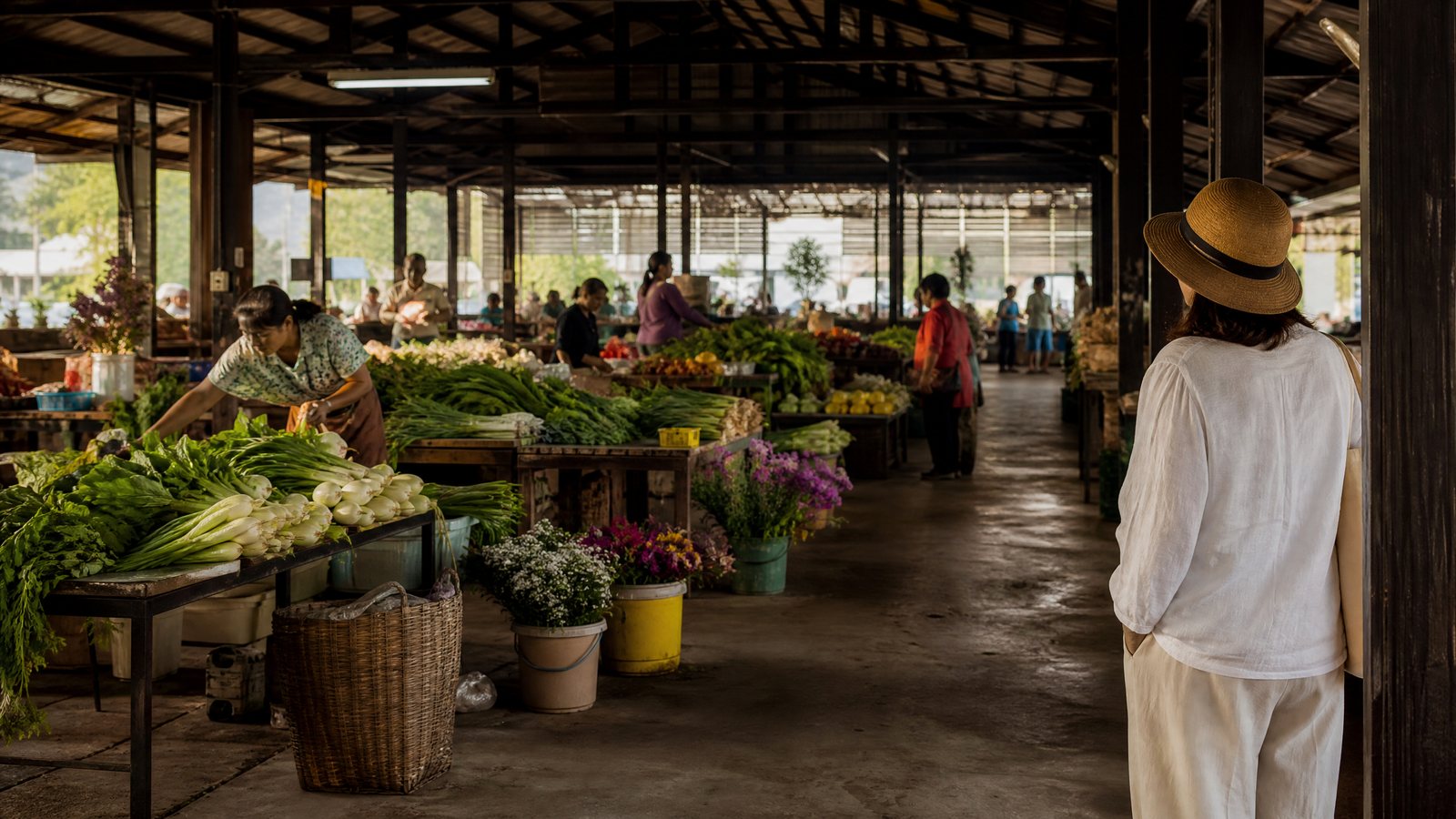
A market morning is often described as a way to “see local life.” That phrase can hide the more important fact: people are there to earn, shop, carry, cook, meet and get on with a day. The useful slow-travel question is therefore not How much can I fit into this visit? It is What kind of presence does this working place make possible today?
The answer may be a quiet walk through, a small purchase, one short exchange, a return visit, or no photograph at all. None is a lesser outcome. A considered visit protects the market’s purpose while giving a traveller better grounds for understanding what they have seen. It also turns the broad principles in our slow-travel collection into decisions that hold up in a crowded aisle.
Treat the market as a working system
A market is a network of deliveries, set-up, buying, cleaning, payment and departure, not a single attraction with one rhythm. A food counter can be calm one minute and under pressure the next; what looks picturesque may be the most time-sensitive part of somebody else’s job.
Notice the infrastructure of work. Is there a handcart route? Do shoppers point, choose with tongs, wait for a number, or hand over a container? A working system is the pattern that lets many people use a limited space without stopping one another. Learning it is more respectful than importing the customs of home or a previous destination.
No confidence with a language is required. Stand out of the passage, watch how regular customers pay and move away, and let staff direct the exchange. Treat a sign, barrier or instruction as practical information, not a boundary to negotiate.
Choose a visit that fits your purpose and capacity
Early is not automatically better. It can mean less crowding but also the busiest unloading period. Later may be easier for conversation, while stock, heat, noise and transport change. Choose a visit whose demands match your purpose, energy and ability to move independently.
Use the PACE framework before leaving: Purpose, Access, Crowd, Exit. It tests whether a market morning suits you and the people using it, rather than asking the market to perform for a visitor. It creates no permission; it helps decide whether to enter, wait, return or choose a different activity.
| PACE question | What to look for | A proportionate decision |
|---|---|---|
| Purpose: Why am I going now? | Need for food, wish to understand ingredients, interest in photography, or simple curiosity | If the purpose is only an image, wait until you know whether photography is welcome and non-disruptive. |
| Access: Can I enter and leave safely? | Surface, steps, width, seating, toilets, shade, noise, communication needs and a companion’s needs | Ask through the relevant local channel about features that matter to you; do not infer access from a promotional image. |
| Crowd: Can I move without becoming an obstacle? | Queues, carts, school groups, weather sheltering, a narrow entrance or visible rush | Keep the visit short, stand aside, or return when circulation is easier. |
| Exit: What is the plan if conditions change? | A known meeting point, payment method, water, medication, weather protection and a route back | Leave early if heat, crowding, fatigue or uncertainty begins to reduce your judgment. |
The framework is especially useful for travellers with reduced mobility, chronic pain, sensory sensitivity, young children, limited time or an unfamiliar transit system. Sensory load is the combined demand of sound, movement, smell, heat, visual clutter and close proximity. A lively market can delight one person and exhaust another. Choosing a smaller market, quieter time, nearby bench or companion may make participation realistic.
For a wider method of building a calm stay around one base, see how to spend seven days in one city. The point is to create enough margin that leaving a crowded market is an available choice.
Observe before you participate
Make the first pass an orientation, not a search for a subject. Keep a camera put away. Follow the outer edge of the circulation path if one exists, and pause only where stopping does not force others to detour. Notice what is sold, how quantities are measured, which stalls are busy, and where people wait.
Queue etiquette is the local pattern for joining, waiting and taking a turn. It may involve a line, ticket, gesture, counter position or informal order. Do not assume a visible cluster is disorder. Watch briefly; if still uncertain, ask the person serving rather than stepping ahead. The aim is to avoid gaining convenience by making someone else’s errand harder.
Do not touch produce, textiles, tools or containers unless invited. Stock may be fragile, priced by weight, freshly arranged or set aside for another customer. A child’s curiosity needs the same guidance: looking is easy; handling waits for a clear invitation. For families, one planned purchase can work better than letting several children drift through a tight aisle.
Observation improves questions. “What is that?” can become “Is this usually cooked or eaten raw?” when the stallholder is unhurried and open to conversation. The narrower question is easier to answer and less likely to turn a person into an unpaid guide. If a queue appears, finish and make room.
Make purchases ordinary, not transactional access
A genuine purchase can be a modest way to participate, especially when it meets a real need: breakfast, fruit for later, an ingredient to cook, or a small household item you will use. But money does not buy an entitlement to a person’s story, workspace, image or time. Treat the transaction as complete unless the seller chooses to extend it.
Prepare so the exchange stays easy: know roughly what you want, keep payment and a reusable bag accessible, and avoid spreading belongings across a counter. If bargaining is visibly customary, keep it good-humoured and brief; if prices are fixed or trade is busy, accept the stated amount. There is no universal rule about bargaining, tipping, sampling or packaging. Local practice should lead.
Avoid “finding the real market” or proving that a place is unchanged. Markets are shaped by harvests, supply chains, migration, household budgets, regulation and labour. Describe what you know—a named ingredient, explained method, queue pattern or time of day—and leave claims about a community’s identity out of one morning’s notes.
This is one reason community respect and visitor etiquette matters beyond formal cultural sites. Ordinary commerce has dignity without needing to be staged as heritage.
Ask for consent before the lens comes up
A photograph changes an encounter. A person taking payment or carrying a crate may feel watched, delayed or reduced to a visual type. Consent is a clear, voluntary and informed agreement. Here it should make clear whether you mean a portrait, hands, stall or wider scene, and leave refusal feeling safe.
A consent sequence that leaves room to refuse
Wait for a lull. Make eye contact, indicate the camera, and ask in a simple prepared phrase if you can. A gesture can assist where language is limited, but it cannot replace a clear answer. A smile, silence, distracted nod or working politeness is not an affirmative response.
If permission is clear, make the image promptly and do not direct a person to repeat an action, rearrange goods or move into better light. Show it only if welcome and feasible. If someone declines, hesitates, signals discomfort or changes their mind, lower the camera without debate and delete the image when asked.
A wider image can reduce intrusion but not remove it. A distinctive face, small business, transaction, religious act, medical condition or identifiable child can make a frame sensitive. Do not photograph children, private arguments, worship or visible distress without unmistakable permission and clear local norms. Local custodians, not visitors, should define a culturally or family-significant practice’s boundary.
When the ethical answer is not to photograph
Not making an image is a positive decision when the market is crowded, when access rules are unclear, when a person is working alone, or when the visit would turn someone’s routine into your content. Keep a written note instead: what you observed, what you were told, what remains uncertain, and why you chose restraint. A note preserves context without claiming a person’s likeness.
This standard is consistent with RAAHCHAL’s editorial policy: accuracy, context and care matter more than a visually easy result. It also avoids treating living practice as a resource to extract. Communities may welcome visitors in one circumstance and limit access in another; both positions deserve respect.
Keep food curiosity proportional to risk
A market can teach how ingredients are selected, stored and cooked, but enthusiasm should not replace food-safety judgment. Foodborne illness is illness caused by harmful organisms or toxins in food or drink. A passer-by cannot fully see water quality, temperature control, handling or storage.
Where sanitation and water safety are unknown, choose risk-reducing signals rather than judging a stallholder or cuisine. Thoroughly cooked food served hot is generally more cautious than raw or undercooked meat, fish, shellfish or eggs. Produce rinsed with known-safe water and peeled by you may carry less risk than pre-cut fruit or raw salad; pasteurised dairy is generally more cautious than unpasteurised dairy. These are risk-reduction measures, not a verdict or promise.
Water, hands and individual health needs
If tap water safety is uncertain, include ice, rinsing water, drinks mixed with water and brushing teeth in the same question. Use a source confirmed as safe through the relevant official or local public-health channel. Wash hands with soap and water before eating when possible. An alcohol-based hand sanitiser containing at least 60% alcohol is a fallback when soap and water are unavailable, but it works less well on visibly dirty or greasy hands and does not replace washing as soon as practical.
People who are pregnant, immunocompromised, very young, older, managing allergies or recovering from illness may need a more cautious plan. So may anyone whose medication, diet or medical advice adds constraints. Ask a qualified clinician before travel when a health condition changes the stakes. Buying sealed food for later, choosing a cooked dish, or simply observing can be appropriate.
Do not confuse “busy” with safe or “quiet” with unsafe. Turnover is only one clue; decline politely rather than making broad judgments about a stall.
Plan for access, crowding and weather without overpromising
Market access is more than an open door. The route may have uneven paving, steps, drains, temporary boxes, heat, a narrow entrance, noise, strong smells, little seating or limited shade. Accessible tourism is an inclusion principle, not evidence that a particular market will meet a particular need. Information must be specific.
Ask specific questions through the right channel
Before the visit, ask the market operator, municipal visitor service, accommodation host or another relevant local channel about the precise feature that affects you: step-free entry, toilet availability, seating, quiet periods, queue assistance, mobility-aid storage or service-animal rules. “Is it accessible?” is broad; “Are there steps between the transit stop and produce hall?” is actionable.
Bring only what you can manage. Keep a compact bag close; if you use a wheelchair, stroller, cane, hearing device, medication, cooling aid or communication support, plan an exit route and margin for delays. With children, one adult can buy while another stays out of the pinch point.
Weather is a separate variable from climate. Weather is the short-term condition of the atmosphere—such as heat, rain, wind and humidity—while climate describes longer patterns. A usual seasonal pattern cannot tell you whether a market day will bring intense sun, a storm, flooded streets or transport disruption. Forecasts and official warnings support better decisions, but their usefulness depends on checking close to departure and responding to the uncertainty they communicate. For a fuller guide to that distinction, read when a weather forecast becomes useful.
Record context without turning people into evidence
A good market note separates observation from interpretation. Record the date, approximate time, weather, what you saw, what someone directly told you, and what you did not understand. “Several customers waited at the left side of the counter” is observation; “This is how the city shops” is too large an interpretation for one morning.
Apply the same discipline to photographs. Keep captions factual and avoid claiming cultural authority from a purchase or one granted image. Consent for a quick personal picture may not cover broad publication, location tagging or an enduring public record. If that distinction is uncertain, do not extend the use.
A market can teach about seasonality, ingredients, prices and logistics, but cannot stand in for an entire place. Build understanding through repeat visits, varied neighbourhoods and conversations people choose to have. Planning a walkable neighbourhood can create this low-pressure pattern.
Return in a way that reduces pressure
A second visit is useful only if it makes you less demanding. Return without a camera, buy something you will use, choose a different edge, or arrive at another time if local guidance indicates that is appropriate. A delivery rush, rain sheltering or seasonal product may correct a first impression.
Familiarity is not access. Knowing a vendor’s face or aisle layout does not remove the need to ask before photographing, make way in a queue or respect a new instruction. Returning slowly should make your footprint lighter, not your expectations larger.
A rest day can also be the right response after a sensory-heavy or physically demanding morning. Slow travel is not a test of endurance. Use the principles in designing meaningful rest days to protect the time and energy that let attention remain generous.
Confirm changing conditions close to the visit
Some guidance in this article is durable: do not obstruct trade, do not assume consent, make purchases ordinary, and use food and water precautions when conditions are uncertain. Other details can change quickly and should never be inferred from a past article, a photograph, or another traveller’s account.
Confirm the following through the relevant local or official channel close to the visit: opening days and hours; temporary closures; public-holiday or observance changes; entry and photography rules; payment arrangements; transport disruption; severe-weather advice; crowd controls; accessibility features; and drinking-water guidance. A market manager can clarify an operating rule, while a public-health or meteorological authority is better placed to clarify a health or weather warning. If reliable confirmation is unavailable, choose the lower-impact plan: carry supplies, shorten the visit, skip eating, leave the camera away, or go elsewhere.
A compact checklist and direct conclusion
Before leaving, use this short check rather than a long itinerary:
- I know my purpose, an exit route and one thing that could make me leave early.
- I have checked the local conditions that can change: operations, weather, transport, access and rules.
- I can carry my bag, payment and equipment without blocking a counter or aisle.
- I will observe first, follow the queue, touch nothing without invitation and keep questions brief during a rush.
- I will ask clear consent before photographing an identifiable person, and accept refusal or uncertainty immediately.
- I have a food and water plan that matches my health needs and the information available today.
The lasting reward of a market morning is not proof that you found something hidden. It is the ability to notice a place on its own terms: work before spectacle, consent before documentation, and practical care before appetite. Enter with a modest purpose, let local routines set the pace, and leave room for the possibility that the most respectful memory is one you did not photograph.