When to Go
Cherry-Blossom Season Without Crowd Chasing
Plan for a changing natural event, not one perfect frame: read bloom stages accurately, spread attention across a wider map and make room for access, weather and shared-space care.
Expanded evergreen planning guide
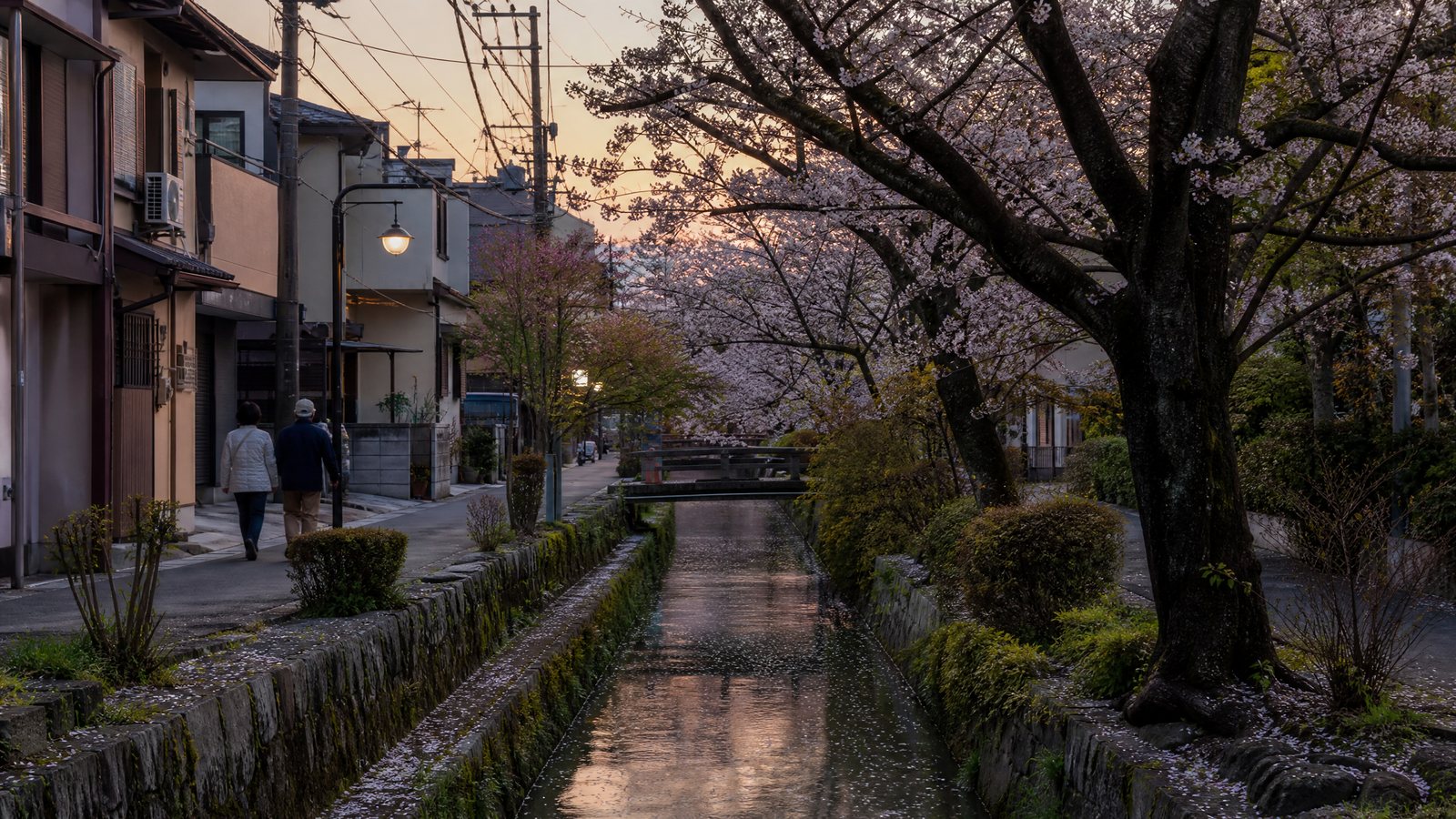
A satisfying cherry-blossom trip does not depend on arriving at a celebrated viewpoint during a narrow, photogenic moment. It depends on designing for a living seasonal event and for the public spaces that hold it. That means distinguishing a forecast from an observation, choosing a base with more than one worthwhile walk, and treating a change of plan as part of the design rather than a failure.
Define success before you follow a bloom forecast
Start by replacing the vague objective of “seeing the blossoms” with a small set of personal conditions. A traveller who wants a quiet sketching walk needs a different setting from a parent managing a pushchair, a visitor with limited standing tolerance, or a photographer seeking soft light and a clear background. The famous location may be appropriate for one objective and a poor fit for another.
Write two or three measures of a good day. Examples include a continuous, level-enough walk with places to pause; a public landscape where children can move without blocking a route; a view with time to return in different light; or a short outing combined with an indoor cultural stop. This makes the plan resilient because it judges the day by experience, not by whether every blossom is open.
This is a slow-travel approach: remain in one area long enough for weather, energy and local conditions to influence the day. It may not suit a tightly fixed overnight stop or a trip centred on a particular tree in a particular stage.
Understand what a blossom report actually measures
Phenology is the study of recurring biological timing, including budding and flowering. It explains why a calendar date is evidence, not an outcome: temperature, rainfall and other cues influence the cycle, but records cannot make a city bloom uniformly.
A forecast uses historical relationships and recent or expected conditions. An observation records what is visible at a named place on a stated date. Give the latter more weight as travel approaches, but an update for one garden, species or observation tree is not a report for every street tree.
Flowering, full bloom and petal fall are different stages
In formal monitoring, flowering can mean that a defined small number of flowers has opened on a designated sample tree. Full bloom is a separate threshold on that tree, not a citywide visual judgment. Read the wording attached to a local report.
Treat stages as choices, not grades. Buds suit close observation; fuller canopy suits a broad view; petal fall can be striking but weather-vulnerable. Emerging leaves change colour and density. A less-publicised stage or a frame using water, sky or trunk can reduce the need to wait for a universally “best” day.
Why one neighbourhood can differ from another
Tree variety, exposure, elevation and built environment can vary within a small area. Official calendars distinguish varieties and acknowledge elevation effects, so use a citywide forecast to choose a broad period, not to command a better district.
Think in layers: the regional season informs the window, a current site report helps choose tomorrow, and the entrance scene decides whether to continue or move on. See our shoulder-season planning guide for a wider method.
Choose a travel window with slack, not a single target date
A window is a period in which several outcomes are acceptable; a target date concentrates the trip on one forecast. A window has slack: uncommitted daylight, a second local area and a worthwhile non-blossom activity.
With several days, put the celebrated view on a movable day. With one day, reduce the radius: choose a compact base with plausible outdoor and indoor alternatives. The aim is choice without turning the day into transport.
| Planning choice | What it protects against | Main trade-off | Often suits | May not suit |
|---|---|---|---|---|
| A multi-day window with two light daytime periods | Early or late flowering; rain; a congested first attempt | More calendar flexibility is needed | Visitors staying in one city or region | A one-night transit stop |
| One base with several walkable blossom settings | A single hotspot becoming uncomfortable | The headline landmark may receive less time | Walkers, families and low-energy travellers | People committed to one specific tree |
| A paired blossom outing and indoor anchor | Wet, windy or cold conditions | Less time devoted solely to flowers | Anyone who values a lower-pressure day | Visitors seeking an all-day outdoor route |
| A nearby elevation or variety contrast | Uneven local progression | Extra travel can consume the day | Visitors with adequate time and mobility | Those with strict access or energy limits |
Choose a second location for a distinct experience: a labelled collection for tree variety, a wide river path for steady walking, or a small park for a short rest-focused outing. It reduces the temptation to force an uncomfortable visit.
Pick a base that supports more than one kind of blossom day
The most useful base is not necessarily closest to the best-known grove. It reaches several public spaces without a complex transfer and has food, toilets, shelter and a non-blossom activity close by.
Map by setting, not fame: a waterside route, local park, labelled collection, public civic street and indoor anchor. Confirm public access; trees visible from a map are not permission to enter private or sensitive space.
Repeat a neighbourhood at different times, as in a one-city rhythm, rather than making every morning a race. Never assume that early means empty or that access is available outside published times.
Use the Blossom Day decision framework
Use this five-part framework after checking the latest responsible local and official channels. It turns a forecast into a proportionate decision rather than a chase.
The BLOOM framework: Bloom, Load, Options, Obstacles, Manners. Assess the observed stage, the pressure on the space, the alternatives within reach, any access or weather obstacles, and the conduct needed to leave the place workable for others.
B — Bloom. What has been observed at the named site, and what stage would still satisfy your aim? An old report is context, not evidence for a whole district.
L — Load. Is the entrance full, the footpath slow-moving, or the route narrowed? Load is people relative to available space; a modest number on a narrow path can be less accessible than a larger number in a broad park.
O — Options. Name a genuinely different alternative before leaving. It needs an arrival route, a reason to go and a clear point at which you will choose it.
O — Obstacles. Check warnings, surfaces, temporary route changes, step-free access, toilets, lighting and group energy. A flowering report answers none of these. Use our walkable-neighbourhood guide to plan around streets rather than landmarks alone.
M — Manners. Keep routes clear, shorten photo stops, use an approved picnic area if one exists and carry waste to an appropriate disposal point. Leaving is valid when a visit is intrusive or inaccessible.
Build a day that can change without becoming chaotic
A flexible day still needs structure. Give it three blocks: an early or late blossom walk, a middle block that works in poor weather, and a short second outdoor option. Do not schedule all three as obligations. They are different shapes the day can take.
For example, a comfortable walker might start waterside, then decide whether a formal garden is worth entering. A family might begin with a short park circuit near toilets and seating, then reset indoors. A visitor using a wheelchair or managing fatigue may prioritise a verified accessible approach and short turnaround over a dramatic route.
Set a turn-around rule before you leave
A turn-around rule is an agreed condition for changing plans: take the alternate street if a queue repeatedly halts the path; move indoors if rain makes surfaces unsafe; shorten the loop if energy falls. It prevents sunk travel time from dictating an unsuitable experience.
Use time as a buffer. Arrive with margin to read signs, locate facilities and decide whether the scene suits you. On a busy route, take one composition and step aside to review it.
Widen the map without exporting pressure elsewhere
A quieter-looking alternative is not automatically an ethical alternative. A small residential street may be someone’s commute route; a local park may have little capacity for large groups; a sacred or memorial landscape can require particular restraint. The aim is not to locate an unprotected place that can absorb more visitors. It is to distribute your own attention while respecting the purpose and capacity of each space.
Choose alternatives by fit. Broad paths and multiple exits can work well for a group that needs room to pause. A labelled garden can help a visitor interested in cultivar differences; a cultivar is a cultivated plant variety selected for particular traits. A modest street route can work for a short, quiet walk if it is public, passable and free of local restrictions. None of these categories makes a place vacant, and none cancels the duty to yield space.
Avoid geotagging a sensitive-looking residential corner in real time, clustering around a private frontage, or treating a scenic lane as a studio. If a place has barriers, a marked route or staff direction, those signals describe its capacity better than a map or a previous traveller’s image. Our visitor-etiquette guide develops the same temporary-neighbour mindset for shared destinations.
Plan access and pace as central decisions, not afterthoughts
Accessibility is not a single yes-or-no label. A route may have a step-free entrance but long distances, uneven paving, steep gradients, limited seating, crowded pinch points or inaccessible toilets. A person’s needs can also change with weather, companions, pain, fatigue, a mobility aid or a child’s nap schedule. Describe the route in functional questions rather than assuming that a cherry-lined walk is gentle.
Before departure, confirm through the responsible local or official channel whether the chosen entrance, surfaced route, accessible facilities, parking or drop-off arrangements, and temporary diversions meet your needs. Do this again near the day because maintenance, events and weather can alter the usable route. If information is incomplete, plan a shorter circuit and an easy exit rather than placing the entire day beyond a difficult approach.
Match the route to the least flexible need in the group
A group should plan from its least flexible need, not from its fastest walker. If one person cannot stand in a dense queue, choose an area with room to leave. If someone needs frequent toilets or a predictable rest point, identify those before committing to the route. If a child becomes overwhelmed by noise, prioritise a short loop with an indoor reset. These choices improve the experience for everyone and prevent the common pattern in which one person has to push past their limit to keep up.
Do not confuse a shorter route with a lesser encounter. A single accessible view, followed by time to sit and look carefully, can be more meaningful than a long circuit undertaken under strain. Designing rest days can help place this principle within a larger itinerary.
Protect trees, paths and the people using them
Cherry trees are not props. Repeated trampling around roots can compact soil, reducing the air and water available to the root zone and harming tree health. Stay on marked paths, lawn areas that are explicitly open for use, and other designated surfaces. Do not climb, shake, pull or pick from trees, and do not cross a barrier for an unobstructed image. A single shortcut can become a worn desire line when copied by others.
Make your presence light on the route. Keep bags and tripods out of narrow passages. Let people using mobility aids, pushing prams, travelling to work or carrying loads pass before setting up a photograph. Keep conversations and sound at a level suited to the place. If food is appropriate there, eat away from the main flow and leave no trace; where bins are scarce, carry waste until an appropriate disposal point is available.
Photograph people as people, not scenery. Ask before making close images of strangers, especially children, families, ceremonial visitors or anyone in distinctive dress. Obey site-specific rules on photography and aerial equipment; permission requirements and restrictions can vary by property and jurisdiction. Do not assume that an open-looking landscape permits aerial use. Staff instructions and posted signs always outrank general travel advice.
Confirm changing conditions at the right moment
Some information is durable: blossom timing varies, public landscapes have limited capacity, and considerate conduct reduces harm. Other information has a short life. Bloom stage, weather warnings, opening arrangements, entry rules, path closures, access features, transport disruption, lighting and temporary crowd controls all require current confirmation.
Use a three-point check. First, shortly before travel, consult the relevant local or official channel for observed bloom reports and operational notices. Second, the evening before an outing, confirm weather, route conditions and any change to entry or access arrangements. Third, on arrival, read the actual scene: signage, barriers, staff direction, surface conditions and the rate at which people are moving. If these disagree with an older plan, the site itself has the final say.
There are limits to this article. It cannot assess the condition of an individual tree, predict a precise stage, establish that a route is accessible for a particular person, or determine whether a temporary restriction is in force. It also does not replace local safety advice or site rules. A forecast is most useful when it helps you prepare several good choices, not when it persuades you that one choice is assured.
Pack and decide with a compact low-pressure checklist
Before leaving your base, use this short check rather than adding more destinations.
- Confirm the latest observed bloom status for the named site and note its update date.
- Check weather, warnings, opening information, route changes and any stated access conditions through the responsible local or official channel.
- Name one alternative outdoor setting and one indoor anchor, with a simple way to reach each.
- Carry water, a weather layer, any personal mobility or sensory support, and a way to take waste with you.
- Agree on a turn-around rule and a place to regroup if the first choice is uncomfortable.
- Read signs on arrival, leave bottlenecks clear and change course early when the space is under pressure.
This checklist is deliberately modest. It is not a method for optimising every minute. It is a way to keep a brief natural event from dictating the quality of the whole trip.
Let a good blossom day be broader than one photograph
The calmer blossom trip allows the season to vary and the public landscape to function. Choose a window rather than a perfect date, a base rather than a single attraction, and a route that respects the group’s least flexible need. When a place is too busy, inaccessible or restricted, another walk is often both the more peaceful and the more responsible outcome.