When to Go
Wildfire and Smoke Season: A Decision Framework for Travellers
A practical framework for putting emergency directions first, interpreting smoke data carefully, and deciding when a trip can still work.
Expanded evergreen planning guide
Put safety authority ahead of the itinerary
Wildfire travel decisions become clearer when they are made in the right order. An evacuation instruction, road closure, land closure, or direction from the responsible emergency authority comes before every travel preference. A clear view from town, an accommodation message, or a navigation app cannot overrule it. Leave when directed, use the stated route, and wait for the relevant authority to say that return or access is permitted. The wording and legal force of notices vary by country, region, and municipality, so travellers should confirm the local meaning rather than assume that a familiar label applies everywhere.
This order recognises that emergency managers must protect residents, visitors, crews, and evacuation corridors while fire behaviour, wind, visibility, and road capacity can change. A place that remains open can still be an impractical base. The traveller’s job is to respond to verified information, not to outguess local responders.
Once emergency direction is clear, assess operational viability: whether the arrival route, onward route, accommodation, essential services, and core activities are functioning. Only then assess personal fit: whether the trip still delivers its purpose at an acceptable level of smoke exposure, uncertainty, and disruption. This prevents treating an open airport or hotel as proof that the whole journey remains suitable.
For a wider approach to trips shaped by changing seasonal conditions, see the seasonal travel collection. Wildfire smoke is distinctive because the hazard, air quality, visibility, and access can diverge: a destination may be safe to occupy but poor for its intended outdoor experience, while smoke may also arrive far from the fire itself.
Understand what smoke information can—and cannot—tell you
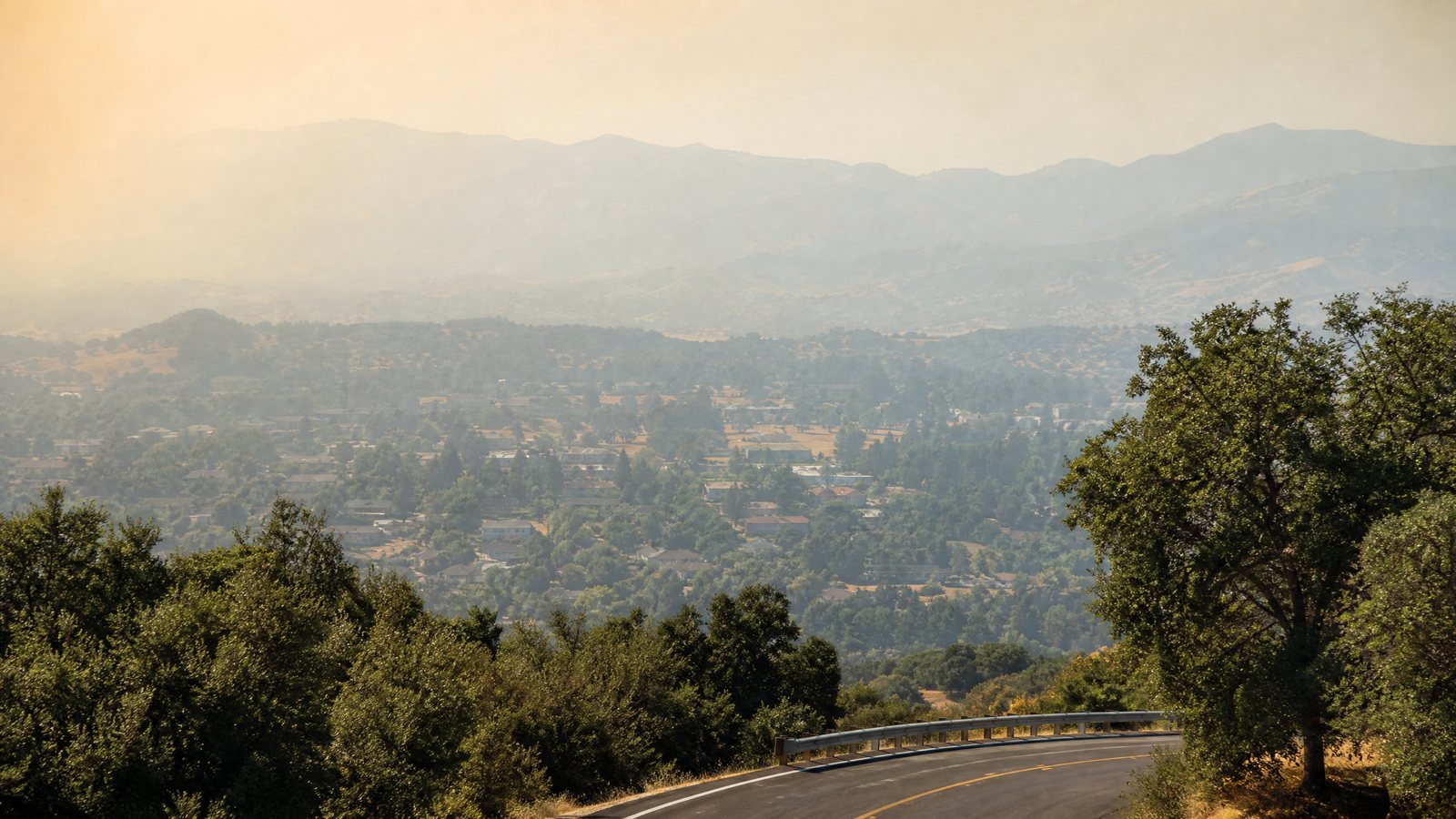
Wildfire smoke is a moving mixture of gases and particles. The pollutant most often used to describe its health relevance is PM2.5: fine particulate matter with a diameter of 2.5 micrometres or less. These particles are small enough to reach deep into the lungs. Smoke can travel far beyond a fire zone, so distance from visible flames is not a reliable measure of exposure or travel suitability.
An air-quality index turns measured pollution into a public number and category. It is not a diagnosis, universal travel rule, or promise about the next hour. Check the pollutant, place, timestamp, and local scale. The United States uses the Air Quality Index; Canada uses the Air Quality Health Index; other places use different scales and action language. Do not convert thresholds from memory across systems.
Current readings, forecasts, and images answer different questions
A current monitor reading describes conditions at a particular place and time. It is strongest when it is recent, official, and close to where you expect to be. It may still miss a valley, waterfront, high-elevation trail, or rural road.
A forecast estimates likely smoke transport and concentration from fire and weather information. It aids timing and direction but is not certainty. Wind shifts, changing fire intensity, cloud, terrain, and atmospheric mixing can alter outcomes. A satellite plume offers broad context, not a ground-level air-quality reading. Treat each tool as a different layer of evidence.
Use the local category and the trend, not a single screenshot
The practical question is what the local service reports where you will sleep, drive, and spend time outdoors, and whether conditions are improving, stable, or worsening. One favourable reading after several poor periods may support a shorter outing and another check, not a remote multi-day plan. A poor reading in a distant city also may not describe a different valley. Read location, timestamp, observation, forecast, and alert language together.
A useful planning habit is to separate exposure from visibility. Haze can spoil a scenic view before someone feels unwell, while conditions that look merely hazy can still carry a meaningful particle burden. A clear photograph, smell, or personal impression should therefore never be the only test. For a discussion of why weather information becomes more useful closer to departure, read how far ahead weather becomes useful.
Decide your personal limits before the pressure rises
There is no smoke threshold at which every traveller should cancel. The response depends on the trip’s purpose, time outdoors, cleaner indoor space, ability to leave, and everyone’s needs. Children, older adults, pregnant people, and people with heart, lung, kidney, or other chronic conditions can be more affected; a traveller with a relevant condition should use advice already agreed with their health professional rather than borrow another person’s threshold.
Write down what the journey needs to be worthwhile. A cabin stay built around long hikes, a scenic road circuit, and tent nights has little redundancy when air quality degrades. A museum-focused city stay with an indoor base may have more room to adapt, though it is not automatically appropriate for a sensitive traveller. A family with a young child may value predictable indoor time and a simple exit route more than a marginal view. Someone using oxygen, mobility equipment, temperature-sensitive medication, or communication technology may need power, accessible transport, and replacement supplies to be trip-critical conditions.
Distinguish a health limit from a holiday limit. A health limit is a reason to reduce exposure, seek appropriate care for concerning symptoms, or leave as advised. A holiday limit means the central experience is no longer intact: perhaps a photography itinerary has no usable visibility, or a walking trip no reasonable outdoor time. Both are valid, but they lead to different decisions.
A pre-agreed limit counters sunk-cost thinking. Ask: If I had not already paid, would the verified conditions make this journey sensible today? If not, decide whether a later check, smaller itinerary, or different destination could change the answer.
Apply the four-gate smoke-season decision framework
Use this article-specific framework whenever smoke affects a journey. Move through the gates in order. A “no” at an earlier gate outweighs a later “yes”; pleasant-looking conditions do not reopen a closed route. It works for day trips, rail journeys, road trips, and longer stays because it asks only what a traveller can verify.
| Gate | Question to answer | Evidence that matters most | Decision if the answer is no |
|---|---|---|---|
| 1. Authority | Is there any evacuation direction, closure, restriction, or instruction affecting the place or route? | Local emergency management, road or land manager, and designated incident notices | Leave, do not enter, or delay. Follow the stated route and instructions. |
| 2. Access | Can the arrival, stay, and exit work without improvising around disrupted roads, services, or power? | Official road and transport notices; direct operational information from the accommodation | Simplify, reroute through officially open access, or choose another base. |
| 3. Exposure | Do the local air-quality category, outlook, duration outdoors, and each traveller’s needs fit the plan? | Responsible air-quality service, local health advice, and an individual care plan where relevant | Reduce outdoor time, use a cleaner indoor base, postpone, or leave. |
| 4. Purpose | Does the remaining trip still meet its essential purpose without burdening a response effort or host community? | Your stated non-negotiables, open facilities, and realistic alternatives | Rebuild the itinerary or defer it rather than forcing the original plan. |
Consider a walker planning two nights in a remote forest area. Gate 1 is clear: no closure affects the trailhead. Gate 2 is uncertain because the only access road could close and there is little fuel or lodging before the main town. Gate 3 shows deteriorating air-quality guidance and no indoor alternative. Replace the remote overnight with a town-based day plan, even without an evacuation order. That is a proportionate response to low resilience, not a prediction of emergency.
By contrast, a visitor in a compact city may pass the first two gates and trade a long park walk for indoor activities, with another check before going out. This may suit a healthy adult whose trip is not defined by outdoor exertion. It may not suit someone whose medical plan calls for lower exposure or a group unable to use the indoor options. The point is to make the trade-off explicit.
Design an itinerary that can shrink without collapsing
The most useful smoke-season flexibility is structural, not last-minute optimism. Choose a base with more than one safe way to spend a day and a smaller version of each important plan. For an outdoor trip, that might mean replacing a remote hike with a short, reversible walk near services, or reserving a day for a local cultural activity. For a driving itinerary, avoid a chain in which one closed pass strands every later stop.
Build decision points into the itinerary: the evening before a long drive, before leaving a signal-rich base, and before sustained outdoor activity. A decision point has three elements: time, the person who checks, and evidence that changes the plan. “We will see how it looks” is not one. “At breakfast, one named traveller checks emergency, road, transport, and air-quality updates for destination and exit route; a closure or worsening category means the city alternative” is.
Plan rest and indoor recovery time even when the forecast appears favourable. It reduces the temptation to press through unsuitable periods just because an activity has been scheduled. The principles behind this kind of pacing are developed in designing rest days. They are particularly useful when travellers need to protect energy, manage children’s routines, or remain close to services while conditions are uncertain.
Do not confuse flexibility with overloading the car or room with supplies. A modest reserve of water, food, necessary medication, chargers, and warm layers can support an orderly change. Stockpiling from a small community, however, can reduce availability for residents and crews. Plan enough to move safely, not enough to treat a destination as a private emergency warehouse.
Make an evacuation-ready stay without staging an expedition
Preparing to leave quickly is compatible with calm, ordinary travel. Know the accommodation address, retain essential documents and reservation details offline, keep devices charged, and agree how companions will reconnect if separated. If a fire or smoke event develops, this preparation saves time without implying that evacuation is expected.
Keep your exit plan accessible to every traveller
An exit plan needs to work for the slowest or most support-dependent member of the group. Before arrival, consider whether everyone can use the likely vehicle or transport alternative; whether mobility aids, spare batteries, refrigerable medication, hearing devices, communication cards, or a service animal can travel with them; and whether a power interruption changes the plan. Travellers with access needs should identify accessible evacuation transport and essential support options through the relevant local authority before relying on a remote location.
This planning does not make a person with a disability responsible for solving a jurisdiction’s emergency arrangements. It simply recognises that a generic “leave quickly” instruction may require practical translation. A companion who knows where medication, equipment instructions, and contact information are kept can reduce stress. Groups should also name a backup decision-maker in case the person holding the phone, keys, or documents is unavailable.
Keep information usable when connection is weak
Save maps, addresses, confirmation numbers, and key contact details for offline access. Carry a paper note with the accommodation address and essential medical or accessibility information if digital access would be difficult. Tell one person outside the immediate group the broad plan and update them if it changes. These are low-tech safeguards, not an invitation to rely on unofficial messages over local instructions.
If an evacuation is ordered, take essential medication, identification, and necessary assistive items, then leave by the specified route. Do not wait to contact every host, carrier, or companion before acting. Do not take informal shortcuts: they may be closed, unsafe, needed for response, or simply create congestion. Return only when the authority responsible for the affected area says it is safe to do so.
Separate transport, accommodation, and money questions from safety
A wildfire can disrupt three different systems at once: access to a destination, the functioning of travel services, and the value of a personal itinerary. Each has its own evidence and its own terms. An accommodation may be operating while the surrounding park is closed. A transport service may be running while smoke makes the visit unsuitable for one traveller. A carrier-initiated cancellation is different from a voluntary decision not to travel. Combining these into one argument makes it harder to act quickly.
Before departure, read the actual terms that apply to transport, accommodation, tickets, and any protection product. Note deadlines, what counts as a supplier change, and what documentation is needed. Keep dated screenshots or downloaded notices, but do not assume that smoke concern automatically creates the same rights as a cancelled service. Consumer rules differ by jurisdiction and product. If a service changes, confirm the current options and relevant consumer protections through the responsible provider or public authority; if an evacuation is active, safety and departure come first.
When deciding whether to alter plans, record the fact rather than an interpretation: “road officially closed at 08:20,” “air-quality notice covers the destination today,” or “the venue suspended entry.” A short record helps later and avoids relying on memory. It also distinguishes legitimate uncertainty from rumour. Do not demand a local worker resolve a reimbursement dispute while they are managing an incident. A respectful pause is often the appropriate first response.
For lower-pressure choices before an incident begins, a slower route and fewer fixed stops can offer useful resilience. The slow travel for beginners guide explains why leaving margin in a journey can make a change less disruptive. Margin is not a substitute for insurance or official information; it is simply time and route capacity that allow a traveller to choose responsibly.
Travel without adding pressure to a strained community
Wildfire conditions change what considerate travel looks like. Follow fire restrictions and closures exactly, including those that seem inconvenient or temporary. Do not enter a closed viewpoint, trail, road, or neighbourhood for a clearer photograph. Do not fly a drone near an incident, stop where it impedes traffic, or approach crews for an update. Emergency personnel and residents need road space, quiet, and attention more than visitors need a dramatic sight.
If the trip continues, use officially open routes and leave generous time for detours. Keep vehicles out of dry vegetation, obey fire bans, and avoid activities that could create sparks or flames where restrictions apply. Ask an accommodation or local business only for the operational information it can reasonably provide, such as whether it is open or whether a service has changed. Hazard instructions should still come from the authority assigned to issue them.
There is a difference between supporting an open community and insisting that a community perform normal hospitality during disruption. Spend within the limits of what is operating, accept reduced services without argument, and be ready to leave if circumstances shift. The broader principles in community respect and visitor etiquette apply with unusual force during an active fire. A traveller’s best contribution may be an uncomplicated, flexible presence—or a timely decision not to arrive.
Confirm live conditions at the moments that matter
Some facts in this article are durable: smoke can move long distances; PM2.5 is a key pollutant in wildfire smoke; emergency instructions outrank an itinerary; and a monitor, forecast, and satellite image provide different types of information. The following facts are not durable and must be confirmed through the relevant official or local channel: the location and behaviour of a fire, evacuation areas and wording, road and trail status, transport operation, power and communication disruption, air-quality observations, forecasts, restrictions, and facility access.
Use a layered check. First, look for emergency direction and closures affecting the destination, approach, and exit route. Second, check the responsible road, land, and transport notices. Third, check the local air-quality observation, forecast, and health advice. Finally, ask whether the resulting conditions still fit the group’s agreed limits and the trip’s central purpose. Repeat the check before a long drive, a remote overnight, or sustained outdoor exertion, not only once at the start of the day.
A calm decision is not the same as a passive one. It is a decision made early enough to follow instructions, preserve options, and avoid transferring uncertainty to residents or responders.
Compact smoke-season checklist
- Confirm emergency notices, closures, and the route the authorities want people to use.
- Check local air-quality information for where you will be, not only the nearest large town.
- Compare the current reading with the outlook and the group’s pre-agreed exposure and holiday limits.
- Verify arrival, overnight, and exit arrangements, including accessible transport or power-dependent needs.
- Save essential addresses, documents, medication details, and contact information for offline use.
- Name the next decision point and the person responsible for checking it.
- Simplify or leave when the earlier gates no longer hold; do not improvise around restrictions.
Conclusion: choose responsiveness over certainty
Wildfire smoke travel requires neither bravado nor automatic cancellation. It requires an order of judgment: follow official direction, test whether access works, consider smoke exposure in relation to the people travelling, and decide whether the remaining journey still has a responsible purpose. A traveller who sets limits before departure, checks local conditions at deliberate moments, and protects an easy exit can change course without panic.
The best outcome is not always completing the original itinerary. Sometimes it is a smaller, indoor-focused stay; sometimes it is a different base; sometimes it is leaving early or not arriving. Those choices respect both the traveller’s needs and the community managing the incident. For the distinction between durable planning guidance and fast-changing local facts, see the RAAHCHAL editorial policy.