When to Go
Mediterranean Summer Heat: Designing Days Around the Middle Hours
Design Mediterranean summer days around exposure: protect the hottest hours, assess shade and exits before each outing, and let official conditions reshape the route.
Expanded evergreen planning guide
Start with thermal exposure, not the list of sights
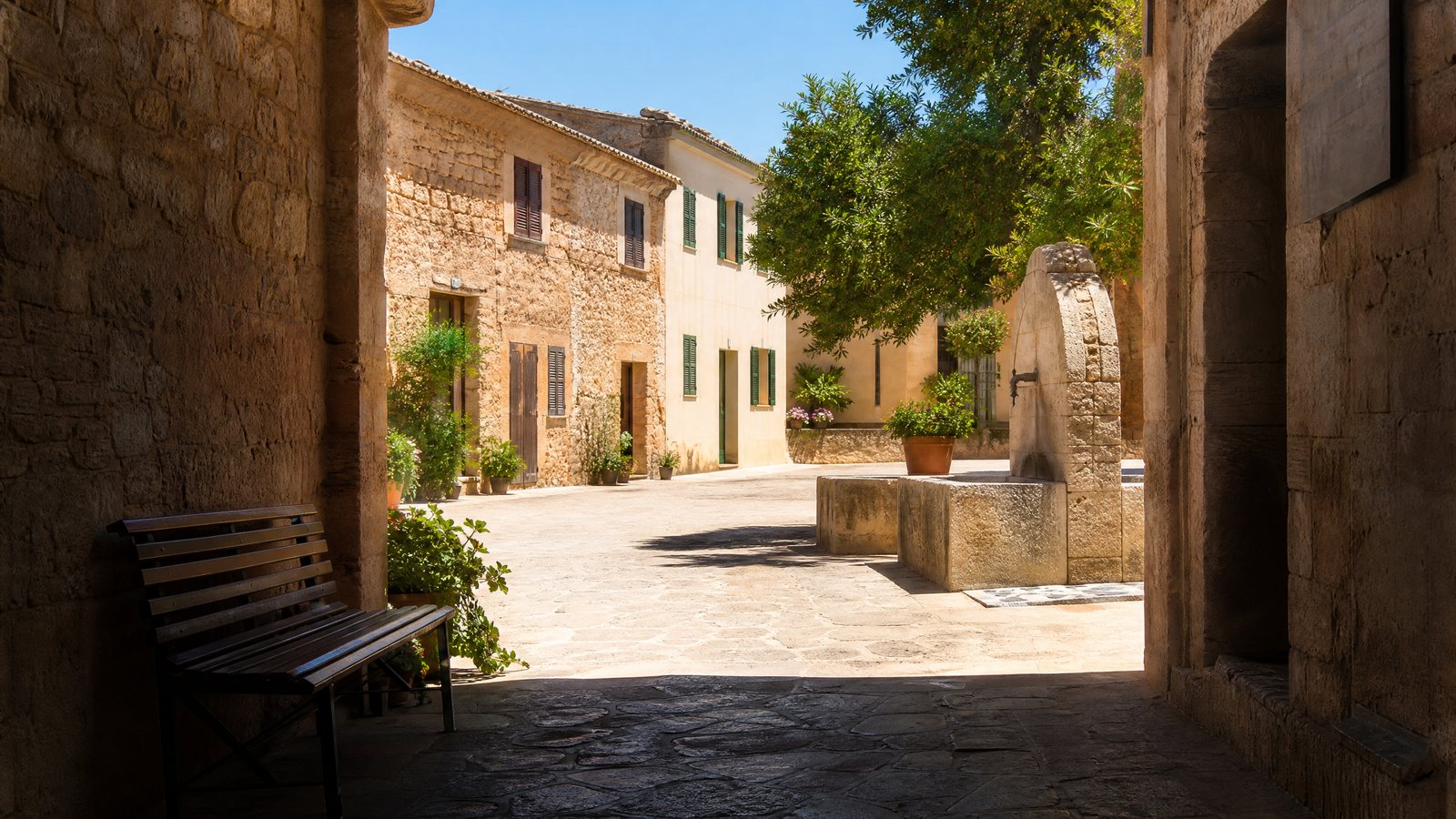
Mediterranean summer planning works best when the day is designed around exposure, not around the number of places reached. Exposure is the combined demand made by sun, hot surfaces, humidity, wind, exertion, time spent waiting, and the difficulty of getting out of the heat. A short uphill approach across pale stone with no shade can be more demanding than a much longer level walk through shaded streets. The name or prestige of the destination tells you very little about that difference.
This matters because the phrase hot day is too blunt for route planning. The World Meteorological Organization uses thermal heat stress for the strain that occurs when environmental conditions overwhelm the body’s ability to cool itself. Temperature is only one part of the picture; humidity, solar radiation and wind also matter. In built-up areas, stone, roads and buildings can store heat and reduce airflow. This urban heat-island effect helps explain why an evening lane or an inland square may remain uncomfortable even after the sun has moved.
The practical response is neither to stay indoors for an entire trip nor to prove that a full itinerary can be endured. It is to assign each part of the day a role: one meaningful outdoor priority in a cooler window, a protected middle, and a later low-pressure outing if conditions allow. That rhythm preserves the slow centre of travel: time to notice a neighbourhood, eat without rushing, or change direction without losing the day. For a broader approach to leaving room in an itinerary, see slow travel.
Read daily conditions rather than seasonal averages
Climate averages can help choose a season, but they cannot describe a particular afternoon. Treat them as background, then base the day on current information from the relevant national or local meteorological and civil-protection channels.
Look beyond the headline maximum
Read the forecast as a pattern. Note the expected hottest period, overnight temperatures, cloud, wind, humidity or a heat-stress measure where provided. A usable early morning may support a short dawn walk and earlier return. No single temperature creates the same risk everywhere, because local thresholds, acclimatisation, terrain and people exposed differ.
Check air quality when information is issued locally. Heat and smoke can compound outdoor activity, especially for people with respiratory or cardiovascular conditions. Do not infer smoke conditions from a distant skyline or old map. Simplify around local air-quality, fire or heat instructions.
Treat warnings as instructions, not colour coding
A warning is an operational signal for a particular place and time, not a travel challenge to interpret from memory. Read the accompanying local advice and any geographic details, then decide whether to move an exposed activity, replace it, or remain in a cooler setting. An alert may be for a district rather than an entire region; the relevant question is the place where you will actually be walking, driving, waiting or travelling.
Warnings also explain why fixed plans need slack. Heat can affect transport, water and health services, while fire conditions can affect roads, paths or coastal access. The day before and again before leaving, check the official forecast, warnings, access notices and the status of any essential transfer. Weather planning lead times can help distinguish a useful planning outlook from information that is too far away to guide a specific day.
Build a three-window Mediterranean day
The most adaptable summer pattern has three windows rather than one continuous outing. The first outdoor window is for the route that is most exposed or important: a viewpoint, archaeological area, market circuit or neighbourhood walk. The middle window is deliberately protected. The later window is for a nearby, lower-commitment outing, not a second attempt to compress everything missed earlier.
The clock times are not fixed. They shift with latitude, date, elevation, cloud, wind, opening rules and the heat accumulated in the city. A three-window plan therefore describes a sequence, not a timetable. Start early enough to finish the exposed element before conditions become demanding, rather than setting an arbitrary departure time that ignores the day’s forecast.
The protected middle can hold a meal in reliable shade, a cultural space that is open and reachable, a return to accommodation, or unplanned rest. It should not be a disguised outdoor queue, uphill detour or long transfer with no refuge. You may see fewer headline stops, but the morning and evening become more attentive and adaptable.
This pattern suits travellers who want a calm pace, people travelling with children, anyone managing energy or mobility, and visitors on foot. It may feel restrictive to people focused on a rapid multi-stop route, but a dense itinerary is fragile when every stop assumes a comfortable noon walk. A one-city stay gives the rhythm more room; seven days in one city shows how depth can substitute for constant movement.
Use the SHADE test before committing to an outing
Use this article-specific SHADE test for any outdoor priority. It is a route-design tool, not a medical score. Answer each letter before leaving. If several answers are vague, shift the plan or choose another activity.
| SHADE question | What to establish | Why it changes the decision |
|---|---|---|
| S — Sun and surface | Is the approach exposed, uphill, reflective, or on heat-holding paving? | Direct radiation and effort can make a short route disproportionately hard. |
| H — Hours outside | How long includes walking, orientation, queues and the return? | The visit is longer than its advertised or imagined core. |
| A — Access to shade | Is there dependable shade or a cool indoor refuge before and after the priority? | A thin awning or a private doorway is not a workable reset point. |
| D — Departure route | Can you leave simply if conditions deteriorate or someone needs a break? | A route without a bailout turns discomfort into a commitment. |
| E — Essentiality | Is this today’s one priority, or could a similar experience happen nearby later? | Scarce energy should go to what genuinely matters to the group. |
For example, an open hilltop ruin may score poorly on sun, hours and departure even when the visit is brief. It belongs in the first window only if approach, shade and return are clear. A dense old-town lane may fail if the plan relies on an unshaded queue or lengthy walk from transport. The framework stops an attractive map pin hiding its physical cost.
Keep one low-exposure substitute close by
For each day, identify a substitute in the same area: a compact shaded neighbourhood loop, a quiet indoor collection, or time to rest and eat nearby. It makes the main plan reversible. Avoid assumptions about cooling, toilets, water points or seating; confirm only what the venue or authority currently states.
Make the middle hours restorative, not merely empty
A protected middle reduces both physical exposure and decision fatigue. Choose a place where the group can sit, drink water, use the toilet if needed, and reassess the later window without rushing. Deep shade, ventilation and an indoor setting are different forms of relief; do not assume any from a photograph or vague description. Historic buildings may have restricted access, uneven surfaces or limited capacity.
Use this time to recalibrate. Ask whether everyone has eaten and drunk enough, whether the forecast or alert has changed, and whether the evening outing is still desirable. A person who is dizzy, unusually weak, nauseated, confused, short of breath, or showing other signs of overheating should not push through a final attraction. Move to a cool setting, seek urgent local medical assistance for severe or worsening symptoms, and follow local emergency guidance. This is general safety information, not a diagnosis or individual clinical advice.
Rest also has cultural value. In communities where the day slows in the hottest period, an unhurried midday is a way to use shared space more lightly. The goal is not to imitate a local routine or assume every business follows one; it is to stop making the hottest pavement your default waiting room. Designing rest days offers a useful companion for making recovery time a planned part of a trip.
Put water, clothing and sun protection into the route plan
Hydration is logistics, not an afterthought. Carry a refillable bottle from the start of an outward journey, particularly before queues, coastal paths, exposed sites or transfers. Identify a legitimate opportunity to refill or obtain water before setting out, but do not assume that a beach, trailhead, small site or transport stop will provide it. Local potable-water guidance can vary, so use current local information if you are unsure.
Drink regularly rather than waiting until a long walk is finished. Needs vary with the person, activity, heat, diet, health conditions and medicines, so build regular access into the day. Follow individual clinician guidance on fluids or salt. Alcohol, prolonged sun and strenuous activity are a poor combination when the day already has a narrow margin.
Loose, light clothing, a brimmed hat, sunglasses and sun protection can reduce direct solar burden and protect skin and eyes. They support a good route; they do not convert a shade-free outing into a low-exposure one. Reapply protection and carry a light covering as appropriate to the activity and local expectations. At a sacred site, clothing rules may be part of respectful access, so plan for them before arriving rather than improvising at the entrance.
A small reset kit earns its space: water, sun protection, a charged phone, identification, an offline map, necessary medication kept as advised, and a lightweight layer. The point is not to pack for every hypothetical problem. It is to avoid turning a missed turn, a delayed vehicle or a changed entrance into a long exposed wait.
Match routes and transport to the heat margin
A heat-aware route is measured from door to door. Include the walk to transport, the platform or stop, transfers, the walk from arrival, the entrance process, the site itself and the return. A museum beside a shaded square can still be a poor middle-hour choice if reaching it requires a long unshaded climb. Conversely, a modest local stop can be the better day if it is close, has a clear exit and leaves enough energy for the evening.
Give every transfer a bailout
A bailout is a simple way to stop, shorten or return without being stranded in sun or far from help. Before a coastal walk, boat outing or outlying archaeological visit, know the earliest sensible point to turn back and the simplest return option. Keep essential tickets or documents accessible, but never presume that an operator will add capacity, run a particular service, or accept a change because conditions are difficult. Confirm live transport information through the relevant operator or public authority before departure.
On a travel day, avoid a plan where a single delay removes the only protected part of the afternoon. Put the heaviest walking before or after the main transfer where possible, and keep arrival ambitions modest. This approach suits people carrying luggage, families, older travellers and anyone with limited heat tolerance. It may be less necessary for a short, familiar urban route with frequent shelter, but it remains a useful check when the forecast is severe.
Adapt the plan to the people travelling
Heat planning is not one-size-fits-all. Public-health guidance identifies increased vulnerability among older adults, infants and children, pregnant people, people with disabilities, outdoor workers, and people with certain heart, lung, kidney, mental-health or other long-term conditions. Some medicines can affect hydration, temperature regulation or sun sensitivity. That does not mean such travellers should avoid Mediterranean summer travel by default; it means the day needs more margin and personalised preparation.
For someone with a condition, medication or past heat illness that could change their risk, seek advice from their usual qualified clinician before travel and take enough time to understand medication storage or fluid guidance. Do not alter prescribed medicine in response to a forecast without professional advice. During the trip, assign a clear decision-maker for stopping, especially when one person may hesitate to slow a group down.
Children need a rhythm designed for them rather than an adult route with smaller breaks. Keep outings short, make shade and drinking opportunities frequent, and do not leave a child or an animal in a parked vehicle for any length of time. Travellers with mobility, sensory or energy-limiting access needs should assess surfaces, gradients, seating, toilet access, entrance arrangements and a shaded waiting alternative in addition to step-free claims. Confirm accessibility details directly with the responsible venue or authority; descriptions can be incomplete and conditions can change.
The principle is dignity, not surveillance. Agree beforehand that anyone can call a reset without having to justify it. This is especially helpful in a mixed group, where the fittest person can accidentally set the pace. For more on moving through communities with consideration, read community-respect visitor etiquette.
Let closures, smoke and fire controls change the day
Cultural sites use opening schedules and access restrictions as management tools, including to protect staff, visitors and the place itself. A closure, reduced route, changed entrance or early last admission is not a puzzle to work around. Do not cross barriers, use closed paths, enter fenced areas, wait in private doorways, or pressure staff for an exception. Replace the activity with the prepared low-exposure option.
Wildfire risk is shaped by dry conditions but also by wind, vegetation and terrain. Smoke, road controls and emergency operations can change faster than a regional map or a previous day’s report. Follow directions from local civil-protection authorities, land managers and transport operators. Do not use a closed forest road, trail or beach access to preserve a plan, and do not drive toward an active incident to assess it. Wildfire and smoke travel decisions provides a separate framework for the moments when conditions are changing quickly.
This is also where a single-base itinerary shows its value. A return to a familiar, reachable area may be more sensible than trying to recreate a missed excursion somewhere else. Flexibility is not an empty promise; it is the practical ability to eat, rest, relocate or remain indoors without needing to rescue a chain of fixed activities.
Limitations and details to confirm locally
This guidance offers durable planning principles, not live conditions or medical clearance. It cannot tell you the temperature felt on a particular street, the condition of a path, the shade available in a queue, or whether a specific interior is open, accessible or suitable for a reset. Nor can it interpret an official warning on behalf of a local authority.
Confirm these changeable details through the relevant official local channel on the day before and the morning of an outing:
- the location-specific forecast, heat warning and any associated public-health instructions;
- air-quality, smoke, fire, road, trail or marine notices where they affect the route;
- opening status, entrance arrangements, capacity rules and last admission for fixed-time priorities;
- transport status and the simplest return option; and
- water, accessibility and family facilities only where the responsible authority or venue currently confirms them.
If official information is unavailable, contradictory or hard to understand, choose the lower-exposure alternative. A plan with uncertainty at every critical point is not flexible; it is simply under-specified.
Use this compact next-day checklist
Run this checklist in the evening, then repeat the live-condition checks before leaving. It turns a general intention to be careful into an itinerary that can actually change.
- Name one outdoor priority and place it in the first suitable cooler window.
- Run the SHADE test on its approach, wait, visit and return.
- Identify a genuine protected middle and one nearby low-exposure substitute.
- Carry water from the start; set a legitimate refill or water stop before the outward route.
- Check the relevant official weather, alert, smoke/fire, access and transport information.
- Share the bailout point and return plan with everyone travelling.
- Reduce the route immediately if heat, smoke, a closure, a delay or anyone’s condition removes the margin.
Conclusion: protect the day’s middle to protect the trip
The most useful Mediterranean summer itinerary is not the one that keeps moving at noon. It is the one that gives exposed places their best available window, treats shade and water as route infrastructure, and allows official conditions to overrule an appealing plan. Choose a single meaningful outdoor priority, make the middle genuinely restorative, and keep a nearby alternative ready. That approach may produce fewer pins on a map, but it creates more room for attention, comfort and responsible use of shared places.