Field Notes
Nepal’s Krishnabhir road remains closed while a temporary track is built
A closed Prithvi Highway section at Krishnabhir is being rebuilt with a temporary hillside track; no confirmed reopening notice has been reported.
Closed — reopening target not confirmed
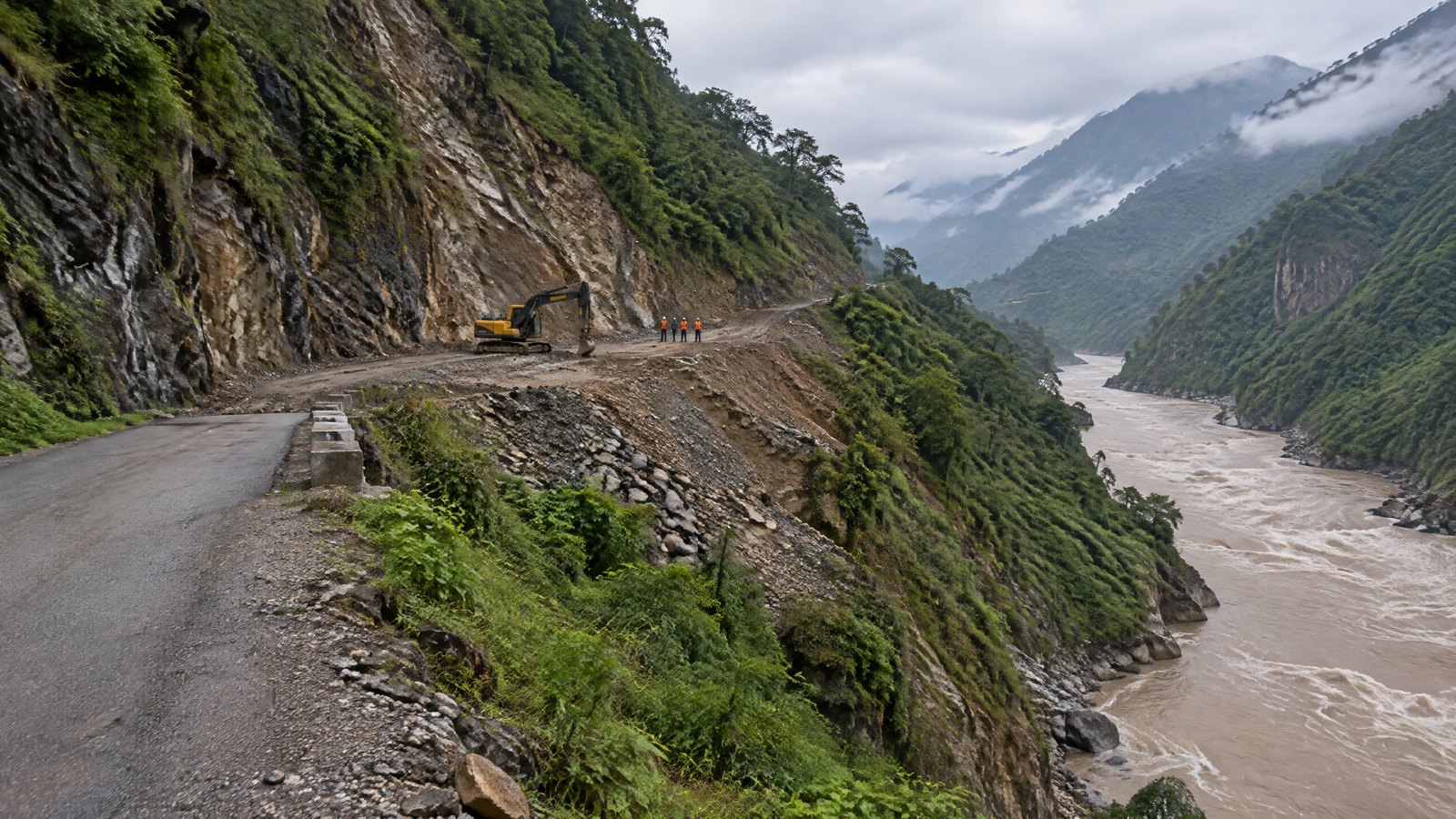
Status at a glance: The Krishnabhir section of Nepal’s Prithvi Highway remains closed. A 12 September works report describes crews constructing a temporary hillside track at the failed section, rather than restoring normal through-road conditions. The report says the track is roughly 250 metres long, with ten machines and 30 personnel assigned to the work, and records an aim of completing it by the end of September. That aim is not a confirmed reopening date.
For travellers, the key point is simple: do not treat the Kathmandu–Pokhara road corridor as operating normally through Krishnabhir on the strength of construction activity. The information available at the reference time establishes a closed road section and active recovery work. It does not establish that vehicles are moving through the site, that a substitute route is available to all traffic, or that a particular journey will resume on a fixed day.
What is closed, and why it matters
Krishnabhir lies on the Prithvi Highway, a principal overland connection used by journeys between Kathmandu, Pokhara and destinations farther west. Its importance does not turn this incident into an all-Nepal transport shutdown. Kathmandu and Pokhara are not thereby inaccessible by every mode, and the evidence does not describe a closure at the India–Nepal border. It does mean, however, that an itinerary relying on uninterrupted road passage through this part of the highway needs to be reconsidered until an operational authority confirms that traffic has resumed.
The reported failure followed late-August flood conditions, when Trishuli River erosion undermined the road corridor and collapse or subsidence blocked the section by 30 August. A road that appears nearly complete can still need stable support, drainage and safe width. The 12 September report is a recovery snapshot, not a road-authority or traffic-police notice confirming a reopened lane.
A route-specific disruption, not a national closure
The closure matters to road-based Kathmandu–Pokhara trips, onward movement toward western Nepal, and journeys by coach, private vehicle, shared jeep or freight-linked service. A blocked section can delay or reshape plans well beyond the work site.
This report does not verify every road in Nepal, establish that all departures to Pokhara have stopped, or verify a detour. Conditions, vehicle class, weather and local traffic management can make an alternative usable for one purpose but unsuitable for another. Until a first-party notice identifies an alternative, ask operators what they are actually using rather than assume a mapped route is viable.
For an example of how RAAHCHAL separates a narrow route status from wider regional assumptions, see the Gyirong Port and Kailash route status report. The incidents are not geographically connected; use equally precise status language here.
The temporary track now under construction
The qualifying 12 September report says the recovery effort centres on a roughly 250-metre temporary track cut along the hillside. Ten machines and 30 personnel are reported to be working on that task. The scale and composition of the work explain why a simple statement that the road is “being repaired” would be incomplete. A temporary track is an interim access measure built into difficult terrain, not necessarily a replacement for the original road’s capacity, surface, resilience or safety margin.
The account also records an end-of-September aim. This should be understood as a project target described in a report about ongoing works. A target can be affected by rainfall, slope conditions, river behaviour, material supply, machine availability, inspections and the need for finishing work. It is not the same thing as a published notice that traffic has opened.
What the work description tells travellers
A construction update usefully shows that recovery is active and focused on making a hillside passage where the original road was lost or compromised. It signals more than clearing debris from an intact carriageway.
Do not translate the presence of excavators into a service prediction. Crews may still need to stabilise the slope, manage water, grade the formation, add gravel and determine what traffic, if any, can use the track. A temporary surface can be sensitive to rain and repeated heavy vehicles.
The practical implication is to plan on the basis of closed until confirmed open, not “probably passable because work is visible.” That conservative reading protects travellers from turning an uncertain road day into an unplanned overnight delay.
Why the reopening estimates do not match
A separate English-language Ratopati report dated 12 September contains a shorter estimate suggesting that traffic could resume after grading and gravelling within two or three days. That report is machine-translated, carries no clock time, and is useful only as conflicting corroboration. It must not control the page’s headline, publication timing or current-status wording.
Its estimate also does not convert the road’s status into “open soon.” A statement about the time required for grading and gravel may describe an expected work sequence, not a formal authorisation for traffic. It does not answer whether rain will interrupt the sequence, whether the completed formation will pass inspection, whether traffic will be restricted by vehicle type, or whether an authority will issue an operational notice.
| Reported point | What it supports | What it does not support |
|---|---|---|
| Krishnabhir remains closed in the 12 September qualifying report | The current status used on this page | A confirmed reopening day |
| Roughly 250-metre temporary hillside track | The nature and scale of the active work | A claim that normal highway capacity will return |
| Ten machines and 30 personnel | Active construction deployment | A guarantee that weather or ground conditions will not delay work |
| End-of-September aim | A reported project target | An assurance that traffic will reopen by that date |
| Two-to-three-day estimate in the machine-translated Ratopati report | A conflicting, untime-stamped work estimate | A confirmed reopening or a timetable for travellers |
Both descriptions can exist at different moments of the same civil-work process. One may reflect the broader target for constructing the temporary track; the other may describe a near-term expectation for remaining surface work. Neither replaces a road-authority or police confirmation that vehicles are being permitted through the site. The responsible conclusion is not to choose the faster estimate. It is to recognise that the evidence is incomplete and wait for an explicit traffic-status update.
Journeys most exposed to the closure
The clearest exposure is for through-road Kathmandu–Pokhara trips, including plans with accommodation bookings, domestic connections, guided departures, family visits, time-sensitive permits or onward western-Nepal road travel. Freight and service-vehicle delays may also alter passenger departures.
Risk rises where an itinerary has a hard arrival deadline, limited daylight, an inflexible transfer or no overnight contingency. Wet conditions can rapidly change the safety picture at a constrained riverside work site. A generous buffer is more resilient than assuming a normal drive time and a single connection.
For travellers deciding whether a longer surface journey remains the right mode for a fixed-date plan, RAAHCHAL’s guide to train journeys versus short flights offers a useful framework for comparing reliability, transfer risk and the value of flexibility. It is not a substitute-route recommendation for this closure; it is a way to weigh mode choices when a road segment becomes uncertain.
Build time buffers before committing
Do not make a same-day chain of tickets, hotel check-in, tour departure and essential commitments depend on an unverified passage. If road travel remains necessary, treat timing as unknown until the departing operator supplies a current plan, including what happens if movement stops after departure.
A rest-day buffer can be an operational safeguard rather than a luxury. The guide to designing rest days explains how to make an itinerary absorb weather, transport and energy changes without forcing a risky choice. In this case, a buffer day gives you room to postpone, change modes where possible, or remain in a safe place rather than pressing toward a work site at the end of the day.
Before committing to the road
Start with the carrier, coach operator, driver or tour organiser responsible for your departure; ask for a specific current answer about Krishnabhir, not a general assurance that “the highway is fine.” Then check for a current notice from the relevant road authority, local administration or traffic police. A status from before rain or a work shift may no longer describe departure conditions.
Test the itinerary’s failure points: where can you stay if the vehicle cannot continue, are medication and water accessible, and is there a safe halt before dark? Travellers with limited mobility, young children, older companions or scheduled-medication needs should be especially cautious about uncertain roadside waits. Food, water, warmth, charging capacity and prescribed medicines can be more valuable than an optimistic arrival estimate.
Keep questions compact:
- Is the Krishnabhir section currently open to the vehicle class in question, and who issued that confirmation?
- Does the service have a verified route plan, or is it waiting for conditions at the work site?
- Where will passengers be taken if onward movement is paused or turned back?
- Can the booking be moved if an official status update prevents travel?
- Does the onward itinerary have enough time to absorb a full-day delay?
Do not rely on social posts, old journey reports or navigation as proof that the road is passable. They can lag a closure, omit vehicle restrictions or suggest unsuitable roads.
Rain, terrain and night movement
Rain, river erosion and steep ground interact at the temporary-track site. Water management and surface stability remain central after cutting work, and a new gravel formation may change quickly in heavy rain.
Do not use nightfall as a reason to press on. Limited visibility makes road edges, active plant, loose material and traffic control harder to assess. Near the work zone, follow on-site instructions and accept that waiting may be the safe decision.
The broader seasonal context is also worth reviewing through RAAHCHAL’s autumn mountain weather guide. That guide cannot predict conditions at Krishnabhir, but it explains why local precipitation, temperature and terrain can matter more than a broad regional forecast when a mountain road is under repair.
What this report does not establish
This report records a closed Prithvi Highway section at Krishnabhir and a documented temporary-track project. It does not establish an India–Nepal border closure. It does not establish an all-Nepal transport shutdown. It does not verify a detour, an alternative road suitable for visitor traffic, normal access to every destination, or a fixed reopening date.
It also does not treat the machine-translated two-to-three-day estimate as a confirmed reopening. Until a current authority or traffic-management notice says that traffic has resumed, travellers should continue to regard the section as closed. A later confirmation should update this permanent report rather than be inferred from a construction forecast.
Dated verification note
Last editorial verification: 12 September 2026, based on a qualifying report published at 12:05 Nepal time. At that reference point, Krishnabhir remained closed and work on the approximately 250-metre temporary hillside track was under way with ten machines and 30 personnel. The reported end-of-September aim remains an aim, not a reopening notice. RAAHCHAL will revise this page when a material, attributable road-status update is available; readers can monitor the wider archive at RAAHCHAL articles for subsequent verified travel updates.