Slow Travel
A Digital-Detox Travel Rhythm That Does Not Require Disappearing
A safety-aware rhythm for using maps, alerts, messages and photographs deliberately, so a phone supports the journey without deciding the day’s pace.
Expanded evergreen planning guide
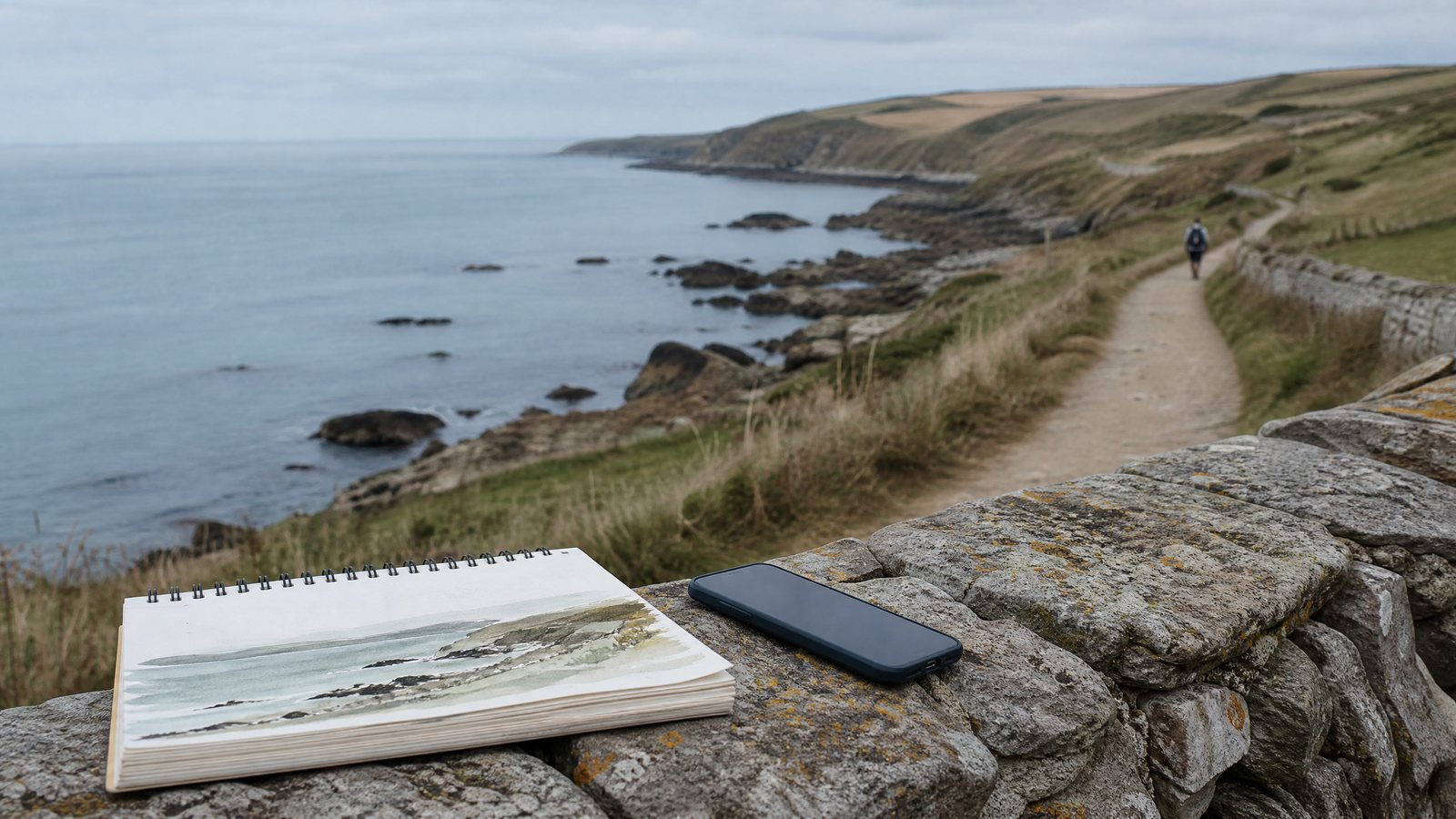
A travel detox is a routing system, not a disappearance
A useful travel detox does not ask you to become unreachable or uninformed. It asks you to give each phone action a job. A map, a transit notice, an accessibility update, a message to a companion and an emergency call solve specific travel problems. Repeatedly opening a feed because a queue is slow does not. The distinction is practical rather than moral: use the device when it reduces uncertainty or risk; set it aside when it merely fills a pause.
Here, digital detox means an intentional reduction in selected digital activity, not a claim that all technology is harmful. Research on social-media breaks has tested different rules and populations. A 2024 review found some evidence of benefit for depressive symptoms, but no statistically significant pooled effect for overall wellbeing, life satisfaction or stress. A smaller study documented substitution with other screens and post-limit catch-up use. Treat a travel boundary as an experiment in attention, not a treatment or contest.
The slow-travel purpose is equally concrete. When directions have been checked before leaving, a walk can be navigated by street names, gradients, landmarks and the occasional deliberate glance rather than by continuous screen reference. When photographs are reviewed later, a meal can remain a meal. When people at home know when to expect a message, silence need not become anxiety. That makes this practice a companion to the principles in our slow-travel collection, rather than a rule to endure.
Choose the boundary by risk, reliance and reason
A fixed rule such as “no phone until evening” is too blunt for travel. It can work during an unhurried neighbourhood walk with a downloaded map; it can be unwise on a late arrival, exposed trail, or a day when a traveller relies on a screen reader, translation, medication reminder or mobility information. Start with the day you have.
Use the Signal–Safety–Space framework. Signal is live information that may change a decision: a warning, platform alteration, gate change or companion’s message. Safety is the consequence if access fails: getting lost after dark, missing a prescribed reminder or being unable to contact assistance. Space is the uninterrupted attention an activity deserves. The first two determine what stays available; the third determines when the device goes away.
Apply the Signal–Safety–Space framework before leaving
Ask three questions. Could information change before I arrive? Preserve a way to receive the relevant official or local notice. What happens if my battery, data or screen fails? Add a written address, paper map, charged power source or a person who knows the plan when the consequence is meaningful. Where would an interruption cost attention or courtesy? Mark that period as device-away time.
| Day situation | Signal and safety need | Boundary that fits | Useful fallback |
|---|---|---|---|
| Familiar daytime walk in a compact area | Low; a route may still change | Check route before departure and at a planned landmark | Written return address and an offline area map |
| Multi-leg rail or coach transfer | Moderate to high; platforms, delays and connections can change | Keep travel notices and messages audible; avoid feeds between checks | Essential details saved for offline viewing and a charged power source |
| Solo hike, cycle ride or water activity | High; route, weather and help may be time-sensitive | Use navigation and safety tools continuously when needed; suspend the detox if conditions shift | Physical map where appropriate, extra power and a trusted contact with the plan |
| Meal, class, performance or conversation | Usually low once settled | Put the device out of sight; respond only to pre-agreed exceptions | Tell essential contacts when the next check-in will be |
The framework prevents a common mistake: treating inconvenience and danger as equal. Waiting five minutes without a feed is a tolerable gap. Continuing toward an exposed route after an alert is not. Make the boundary lighter when the setting is stable and more permissive when conditions are uncertain.
Prepare the phone so it can be used less
The least intrusive phone use is often done before the day begins. Save the next destination, accommodation address, first connection and return route in a form readable without a signal. Download the relevant map area if available, and identify a visual anchor near each key place: a square, bridge, station exit, park edge or distinctive street. A blue dot alone is poor orientation; it does not teach you what the place looks like.
Carry information in two forms when failure would cause more than mild inconvenience. A folded map, written address, printed confirmation or wallet note helps when a phone is damaged, drained or inaccessible. For outdoor travel, bring a physical map you know how to read. Check charge before departure and bring extra power where a day is long or navigation is essential.
Build a travel-tool home screen
Reduce friction, the small barriers that make an unwanted action less automatic, without hiding safety functions. Put maps, confirmations, camera, required translation, messages and an official-alert channel on the first screen. Move feeds, games, shopping prompts and work apps away from it; mute non-essential notifications and remove distracting badges. Keep emergency calling, accessibility settings and important contacts easy to reach.
Do not turn a boundary into a fragile technical puzzle. The goal is one extra pause before distraction, not a locked door between you and help. Before relying on downloaded material, open it once while offline to see what remains available.
A compact pre-departure checklist
- Confirm the first route, the return route and the next decision point.
- Save or write the address and one nearby landmark.
- Check charge, cable and any backup power.
- Keep maps, essential details and accessibility tools available offline where possible.
- Silence non-essential notifications, but allow agreed safety exceptions.
- Tell one trusted person the broad plan and the next expected check-in when the day warrants it.
- Check relevant local or official weather, transport and safety notices.
- Decide one period when the phone will be out of sight.
For a gentler introduction, pair this setup with the pacing ideas in a beginner’s guide to slow travel. The point is not to add another perfect routine; it is to make the next day easier to inhabit.
Set navigation rules that return attention to the street
Navigation is the function most likely to keep a phone in hand, and the function most worth preserving. Turn continuous reference into decision-point navigation: consult the route at moments that change what you do, then put it away between them.
A decision point might be leaving a station, choosing the correct side of a river, changing lines or reaching a planned landmark. Before moving, identify the next instruction and confirming feature. Then walk until it. If streets, terrain or time no longer match the plan, stop in a safe place and check again: orient, move, notice, reassess.
A simple example is a walk from a train station to a neighbourhood café. At the station, note the exit, main avenue and turn after the public garden. Keep the map accessible but not in hand. At the garden, confirm the next turn. If construction changes the path, use the phone and recalibrate.
This suits urban walks, rail-based days and known cycling routes when the environment is legible. It may not suit driving, technical hiking, night navigation, severe weather, low-vision travel or any activity requiring continuous guidance. Use the appropriate live tool. A slower rhythm can come from choosing fewer stops or building more time into the day, as explored in one city, seven days, rather than weakening navigation.
Build communication windows that people can trust
A boundary works better when nobody has to guess whether silence means pleasure, delay or trouble. Before a trip, name the people who need an update and agree on a pattern: an arrival message, a check after a long transfer and a brief evening note. This is different from transmitting a live location to a broad audience.
Set exception rules before muting notifications. Repeated calls from a designated contact, a separated companion, a safety alert or a transport notice should interrupt. Everything else can wait. Narrow the gap between check-ins for solo or remote travel, illness, disruption or a care responsibility.
There is also a privacy reason to delay detailed public sharing. A precise location, accommodation information or future route can reveal more than a travel photograph requires. Consider sharing after leaving and removing details that identify where you are staying or expose another person’s home, workplace or private life.
Communication windows should be negotiated, not imposed. A traveller accompanying children, an older relative, a person with a disability, or someone new to independent travel may need frequent coordination. That is not a lesser form of slow travel. It is a route to calm because the people involved know what support is available and when.
Use the camera with consent and context
Photography can invite close looking, but also turn every moment into material. Use a capture, then continue rule: take one considered frame or a few variations, lower the phone and remain in the scene. Review, edit and share later. The camera becomes a record rather than a running commentary.
Ask what the photograph asks of the person or place. A market worker may be completing a job, not volunteering as a subject. In worship spaces, memorials, schools, homes or intimate events, a technically public setting does not erase restraint. Ask before a close portrait, accept refusal without negotiation, and be especially careful around children or people whose work makes refusal difficult.
Check site rules, then read the room
Photography rules vary by site, activity and local law. A location may permit handheld images but restrict equipment, sensitive areas, flash, tripods, filming or interference with other visitors. The site authority, custodian or posted instruction takes precedence. Confirm rules through the appropriate local or official channel on the day, because restrictions can change.
Rules are a minimum. Do not block an entrance, cross a barrier, delay a queue, intrude on worship, or ask someone to repeat work or emotion for the camera. Put the device away when conversation begins. For wider guidance, read community respect and visitor etiquette.
Use live information without feeding a scroll
Travel conditions are not static. A forecast is not a road surface or a promise that a route remains passable. Transport, trail conditions, water safety, smoke, heat and access rules can change after preparation. Identify the few decisions that require a live check and use the official or relevant local channel immediately before them.
Set two safety windows: before departure and before an exposed activity or major transfer. Check warnings, local conditions, transport status and instructions from staff or authorities. Hazards can develop quickly: heat may change water, shade and timing; flood or lightning may call for a route change; smoke can matter especially for people with respiratory conditions. Do not substitute a seasonal expectation for present conditions.
When an alert, illness, missed connection or uneasy interaction occurs, end the experiment. Turn on needed tools, seek help from appropriate staff or authorities, and choose a safe route. A boundary needs an exit rule; it never asks you to trade judgment for resolve.
This is why slow travel and seasonal awareness belong together. The aim is enough time to respond without rushing, not false certainty. Our seasonal travel guidance and explainer on how far ahead weather is useful can help distinguish broad planning from the final local confirmation that a particular day demands.
Match the rhythm to your travel style and access needs
The same settings will not suit everyone. A solo traveller on a city break may use a short planning session, two check-in windows and device-away meals. A family between museums may need maps, tickets, translation and coordination all day. A person using a phone for wayfinding, hearing support, captioning, health monitoring or sensory regulation should protect those functions. Accessibility is part of the design brief.
When a lighter boundary is the better choice
Keep the phone more available for late arrivals, unfamiliar or remote routes, changing weather, driving, water activities, a tight connection, medical needs or a companion needing support. Choose low-risk reductions: silence feeds, defer posting, keep the camera in a bag at meals, or make one message check intentional. The less predictable the day, the less useful a rigid detox.
A stronger boundary may suit a settled walkable stay, repeated local routine, museum morning, long lunch or rest day. Define exceptions first. Children benefit when adults explain why they check directions and when the table is device-free. Slow travel with children offers adaptations where attention and logistics coexist.
Group travel has another trade-off: one person may want an unplugged afternoon while another handles directions or time-sensitive communication. Name the role, rotate navigation and agree who checks the next change. Shared responsibility is more sustainable than one person carrying the device and mental load.
Close the day without a catch-up spiral
A day-end check needs a boundary of its own. Reply to essential messages, confirm tomorrow’s first movement, review forecasts or warnings, back up needed images, charge devices and note one unresolved question. Then stop. The goal is reducing morning uncertainty, not moving every deferred feed, work alert and chat to the last hour before sleep.
If bedtime scrolling is a pattern, use a cut-off after the essential check. Public-health sleep guidance recommends turning off electronic devices at least 30 minutes before bed; it is a general habit, not a promise of improved travel sleep. Time zones, shared rooms, anxiety, illness and unfamiliar surroundings can disrupt rest. Earlier planning gives the phone fewer reasons to be the final object in hand.
Keep a small analogue substitute within reach: a book, notebook, paper map or list of tomorrow’s questions. The substitute matters because an empty five-minute gap is where automatic scrolling often returns. It need not be productive. Looking from a window, listening to a station settle, or doing nothing at all is a legitimate end to a travel day.
What needs current confirmation and what this cannot solve
Some principles are durable: protect navigation and accessibility, carry a backup when failure matters, agree communication expectations, obtain consent, and let safety override any screen boundary. Other information has a short shelf life. Confirm through the relevant local or official channel close to use: forecasts and warnings, route conditions, transport disruptions, venue access rules, photography restrictions, emergency numbers, local safety advice and the availability of assistance. If a staff member, guide, authority or posted sign gives a more specific instruction, follow it.
This rhythm also has limits. Reducing feeds will not resolve loneliness, conflict, financial pressure, illness, grief, a difficult travel companion or a mental-health condition. It may make some people feel more disconnected, especially when social platforms are a meaningful source of community or support. It can also lead to screen substitution, where a person stops using one app and simply moves the same habit to news, video, games or another device. Notice the function of the use, not only the minutes.
The research base does not justify a universal number of screen-free hours or an assured improvement in mood, focus or sleep. If phone use feels compulsive, causes distress, interferes with safety or relationships, or is part of a wider health concern, a travel rule is not a substitute for appropriate professional support. Start smaller, review what actually changed, and keep the functions that make the journey safer and more accessible.
Conclusion: keep the useful signal
A digital-detox travel rhythm succeeds when it makes a day more navigable, not more precarious. Prepare the information that matters, decide when live updates are necessary, agree how trusted people will reach you, and put the device away during the parts of travel that deserve your full attention. Use the Signal–Safety–Space framework whenever the plan changes. It leaves room for maps, warnings, access tools, messages and photographs while refusing to let every idle moment become a demand for more screen time.
The best result is not total absence from the internet. It is a journey in which the phone is available when it is useful and quiet when the place, the people and your own rest have more to offer.