South India · State · TN
Tamil Nadu
Tamil Nadu rewards a route built around contrasts rather than a checklist. Chennai is a major coastal capital; the eastern shore holds Pallava monuments, mangroves and bird wetlands; the Kaveri plain concentrates Chola temples, rice country and artistic traditions; the far southeast moves through island pilgrimage and fragile marine habitats. Westward, the Nilgiris and Palani Hills replace humid lowlands with cool, winding high country and protected forests. Tamil is the everyday language and classical cultural anchor, while English is useful in many urban, transport and visitor-facing settings. A first visit works best as two or three linked regions, not an attempt to cross the whole state quickly. Temperatures, rain, festival crowds, sea conditions and forest access vary markedly by coast, plain and plateau, so timing is a core route decision.
Regional notebook
Begin with the shape of the region.
Tamil Nadu links monumental temple towns, craft knowledge, ports, wetlands and mountains in an unusually coherent but geographically large state. Its best journeys connect two or three complementary regions: northern coast, Kaveri delta and south-east, or western highlands. Chennai is an effective gateway, yet a cross-state dash loses the regional contrasts that make the journey meaningful. This representative selection is not exhaustive.
Landscape
Geography changes the journey.
Tamil Nadu occupies India’s southeast, bounded by Andhra Pradesh and Karnataka in the north, Kerala in the west, the Bay of Bengal in the east and the Indian Ocean in the south. Coasts, deltas and dry interiors rise toward the Western Ghats, Nilgiris and Palani Hills. This relief creates real differences in temperature, rainfall, visibility and travel speed. Coastal warnings and mountain rain can alter access.
Living culture
Arrive as a guest, not an audience.
Tamil is the state’s cultural anchor, expressed through literature, sacred geography and public life. Pallava, Chola, Nayak, Maratha, colonial and mercantile layers are tangible in distinct regions. Temples are active institutions, so ritual, dress, queues and photography rules take precedence over sightseeing. Bharatanatyam, Carnatic music, bronze casting, painting, silk weaving and Chettinad building traditions are living practices. Ask before photographing people, shrines, workshops or ceremonies.
Curated regional atlas
Places that reveal different parts of Tamil Nadu
This is a selective, geographically varied starting point rather than an exhaustive list. Use it to choose a coherent route, not to compress every place into one trip.
State capital and coastal metropolis · Chennai district, northeastern Tamil Nadu
Chennai
Chennai is Tamil Nadu’s capital, principal aviation and rail gateway, and a Bay of Bengal city where colonial-era districts, Tamil public culture, museums, music venues, temples and a long urban shoreline meet. It is best approached as an inhabited working metropolis rather than a compact heritage enclave. Neighbourhood scale matters: central civic and museum districts, older commercial quarters, Mylapore’s temple streets and the coast each need separate time. The city is also the practical place to reset before or after a longer regional circuit, buy essentials and use major transport connections. Heat, humidity, traffic and seasonal heavy rain shape every day outdoors.
Why this place matters
Go to understand the contemporary urban frame around Tamil Nadu’s historic regions and to access its layered civic, religious and cultural life. Chennai rewards travellers who slow down for a few focused districts instead of moving continuously across the city. It is especially useful as the start for a north-coast route, since that reduces long arrival-day transfers. The payoff is context: a living Tamil capital with strong connections to classical music, dance, publishing, education, industry and the sea. It is less suited to a quiet, walk-everywhere break; choose it for city energy, structured visits and transport convenience.
World Heritage monument town and coast · Mamallapuram, Chengalpattu district
Mamallapuram Heritage Coast
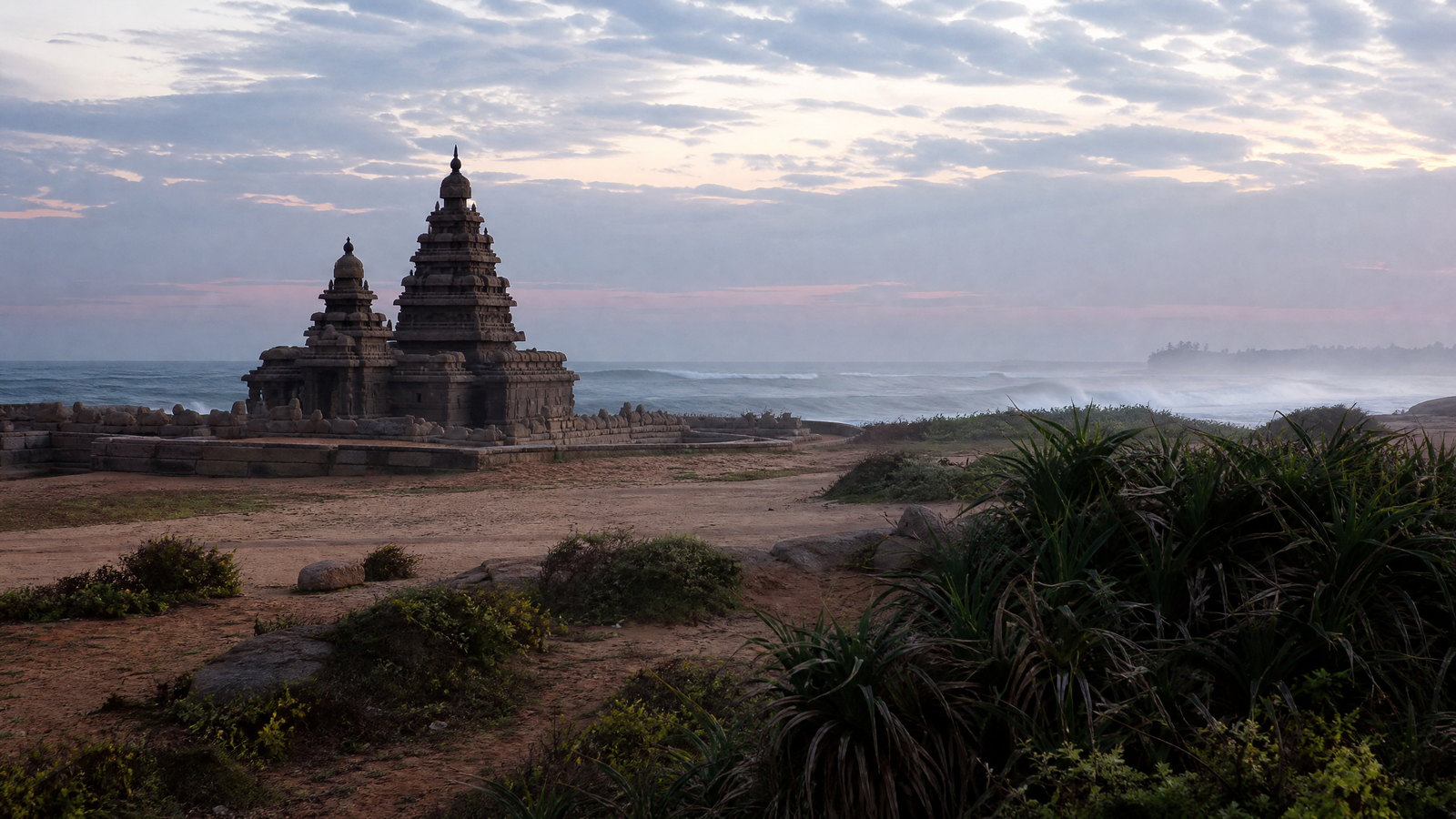
Mamallapuram, also called Mahabalipuram, preserves a concentrated Pallava-era ensemble on the Coromandel coast. Its seventh- and eighth-century rock-cut caves, monolithic rathas, open-air reliefs and structural Shore Temple show successive experiments in stone architecture. The World Heritage property is more rewarding when read as a group: a cave sanctuary, a boulder-shaped temple and a carved relief illuminate one another. The town’s historic port setting adds a coastal dimension, but salt air, humidity and visitor pressure make conservation relevant to the experience. It pairs naturally with Chennai or Kanchipuram, while still deserving an overnight rather than a rushed roadside stop.
Why this place matters
Go for an unusually direct encounter with Pallava design, where landscape, bedrock and sculpture form one visual language. The Descent of the Ganges relief and the rathas communicate at a scale that photographs flatten, while the Shore Temple shows the shift to built stone architecture. Morning or late afternoon light also reduces heat and makes carving legible. This is a strong choice for architecture, art history and coastal heritage, but it is not an isolated ruin: crowds, weather and nearby town activity are part of its reality. The best visit prioritizes protected monuments and leaves time to absorb their setting.
Temple city and weaving centre · Kancheepuram district, northeastern Tamil Nadu
Kanchipuram
Kanchipuram is a historic temple city whose identity combines Pallava-era associations, later dynastic layers, living Hindu institutions and a renowned handloom silk tradition. Major temple precincts include Shaiva and Vaishnava sites, so the town offers more than one architectural or devotional vocabulary. The wider district also holds a notable concentration of notified megalithic areas, a reminder that the landscape predates its better-known medieval monuments. Weaving remains a livelihood for many families, making craft interest most meaningful when approached as skilled work rather than souvenir hunting. Kanchipuram is reachable from Chennai, but its heat, ritual rhythms and dispersed sites favor a full day or overnight.
Why this place matters
Go to compare temple architecture across active institutions and to see how sacred geography and handloom production coexist in a present-day town. Kanchipuram offers a different experience from Mamallapuram: less coastal monument park, more dense urban pilgrimage and craft landscape. Visitors interested in textiles can learn by observing respectfully, asking permission before photography and allowing makers to set the terms of conversation. Cooler months make temple streets much easier to navigate. The place rewards a selective plan of two or three precincts rather than an attempt to see every shrine, and it works well as a cultural counterpoint to Chennai.
Estuarine mangrove landscape · Near Chidambaram, Cuddalore district
Pichavaram Mangroves
Pichavaram is a broad mangrove and estuarine landscape between the Vellar and Coleroon estuaries. Its narrow tidal channels, mangrove vegetation and aquatic habitat make the experience fundamentally different from a beach visit: the attraction is the ecological structure of a marine forest. The district administration describes a network suitable for regulated boating, but the strongest reason to visit is to understand why mangroves matter for biodiversity, shore protection and estuarine life. Pichavaram can be paired with Chidambaram or the east-coast heritage route, yet it should not be compressed into a noisy recreation stop. Weather, tide, water level and operational conditions shape what can be seen.
Why this place matters
Go for a close, low-speed view of a coastal ecosystem that is often overlooked beside Tamil Nadu’s temples and beaches. A quiet boat journey reveals roots, channels, birdlife and changing light, while also making the fragility of the habitat apparent. It is a useful nature counterpoint to Chola and Pallava architecture, particularly for travellers interested in climate resilience and estuary ecology. The experience is strongest when visitors accept the limits of regulated routes and avoid treating wildlife as a performance. Choose calmer weather and be prepared for heat, insects and occasional rain.
Historic city, temple landscape and agricultural plain · Thanjavur district, central-eastern Tamil Nadu
Thanjavur and the Kaveri Delta
Thanjavur is the principal urban base for the Kaveri delta, where paddy fields, temple towns, scholarship and fine arts have long been intertwined. Brihadisvara Temple is part of the Great Living Chola Temples, a World Heritage group that also includes Gangaikondacholapuram and Darasuram. Its scale and formal geometry make it a powerful anchor, but the city also supports study of bronze casting, painting, music, manuscripts and later political layers. The term living matters: ritual continues alongside conservation. Use Thanjavur as a base for a measured delta circuit rather than trying to cover all three Chola components in a single hurried outing.
Why this place matters
Go to see high Chola architecture in its social and agricultural setting, not detached from the Tamil cultural practices it helped sustain. Brihadisvara’s tower, mural and sculptural program reward time and repeated looking, while nearby collections and temple towns expand the story beyond one monument. This is an excellent choice for art, architecture and music-minded travellers. Hot tropical conditions are the trade-off, so arrange outdoor temple viewing early and reserve the middle of the day for indoor or shaded cultural stops. Allow enough time for the delta’s distances and the active religious life of its temples.
Ramsar wetland and wildlife sanctuary · Nagapattinam and Tiruvarur districts, southeastern coast
Point Calimere Wetland
Point Calimere, also known as Kodikkarai, is a vast coastal wetland complex of shallow marine water, mudflats, saline lagoons, salt flats, dunes, mangroves and grazing land. Its Ramsar designation reflects ecological value on a migratory flyway; the site supports large numbers of waterbirds and is associated with blackbuck. The landscape changes sharply with season as water spreads, recedes and salinity rises, so it should not be imagined as a fixed lake or guaranteed bird spectacle. Local livelihoods also depend on the wetland. Its value is in patient observation of an active coastal system, with access constrained by habitat protection and conditions.
Why this place matters
Go for shorebird and wetland habitat diversity rather than a conventional beach day. Point Calimere makes a thoughtful addition to a delta itinerary because it reveals the coast’s ecological and community dimensions after temple-heavy days. In favorable seasons, binoculars and a slow pace are more useful than ambitious movement across the site. The reward is an open, changeable landscape of water, salt, mud and sky; the trade-off is that wildlife encounters cannot be promised and authorized viewing may be limited. Respect staff guidance and leave room for weather, tide and seasonal habitat variation.
Historic temple city · Madurai district, south-central Tamil Nadu
Madurai
Madurai is a major south Tamil city organized culturally and spatially around the Meenakshi Amman Temple. The complex’s towers, halls, water tank, sculptural program and festival calendar make it both an architectural landmark and an active centre of worship. The city’s significance extends into Tamil literary memory, trade, food and religious plurality, with museums, markets and other sacred sites giving a wider urban frame. It is not a silent monument zone: queues, processions, heat and dense street life are integral to the experience. Madurai works as a strong southern circuit base, especially when paired with Chettinad or the road toward Rameswaram.
Why this place matters
Go to experience a temple city as a living urban organism. Meenakshi Amman Temple is compelling for its architecture, but the deeper value is seeing how ritual, market streets, sound and everyday movement shape the precinct. Early hours can be cooler and calmer, while festival periods offer intensity at the cost of crowding and altered circulation. Madurai suits travellers who welcome sensory density and want a grounded introduction to southern Tamil culture. It is less suitable for those seeking a secluded heritage visit, but its energy gives the regional journey a human scale between rural and coastal stops.
Historic merchant-town and craft region · Karaikudi, Kanadukathan and surrounding settlements, Sivaganga district
Chettinad Cultural Landscape
Chettinad is a regional cultural landscape centered on Karaikudi and surrounding settlements associated with the Nattukottai Chettiar community. Its distinctive townscape includes expansive courtyard houses, temples, lanes and workshops shaped by nineteenth- and early twentieth-century mercantile networks. Buildings blend local climatic design with materials and decorative influences from wider trade connections. The beauty of the region is inseparable from its vulnerability: many historic houses are family properties, partly occupied or in uneven repair, and decorative elements have faced removal and loss. Visit as a living residential landscape, not as an open-air collection of interiors.
Why this place matters
Go for domestic architecture and regional craft traditions that offer a deliberate contrast to monumental temple complexes. Courtyards, verandas, tiles, timber, lime work and ceremonial streets make climate, status and social life readable in built form. Chettinad also gives a slower link between Madurai and the coast, with the chance to learn why conservation of private heritage is complicated. The most respectful visits are selective and permission-based; a closed doorway is not an invitation to enter. Choose it for observation, dialogue and architectural detail, not for rapid mansion-hopping or intrusive photography.
Island pilgrimage town and exposed coastal landscape · Pamban Island, Ramanathapuram district
Rameswaram and Dhanushkodi
Rameswaram occupies Pamban Island, joined to the mainland by the Pamban crossing and shaped by pilgrimage, fishing culture and a narrow maritime setting. Ramanathaswamy Temple is a major Hindu pilgrimage site known for its long corridors and sculpted pillars. Eastward, Dhanushkodi presents a much more exposed shoreline, where sand, sea and weather dominate. The combination is powerful precisely because it links sacred geography to a vulnerable coast rather than separating them. Distances are manageable but conditions can change quickly with wind, rain and warnings. Give the temple and coast different parts of the day instead of treating either as a brief photo stop.
Why this place matters
Go for the meeting of ritual architecture, island infrastructure and elemental seascape. Rameswaram provides one of Tamil Nadu’s clearest examples of pilgrimage functioning within everyday town life, while Dhanushkodi shifts attention toward coastal exposure and natural limits. This is a rewarding final stage of a southern journey for travellers interested in faith, engineering and marine geography. The trade-off is weather sensitivity: sea conditions, wind and official restrictions matter more than an itinerary. Modest dress and respect for worship practices are essential, and the coast should be observed from authorized safe areas.
Marine national park and biosphere reserve · Ramanathapuram and Thoothukudi coast
Gulf of Mannar Marine National Park
The Gulf of Mannar Marine National Park forms part of South Asia’s first marine biosphere reserve and spans a chain of 21 islands with seagrass, coral, mangroves, salt marshes, beaches and estuaries. Its ecological importance includes habitat for dugongs, turtles and many marine species, but that is exactly why it should not be treated as unrestricted island recreation. Public access within the park is controlled and conditions depend on conservation rules and sea state. The mainland coast near Mandapam and Rameswaram provides the most practical context for understanding the reserve. It is a place to learn about marine ecosystems, not to pursue close wildlife encounters.
Why this place matters
Go to add a marine conservation perspective to an island and pilgrimage route. The Gulf’s seagrass and coral systems broaden the story of Tamil Nadu’s coast beyond temples and beaches, while regulated viewing can make the limits of access part of the lesson. Travellers interested in ecology should favor authorized interpretation and low-impact observation over water activities that put pressure on habitats. Sea clarity, weather and operational choices may affect what is possible on a given day. The greatest value is seeing an exceptional but sensitive marine landscape with conservation, rather than spectacle, at the center.
Hill town and montane landscape · Dindigul district, central-western Tamil Nadu
Kodaikanal and the Palani Hills
Kodaikanal sits high in the Palani Hills, at roughly 7,000 feet above sea level, with a markedly cooler feel than the surrounding plains. Lakes, forest edges, viewpoints, shola-linked uplands and steep approaches make it a useful climate and landscape counterpoint to Madurai or Thanjavur. The town developed as a nineteenth-century hill retreat, but it also lies within a much older mountain environment and near protected forests. Its appeal is not only mist and scenery: altitude, sudden rain, traffic at popular viewpoints and sensitive habitats require a slower approach. Treat it as a mountain stay, not simply a day excursion from the lowlands.
Why this place matters
Go to reset the pace after hot city and temple routes, with time for cool air, short walks and broad escarpment views. Kodaikanal is appropriate for travellers seeking a gentler highland base rather than wildlife intensity or technical trekking. Its upland setting offers a different lens on Tamil Nadu’s ecology and water systems, especially when visited with respect for forest boundaries. The trade-off is variable visibility: cloud and rain can obscure views, while hill roads lengthen transfers. Plan flexible days, carry warm and rain layers, and choose authorized walks rather than attempting unmarked routes.
World Heritage mountain railway and hill region · Mettupalayam–Coonoor–Udhagamandalam, Nilgiris district
Nilgiri Mountain Railway and Ooty
The Nilgiri Mountain Railway links Mettupalayam with Ooty through Coonoor and other hill stations, rising from roughly 326 to 2,203 metres over about 46 kilometres. Completed in 1908, it is part of the Mountain Railways of India World Heritage property and remains a functioning line using rack-and-pinion technology on steep sections. The journey is as important as the destination: bridges, tunnels, slopes and changing vegetation explain the engineering achievement. Ooty and Coonoor provide practical highland bases, but the railway is not a guaranteed scenic amusement; limited capacity, weather and operational needs govern service. It works best with a flexible mountain itinerary.
Why this place matters
Go for a rare combination of living transport heritage and a gradual geographic transition from foothill warmth to Nilgiri highlands. The line makes engineering visible in a way a road transfer does not, and its slow pace encourages attention to terrain rather than destination collecting. It is ideal for railway history, landscape and architecture-minded travellers. The trade-off is operational uncertainty: seasonal rain, landslide risk, maintenance and demand can affect the journey. Do not plan a critical same-day connection around it. Allow extra time in the Nilgiris and treat a train ride as one meaningful component of the wider hill region.
Tiger reserve and forest landscape · Nilgiris district, northwestern Tamil Nadu
Mudumalai Tiger Reserve
Mudumalai Tiger Reserve lies in the Nilgiris landscape near the Karnataka and Kerala borders, connecting forest systems across state lines. The reserve’s conservation focus includes tiger habitat, prey species, wider biodiversity, community-linked eco-development and reducing pressure on forest resources. For visitors, its significance is broader than a tiger sighting: dry forest, water, elephants, birds and the scale of the protected landscape are the real story. Wildlife is free-ranging and views are never assured. Access uses regulated activities and designated areas, while roads and weather can influence operations. Approach Mudumalai as a conservation landscape with firm boundaries, not a wildlife display.
Why this place matters
Go to experience the ecological side of the Nilgiris after a railway or hill-town stay, with the possibility of learning how protected areas manage habitat and human pressures. Mudumalai suits patient observers who accept uncertainty and value forest time even without iconic animal encounters. Early, quiet hours and responsible interpretation are more meaningful than a rushed search for one species. The reserve is not designed for independent wandering, and ethical wildlife viewing means maintaining distance, avoiding noise and accepting route limits. Build it into a two-night western circuit, with enough slack for weather or changed operations.
Season and pace
Choose a date window for the experience, then keep a fallback.
November–February is generally most forgiving for lowland cities, heritage and coasts, though northeast-monsoon rain may persist late in the year. March–June brings serious plain heat: schedule outdoor sites early and late. Western slopes and hills receive southwest-monsoon influence from roughly June, while east-coast rainfall peaks broadly October–December. Hills stay cooler but can be foggy or wet. Check district forecasts and warnings before each transfer.
Movement and planning
Distance on a map is not the same as usable travel time.
Moving through the region
Chennai is the main air and rail gateway; Coimbatore, Tiruchirappalli and Madurai can simplify regional routes. Rail and buses connect major towns, but last-mile links to reserves, wetlands, villages and viewpoints are slower. Mountain roads require daylight slack. The Nilgiri Railway has limited operational capacity, so do not base a critical connection on it. In cities, heat, traffic, uneven pavements and stairs can limit step-free travel.
Building a workable route
Pick an axis: Chennai–Kanchipuram–Mamallapuram–Pichavaram; Thanjavur–Madurai–Chettinad–Rameswaram; or Nilgiris–Mudumalai–Kodaikanal. Carry modest temple clothing, sun and rain protection, refillable water and mountain layers. Give wetlands and reserves unhurried time and keep a weather buffer before fixed transport. Confirm current ritual restrictions, forest or boat access, road conditions, rail operations and any announced travel controls through the relevant official or local channel.
Travel responsibly
The regional context includes its limits.
Coasts and wetlands are working ecological systems. Stay on authorized routes and never approach nesting birds, coral, seagrass, mangroves or wildlife for images. Do not buy shells, coral, wildlife products or heritage fragments. In reserves, staff guidance and distance outrank sightings. At temples, comply with entry, dress, queue and photography rules. Chettinad houses are often homes: ask before entering or photographing. Carry out waste where facilities are limited, and accept weather or conservation closures.
This is an evergreen regional guide. Weather, permits, closures, transport and local rules can change; confirm material conditions through the relevant local or official channel before travel.