North India · State · PB
Punjab
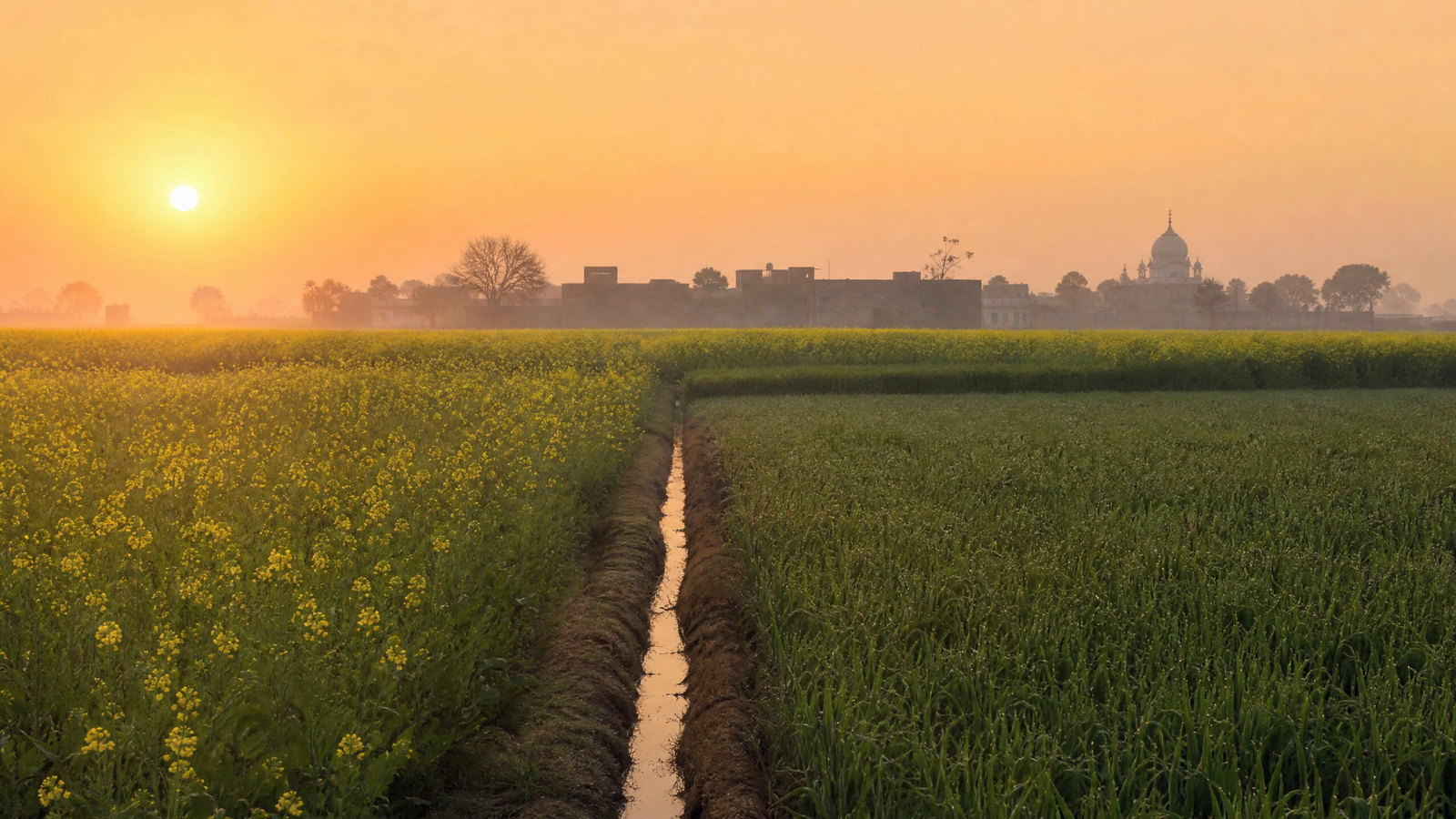
Punjab is a northwestern state where cultivated plains, riverine wetlands, historic towns and the Shivalik foothills meet within short but meaningful travel distances. Chandigarh is its capital, though it is a separate Union Territory shared with Haryana; Amritsar, Ludhiana, Jalandhar, Patiala and Anandpur Sahib are key visitor centres. A route can move from the Amrit Sarovar to royal-era murals, Partition memory, winter bird habitat and farming landscapes shaped by canals and the Green Revolution. The strongest itineraries preserve this range: Amritsar is dense and emotionally charged; the southwest is hotter and drier; the northeast is greener and hillier. October through March is usually the most forgiving travel window, but winter fog, festival crowds and changing local arrangements demand flexibility.
Regional notebook
Begin with the shape of the region.
Punjab is best understood through connected landscapes rather than one headline city. Its river-watered plains hold sacred centres, princely towns, border memory, industrial cities, farming institutions and Ramsar wetlands. Amritsar is the densest introduction, but Anandpur Sahib turns toward the Shivalik foothills; Patiala and Bathinda trace royal and fort histories; Ludhiana interprets agrarian change; Harike and Abohar shift attention to ecology. Sikh heritage is foundational, yet Hindu, Muslim, Sufi, colonial and Partition histories remain visible. This is a lowland destination, not a mountain escape. Choose two or three clusters and leave time for place-specific rhythms rather than treating Punjab as a rapid checklist.
Landscape
Geography changes the journey.
Punjab covers about 50,362 square kilometres in northwestern India, bordered by Pakistan, Jammu and Kashmir, Himachal Pradesh, Haryana and Rajasthan. Its average elevation is about 300 metres, rising from roughly 180 metres in the southwest to above 500 metres near the northeastern edge. Fertile plains, rivers, canals and irrigation underpin most routes. The Shivalik fringe around Anandpur Sahib, Nangal, Hoshiarpur and Mohali is more undulating, with seasonal streams and erosion-prone ground. It is not high altitude, but heavy rain can rapidly alter local conditions. Protected wetlands are ecological systems, not generic waterfronts; use authorised public areas only.
Living culture
Arrive as a guest, not an audience.
Punjabi, written in Gurmukhi, is the official language; Hindi and English are useful in urban travel. Sikh traditions shape the rhythm, architecture and ethics of gurdwaras, where humility and collective service remain primary. Sri Harmandir Sahib, Anandpur Sahib and Fatehgarh Sahib are living sacred settings. Punjab’s cultural story also encompasses pre-Partition connections, Mughal and princely patronage, Sufi lineages and the freedom movement. Bhangra, giddha, phulkari, devotional music and wheat-and-dairy foodways offer context, but culture should not be reduced to performance. Ask before photographing people or worship, and approach memorials with care.
Curated regional atlas
Places that reveal different parts of Punjab
This is a selective, geographically varied starting point rather than an exhaustive list. Use it to choose a coherent route, not to compress every place into one trip.
Sikh pilgrimage complex · Amritsar, Amritsar district
Sri Harmandir Sahib
Sri Harmandir Sahib is Sikhism’s principal sacred complex, centred on the Amrit Sarovar in Amritsar. The low shrine, water-bound causeway and four entrances make architecture an expression of welcome across caste, creed, gender and religion. Kirtan, the marble parikrama and langar are part of a working devotional environment, not a display. The experience shifts from reflective dawn to dense daytime movement, prayer and service. Give it unhurried time, follow visible etiquette and remember that worshippers’ needs come first. Nearby historic streets are best explored separately, after rather than during a sacred visit.
Why this place matters
Go to understand how water, music, architecture and collective service create a living sacred landscape. The four-door design offers a clear spatial expression of Sikh openness, while the sarovar changes with light and time. A dawn or evening visit can reveal a different rhythm, though quiet is never guaranteed. Langar provides a direct encounter with egalitarian community practice when joined respectfully. It is also the best starting point for reading Amritsar, which grew around the pool and shrine. Dress and conduct matter as much as efficient sightseeing here.
National memorial · Old city, Amritsar, Amritsar district
Jallianwala Bagh
Jallianwala Bagh is a memorial garden near Sri Harmandir Sahib marking the 13 April 1919 massacre, a defining episode in India’s freedom struggle. Preserved bullet-marked masonry, the memorial well and interpretive material locate the violence within a confined urban space. Its proximity to the pilgrimage precinct makes a rushed pass-through tempting, but this needs a separate quiet visit. The garden is a place to consider colonial rule, public assembly, grief and political memory, not a setting for celebratory images. Pair it with old-city exploration only after allowing time to absorb the site’s historical weight.
Why this place matters
Go for a direct encounter with a site that transformed anti-colonial politics and remains central to Indian public memory. The narrow approaches, physical traces and commemorative elements offer context that a distant account cannot. It is a necessary counterpoint to Amritsar’s sacred grandeur: faith, commerce, imperial history and traumatic memory sit close together here. History and architecture-of-remembrance visitors will find it particularly resonant. Its value lies in attentive observation rather than dramatic performance. Read carefully, speak softly and keep photography restrained; confirm same-day opening, gallery access and security arrangements locally.
Historic fort · Amritsar, Amritsar district
Gobindgarh Fort
Gobindgarh Fort is a 43-acre fortified precinct in central Amritsar whose fabric spans the Bhangi Misl, Maharaja Ranjit Singh, East India Company and Indian Army periods. Its moat, bastions, wells, Toshakhana, Khas Mahal and later Darbar Hall make political transitions legible in built form. It is distinct from the sacred precinct: a military and administrative landscape restored in phases and adapted for public interpretation. Its central location makes it an accessible cultural stop, though the experience depends on which areas are open. Read the surviving structures alongside the different eras that reshaped them.
Why this place matters
Go beyond Amritsar’s pilgrimage image to see a layered record of Sikh, colonial and post-independence power. The large enclosure and surviving components lend scale to a story city streets alone cannot convey. It suits visitors interested in military architecture, adaptive reuse or Maharaja Ranjit Singh’s era, and fits easily between railway, market and old-city areas. Restoration and programming can be uneven or changeable, so regard it as a site in evolution rather than a fixed display. Confirm access, photography rules and any timed presentations before building a tightly scheduled day around the fort.
Border ceremonial site · Attari, Amritsar district
Attari Border Ceremony
Attari is the Indian border point on the historic Amritsar–Lahore route and the setting for a daily flag-lowering ceremony facing Pakistan’s Wagah post. Precise drill, ceremony and patriotic audience energy unfold inside a heavily managed international-border environment. It is a state ceremony, not an informal frontier outing or a substitute for cross-border travel. The open viewing area contrasts sharply with Amritsar’s dense old city, while the surrounding plains underline the geography of Partition. Attendance depends on security management, weather and crowd conditions. Arrive patiently and follow all screening, seating and movement directions.
Why this place matters
Go to witness a structured public ritual that makes the India–Pakistan boundary visible without reducing it to a simple spectacle. The ceremony condenses diplomacy, military display, popular emotion and partitioned geography into a short event. It pairs best with Amritsar’s memorial contexts, where the human consequences of border-making can be considered more fully. The experience rewards curiosity and restraint rather than competitive crowd energy. Waiting areas can be hot and exposed, and arrivals may be tightly controlled. Keep the day flexible, carry only permitted essentials and verify ceremony status, timing and access requirements through the responsible local or official channel.
Sikh sacred town and heritage museum · Sri Anandpur Sahib, Rupnagar district
Sri Anandpur Sahib and Virasat-e-Khalsa
Sri Anandpur Sahib is a major Sikh sacred town near Punjab’s Shivalik edge. Guru Gobind Singh formally founded the Khalsa here at Baisakhi in 1699, and Takht Sri Kesgarh Sahib remains the devotional focus. Across a ravine, Virasat-e-Khalsa presents Sikh and Punjabi history in a contemporary complex of stone, concrete and concave steel roofs. The pairing works exceptionally well: the gurdwara offers living worship while the museum supplies historical sequence and interpretation. The foothill terrain and water features distinguish it from the plains cities. Festival periods are meaningful but can bring demanding crowding and traffic.
Why this place matters
Go to encounter Sikh history through both a living sacred setting and a museum that offers broad historical orientation. The town’s connection to the Khalsa gives the visit spiritual and political depth, while Virasat-e-Khalsa’s galleries and architecture provide vivid context. Its setting makes a useful transition into the Shivalik fringe, so it is stronger as an overnight or full-day stop than a rushed excursion. Give gurdwara and museum their own time, with modest dress and a head covering in sacred spaces. Event calendars, museum slots, gallery availability and traffic can change, especially around Baisakhi; confirm arrangements before travel.
Princely architecture and museum precinct · Patiala, Patiala district
Patiala Royal Heritage Quarter
Patiala’s royal heritage is best read as a connected urban quarter, not a palace checklist. Qila Mubarak developed from a mud fort into a princely complex with inner and outer sections, a Darbar Hall, arms and painted interiors. The nearby Moti Bagh and Sheesh Mahal ensemble brings together water channels, gardens, murals, miniature paintings, manuscripts and decorative arts. These places join Punjabi court culture with Kangra and Rajasthani painting traditions and later institutional reuse. Patiala is less immediately monumental than Amritsar but rewards close looking. Individual opening patterns matter, so do not assume all heritage components operate as one continuous attraction.
Why this place matters
Go for an intimate view of Punjab’s princely states, where fortification, garden planning and collections show how courtly power was staged. Qila Mubarak and Sheesh Mahal offer a useful contrast with Sikh sacred architecture in Amritsar and Anandpur Sahib. The strongest details are painted ceilings, cut-glass chandeliers, water features and miniature art. Patiala is also a practical cultural stop between Chandigarh and central Malwa. Because museums and palace areas may follow different access arrangements, do not overpack the day. Confirm open sections, gallery availability and photography rules, and allow for steps, uneven surfaces and limited shade.
Sikh martyrdom shrine complex · Fatehgarh Sahib, Fatehgarh Sahib district
Gurdwara Sri Fatehgarh Sahib
Gurdwara Sri Fatehgarh Sahib commemorates the martyrdom of Guru Gobind Singh’s younger sons, Sahibzada Zorawar Singh and Sahibzada Fateh Singh, and Mata Gujri. District accounts identify the preserved historic wall at Gurdwara Bhora Sahib and related sites including Burj Mata Gujri and Shahid Ganj. It is therefore a linked landscape of remembrance, prayer and Sikh historical consciousness rather than a single building. The December Shaheedi Jor Mela draws large pilgrim numbers. At quieter times, visitors can better take in the solemnity and scale of the precinct. Approach its traumatic history with sensitivity and avoid intrusive documentation.
Why this place matters
Go to understand a central narrative of Sikh martyrdom in the place where it is actively commemorated. It offers a different register from Sri Harmandir Sahib’s grandeur or Virasat-e-Khalsa’s galleries: the emphasis is remembrance and moral witness. Multiple gurdwaras and preserved elements reward a slow, contextual visit. Fatehgarh Sahib also combines naturally with Patiala or Chandigarh-side travel, avoiding a cross-state detour. December observances are significant but less suitable for those needing predictability or easy mobility. Wear appropriate clothing, follow shrine instructions and confirm local entry, queue and movement arrangements before visiting.
Historic fort · Bathinda, Bathinda district
Qila Mubarak, Bathinda
Qila Mubarak rises in Bathinda’s centre as a massive fortification associated in local accounts with Guru Gobind Singh’s stay. It redirects attention toward Malwa, Punjab’s southern and southwestern cultural zone, where open plains, hotter summers and longer drives shape travel differently from the foothill edge. The fort’s value is also urban: it anchors a major rail and road city rather than an isolated heritage compound. Visit with realistic expectations about interior access and interpretation; the strongest experience is the structure’s scale, setting and continuity. Pair it with an understanding of Bathinda as a working city, and avoid the harshest midday heat.
Why this place matters
Go to balance an Amritsar-and-northeast itinerary with a major fort in the Malwa region. Qila Mubarak makes Punjab’s internal geography tangible: Bathinda feels markedly different from wetland or foothill country. It suits visitors interested in defensive architecture, Sikh historical associations and heritage embedded in everyday urban life. Bathinda Junction makes the city a practical node, but convenience does not create a complete all-day heritage circuit. Summer sun can be punishing and access may vary. Plan an early visit, protect against heat and confirm currently open public routes; never climb or enter any area beyond designated boundaries.
University museum and agricultural heritage site · Punjab Agricultural University, Ludhiana, Ludhiana district
Museum of Social History and Rural Life of Punjab
At Punjab Agricultural University in Ludhiana, the Museum of Social History and Rural Life of Punjab offers a grounded counterpoint to palace and pilgrimage travel. Its displays evoke earlier rural life through tools, domestic objects, cultural material and reconstructed settings. The university location matters: Punjab’s grain-producing identity is inseparable from irrigation, farm labour, mechanisation, the Green Revolution and changing village economies. The museum turns roadside fields from generic scenery into context while reminding visitors that rural life is not frozen in time. Ludhiana is an industrial and commercial city, making this a thoughtful interpretive stop rather than a pastoral escape.
Why this place matters
Go to read Punjab’s agricultural heartland with more nuance than a drive through wheat or paddy fields allows. The collection provides clues to household work, farming practices and social history, while the university setting links inherited knowledge with modern agricultural science. It is a strong stop for students, families, design-minded travellers and anyone including Ludhiana. It also diversifies an itinerary dominated by shrines and forts. Exhibition access and university security arrangements can differ from other museums. Confirm visitor procedures, available galleries and campus-entry requirements locally, and do not assume research areas are open to casual visitors.
Ramsar wetland and wildlife sanctuary · Harike Pattan, across Tarn Taran, Ferozepur and Kapurthala districts
Harike Wetland and Wildlife Sanctuary
Harike is Punjab’s major wetland wildlife destination, protected as a wildlife sanctuary and Ramsar wetland of international importance. It lies at the Beas–Sutlej confluence and extends across three districts. The forest department records winter migratory waterfowl alongside other wetland species, but its appeal is seasonal and ecological rather than guaranteed. Bird movement, water levels, light and disturbance all affect a visit. Open water, reedbeds and the agricultural edge provide a counterweight to the state’s urban heritage circuits. Treat Harike as a conservation landscape: a responsible visit requires patience, quiet observation and respect for management boundaries, not close wildlife encounters.
Why this place matters
Go for Punjab’s clearest introduction to riverine wetland ecology and to see why migratory routes, water management and farming must be part of its story. Winter often offers the strongest bird interest, but reedbeds, open water and converging rivers remain worthwhile without a species list. Harike pairs with Amritsar only if you can start early and unhurriedly; do not squeeze it between city monuments. The trade-off is uncertainty: fog, water, birds and public access zones can change. Confirm the current viewing arrangement through the responsible local or official channel and bring binoculars rather than trying to approach wildlife.
Ramsar wetlands and foothill water landscape · Nangal and Rupnagar, Rupnagar district
Nangal Wetland and Ropar Lake
Nangal Wetland and Ropar Lake form a Sutlej-side water landscape where plain and foothill environments meet. Both are Ramsar-listed wetlands, while Nangal sanctuary is a small protected area at the Shivalik edge. Forest material describes blue-green water, trees, grasses and shrubs supporting resident and migratory birds. Reservoirs, river engineering, nearby sacred places and the first visual rise of hills give the area its character. This is not a high Himalayan experience; its attraction is transition and habitat. Pair it with Anandpur Sahib for a slower eastern circuit. Rain, water operations and seasonal bird movement make access and scenery inherently variable.
Why this place matters
Go to see Punjab shift from agricultural plain to the Shivalik fringe, with water ecology as the link. This is a useful alternative to dense monument hopping for visitors who prefer observation, light walking and bird interest. Its proximity to Anandpur Sahib supports a two-day contrast between sacred history, contemporary museum architecture and wetland habitat. The quieter character is appealing but also means that access conditions matter more. Heavy rain can affect approaches, and habitat protection outranks recreation. Confirm currently open public viewpoints, trails and restrictions through the responsible local or official channel before visiting; stay clear of water-control infrastructure.
Community-linked wildlife sanctuary · Near Abohar, Fazilka district
Abohar Wildlife Sanctuary
Abohar Wildlife Sanctuary offers a conservation model unlike Punjab’s government-held forest tracts. It covers 18,650 hectares of private or community-owned land across thirteen Bishnoi villages and is known for blackbuck and nilgai. The semiarid agricultural setting places wildlife protection amid farms, settlements and local stewardship rather than a remote wilderness. It is valuable for understanding southwest Punjab’s ecological limits and social conservation practices. Abohar is far from the Amritsar–Anandpur axis, so make it part of a dedicated Malwa–Fazilka circuit, not a rushed detour. Sightings are unpredictable, while community privacy, cropping activity and sanctuary rules take priority over photographs.
Why this place matters
Go to encounter a landscape where village land, farming and blackbuck conservation are interwoven. The sanctuary broadens Punjab beyond wetlands and sacred cities, revealing the hotter, drier southwest. It is especially meaningful for visitors interested in community conservation and landscape-scale habitat. This is not a conventional enclosed park drive, and access needs careful local guidance. Allow enough time for responsible travel and avoid summer afternoons. Maintain distance, never enter private land uninvited and confirm authorised viewing arrangements through the responsible local or official channel before going, since land use and access realities can change.
Season and pace
Choose a date window for the experience, then keep a fallback.
October to March is generally easiest. October and November can be warm and clear; December and January may bring cold, fog and slower road or rail travel. February and March are often pleasant but can coincide with crowded gatherings. Summer, roughly mid-April to June, can be severe on open plains, especially in Malwa; plan early starts, shade and hydration. The main rainy period generally runs from early July to late September, with wetter foothill conditions. Rainfall varies substantially by year and district. Check immediate weather, river and local movement conditions before visiting wetlands, foothills or border areas.
Movement and planning
Distance on a map is not the same as usable travel time.
Moving through the region
Amritsar is the principal international air gateway, while Chandigarh is practical for eastern Punjab. Rail works well on major corridors; road travel connects smaller towns, wetlands and shrine complexes. Do not assume fixed travel times: congestion, fog, processions, agricultural traffic, waterlogging and security controls can alter the day. Amritsar’s old city is walkable at quieter hours but crowded and uneven in places. A dedicated vehicle is useful for Harike, Abohar, Attari, Bathinda and the Shivalik fringe, but it does not override local access rules. Confirm transport schedules, museum arrangements and last-mile options through the relevant local or official channel before committing to a transfer.
Building a workable route
Build around two or three clusters. Amritsar needs at least two nights for Sri Harmandir Sahib, Jallianwala Bagh, heritage and Attari. Pair Anandpur Sahib with Nangal–Ropar from Chandigarh or Rupnagar, rather than forcing an excursion from Amritsar. Patiala and Fatehgarh Sahib combine well; Bathinda and Abohar form a longer, hotter southwest circuit. Wetlands are most rewarding early and in winter. Carry a head covering and dress modestly for gurdwaras; follow footwear, photography, queue and food-service directions. Memorials, museums, sanctuaries and border viewpoints can change hours or access zones. Confirm details with the responsible local or official channel.
Travel responsibly
The regional context includes its limits.
Punjab’s main places are lived-in religious, agricultural, memorial and conservation landscapes. At gurdwaras, cover the head, remove shoes where directed and approach langar with patience. Keep voices and photography restrained around worship, memorial galleries and people receiving service. At Jallianwala Bagh and Fatehgarh Sahib, avoid celebratory posing. In wetlands and sanctuaries, stay on authorised routes, do not use drones or wildlife calls, keep distance from birds and blackbuck, and carry out all litter. Heat, air quality, water levels and flash-flood risk can outweigh a scenic image. Use refillable water, support local livelihoods where appropriate and never seek access beyond posted boundaries. At the border, follow security directions without argument.
This is an evergreen regional guide. Weather, permits, closures, transport and local rules can change; confirm material conditions through the relevant local or official channel before travel.