East India · State · OD
Odisha
Odisha is best understood through contrasts. Bhubaneswar, Puri and Konark bring together Kalinga stonework, active pilgrimage and a major World Heritage monument on the Bay of Bengal. Inland, the Mahanadi cuts Satkosia Gorge, the Eastern Ghats rise around Koraput and Deomali, and large protected landscapes hold forests, mangroves and wetlands. Chilika offers birding and boat-based nature viewing; Bhitarkanika brings tidal creeks and crocodile habitat; Similipal is a conservation-managed forest reserve. Cultural depth extends through Jagannath practice, Pattachitra, Gotipua, Odissi, Cuttack filigree and many Indigenous communities with distinct languages and customs. A first visit can link the coastal heritage corridor with one nature extension. Longer, slower trips suit northern reserves or the southwest highlands. Winter is usually most flexible, but crowds, sea weather, heat, rain, reserve controls and ceremonial schedules should determine the final route.
Regional notebook
Begin with the shape of the region.
Odisha is not a single-temple destination. Its coastal plain brings together the capital, pilgrimage, a World Heritage monument, beaches and a brackish lagoon; the interior adds river gorge, forest reserves and Eastern Ghats. Bhubaneswar–Puri–Konark is straightforward, but Bhitarkanika, Similipal, Satkosia and Deomali need deliberate transfers and sometimes managed arrival windows. Pair architecture with one ecological landscape rather than compressing the state into a checklist. The places below are a curated signature set, not exhaustive coverage.
Landscape
Geography changes the journey.
Odisha’s Bay of Bengal coast combines deltas, estuaries, dunes, mangroves and Chilika lagoon. The state profile identifies Northern Plateau, Central River Basins, Eastern Hills and Coastal Plains. The Mahanadi, Brahmani and Baitarani shape major river systems and northern tidal wetlands. Inland terrain rises into the Eastern Ghats; Deomali reaches 1,672 metres. Distances can conceal slow hill roads, forest gates and long gaps between services, so treat remote landscape days as destinations rather than add-ons to city transfers.
Living culture
Arrive as a guest, not an audience.
Odia is the principal public language, but Odisha’s cultural map is plural. Jagannath worship shapes Puri’s calendar, food and processions; Bhubaneswar and Konark display Kalinga architectural traditions; the Buddhist Triangle records another religious and intellectual history. Raghurajpur sustains Pattachitra and Gotipua, while Cuttack is known for silver filigree. Interior communities have distinct languages, institutions and ritual calendars. Seek consent before photography, entering homes or sacred places, and do not treat communities as displays.
Curated regional atlas
Places that reveal different parts of Odisha
This is a selective, geographically varied starting point rather than an exhaustive list. Use it to choose a coherent route, not to compress every place into one trip.
capital city and temple heritage centre · Bhubaneswar, Khordha district
Bhubaneswar
Bhubaneswar is Odisha’s administrative capital and its most useful arrival hub, but the old city gives it a much older rhythm. Its heritage layers include Hindu temples, Jain rock-cut caves, Buddhist associations, museums and an archaeological landscape extending beyond the modern planned city. Odisha Tourism describes the city as a confluence of Hindu, Buddhist and Jain heritage, while its temple precincts make Kalinga architectural forms legible before a visit to Konark. The city’s transport, health and food options make it a practical base for first-time visitors, even though the heritage core is best experienced slowly and on foot.
Why this place matters
Go to understand the architectural and religious vocabulary that runs through the state, then use the city’s services to open up the coast or interior. Lingaraj, Mukteswar, Rajarani and Parasurameswar reward close observation of proportion, carving and ritual setting; Udayagiri and Khandagiri add a different, rock-cut chapter. The city also offers museums and seasonal music, dance and craft events that can give context before visiting village workshops or Indigenous-region museums. It is a strong choice for travellers who want public facilities and heritage density, but less suitable for those seeking a quiet retreat or a single monumental site.
historic river city and craft centre · Cuttack, Cuttack district
Cuttack
Cuttack, Odisha’s former capital, is a historic city shaped by administration, trade and its river setting. The city is more than a millennium old in the state tourism account, with Barabati Fort recalling its strategic past. Its connection with the Mahanadi and inland waterways remains central to its identity, and the maritime museum adds a useful lens on river and coastal movement. Cuttack is also closely associated with tarakasi, the highly detailed silver filigree craft produced in urban workshops. The city lies close to Bhubaneswar, making it an effective counterpoint to the capital rather than a difficult separate excursion.
Why this place matters
Go for a lived-in urban history that differs from the temple concentration of Bhubaneswar. Cuttack’s fort area, river setting, museums and neighbourhood craft economy show how political power, waterways and skilled making have intersected in Odisha. A visit is especially worthwhile for travellers interested in material culture: filigree is not simply a souvenir category but a labour-intensive tradition connected to ceremonial display, including Durga Puja tableaux. It can be paired with Bhubaneswar in a day, though an overnight allows time for streets, museum collections and a less hurried understanding of the city’s commercial life.
pilgrimage city and living sacred precinct · Puri, Puri district
Puri and Shri Jagannath Temple
Puri is a coastal pilgrimage city organised around the twelfth-century Shri Jagannath Temple and its continuing ritual life. The temple is the centre of Jagannath worship and a major place of pilgrimage, with a large walled precinct and a dense surrounding town of markets, processional streets, kitchens and lodging. Its architectural form is important, yet the stronger experience is that of a living sacred city: daily observance, Mahaprasad traditions and major annual ceremonies shape movement through Puri. The sea is nearby, but the temple complex and its public approaches remain the essential cultural focus.
Why this place matters
Go to encounter one of eastern India’s most consequential living pilgrimage landscapes, not simply a historic monument. The annual chariot procession is widely known, but ordinary days can be more revealing for measured observation of ritual rhythm, temple-town commerce and devotional food culture. Puri also works as a base for Konark, Raghurajpur and southern Chilika. The trade-off is intensity: crowds, security, ritual restrictions and high demand can define the visit, especially around major dates. Travellers seeking silence or unrestricted photography should choose a different kind of heritage site.
World Heritage monument · Konark, Puri district
Konark Sun Temple
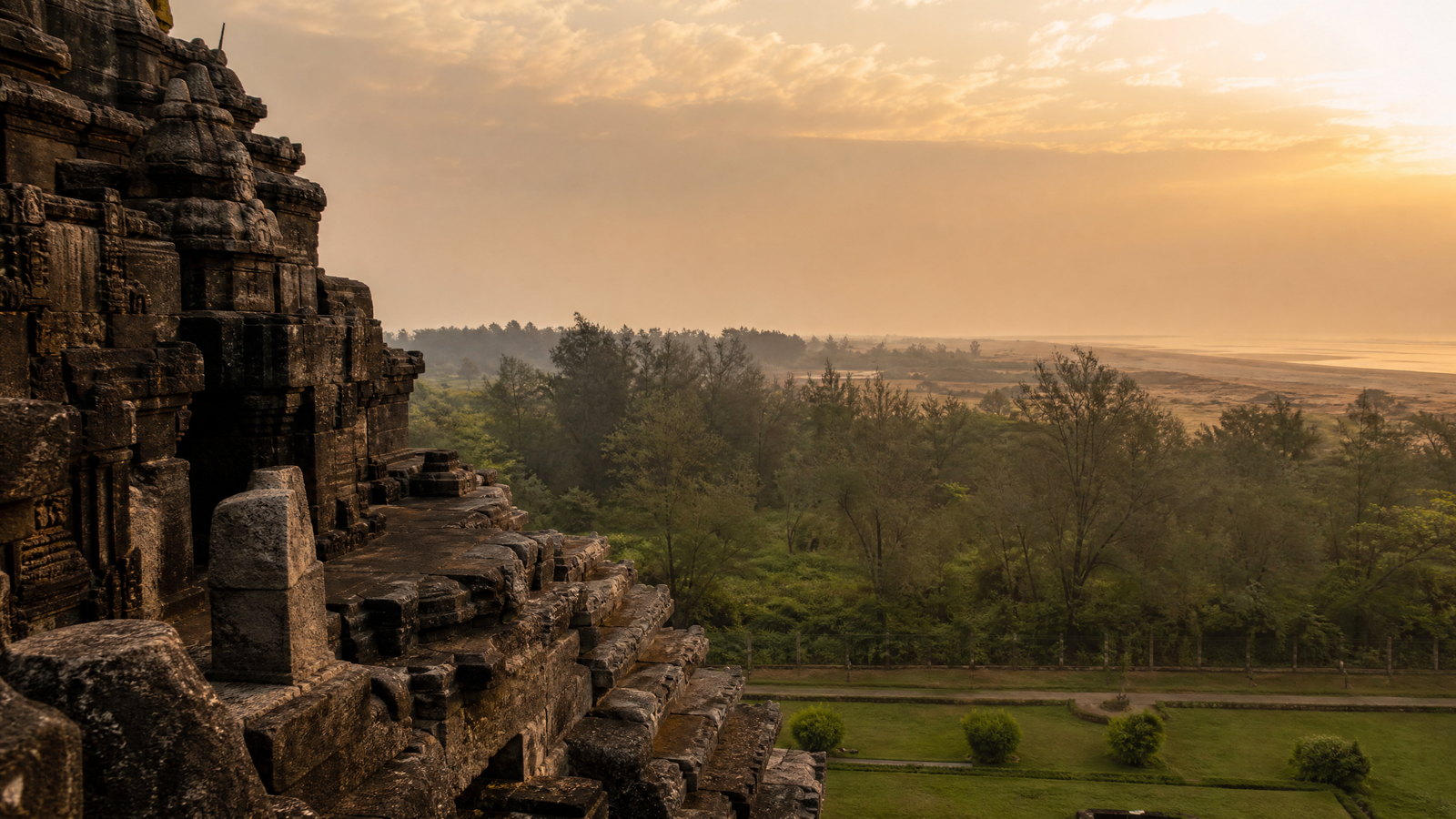
Konark Sun Temple is a thirteenth-century monument conceived as Surya’s colossal chariot on the Bay of Bengal coast. Its sculpted wheels, horses, terraces and narrative panels make the building one of the clearest and most ambitious expressions of Kalinga architecture. UNESCO identifies it as an exceptional testimony to the thirteenth-century kingdom of Orissa and notes the monument’s integration of architecture, sculpture, religious meaning and depictions of contemporary life. The surviving complex is not an intact temple in ordinary ritual use; it is a protected archaeological work whose scale and weathering are part of the encounter.
Why this place matters
Go for the concentrated visual force of carved stone and the chance to read a major Indian monument at close range. The twenty-four wheels and sculptural programme reward unhurried looking, whether or not you know temple iconography. Konark also provides a useful contrast with Puri: one is an active sacred city, the other a monument conserved for its historic and artistic value. The site is compact enough for a half day, but combine it with the coast, a museum or Puri rather than treating it as a hurried roadside stop. Light, heat and crowds materially affect the experience.
living craft village · Raghurajpur, Puri district
Raghurajpur Heritage Craft Village
Raghurajpur is a compact heritage craft village near Puri where many households are associated with Pattachitra, painted cloth narrative art. Odisha Tourism describes rows of artist homes and links the work closely to Jagannath imagery, palm-leaf engraving, masks, toys and related making. The village is also associated with Gotipua performance and with Guru Kelucharan Mohapatra, a leading figure in Odissi dance. Its significance lies in continuity: materials, iconography, performance and household work remain connected, rather than being separated into a museum display. A visit should foreground the artists’ time, consent and expertise.
Why this place matters
Go to see how a regional art practice exists within homes, workshops and ritual connections, and to buy directly from makers when invited. Pattachitra offers a vivid route into stories of Jagannath, Krishna and other mythic themes, while palm-leaf work and masks show different surfaces and techniques. The village adds real cultural texture to a Puri–Konark itinerary, particularly for travellers who prefer conversation and process over large monument sites. It is not a theme park: some homes may be busy, private or unavailable, and a respectful short visit can be more appropriate than a prolonged inspection.
brackish-water lagoon and Ramsar wetland · Satapada, Mangalajodi, Barkul and Rambha across Puri, Khordha and Ganjam districts
Chilika Lagoon
Chilika is a vast brackish-water lagoon on Odisha’s coast, spanning several districts and combining open water, islands, reedbeds, mudflats, fishing settlements and sea influence. It is a wetland of international importance and a major winter refuge for migratory birds. The lagoon also supports Irrawaddy dolphins, although wildlife viewing should never be assumed. Different edges offer distinct experiences: Satapada is associated with the lagoon–sea interface and dolphin viewing, Mangalajodi with birds and wetlands, and Barkul or Rambha with broader lagoon scenery. This is a lived ecological system, not an enclosed attraction.
Why this place matters
Go for a change of scale and pace after stone monuments: horizon, weather, bird calls and boat movement become the experience. Chilika can fit a coastal itinerary, but choosing one access point matters more than trying to cross the entire lagoon in a day. Bird-focused travellers should give themselves winter mornings and patience; others may prefer a scenic boat trip from a suitable local base. The central trade-off is ecological sensitivity. Boats, noise and crowding can disturb wildlife, while rain, wind and marine alerts can cancel or reshape a day without warning.
mangrove national park and estuarine wetland · Kendrapara district
Bhitarkanika National Park
Bhitarkanika is a tidal mangrove landscape of creeks, canals and river mouths supplied by the Brahmani, Baitarani, Dhamra and Patasala systems. Odisha Tourism identifies it as India’s second-largest mangrove ecosystem after the Sundarbans and notes its nationally important saltwater crocodile concentration. The experience is defined by water: mangrove roots, tidal channels, birdlife, reptiles and low, humid horizons rather than broad forest roads. Migratory birds add a seasonal layer, while the former royal hunting lodge provides a reminder of the area’s human history. It is best understood as a sensitive estuarine ecosystem with managed visitor movement.
Why this place matters
Go for a distinctive coastal wetland encounter that is very different from an open beach or inland tiger reserve. A carefully managed boat journey can reveal mangrove structure, kingfishers, heronry activity and the realities of a crocodile habitat. Winter adds birding interest, but the appeal is not dependent on a wildlife checklist; tides, creeks and dense vegetation are the durable draw. Bhitarkanika requires more logistical attention than Puri or Konark, and boat access can be constrained by weather, water level, safety procedures and conservation decisions. Build in flexibility and avoid attempting a rushed return journey.
tiger reserve and forest landscape · Mayurbhanj district
Similipal Tiger Reserve
Similipal is a large protected forest landscape in northern Odisha, associated with sal and other moist-deciduous vegetation, rivers, orchids, waterfalls and wide-ranging wildlife. The reserve is named for the red silk-cotton trees found there, and Odisha Tourism records an area of roughly 2,750 square kilometres. Joranda and Barehipani waterfalls give the terrain a strong vertical character, while the reserve is notable for tigers, elephants and many other species. Its value is ecological rather than performative: forest health, habitat protection and the daily conditions of a managed reserve take priority over visitor expectations.
Why this place matters
Go if you want a multi-layered forest setting where waterfall country, birdlife, plant diversity and long spans of sal forest matter as much as the possibility of large mammals. Similipal is one of the state’s major wilderness experiences and contrasts sharply with coastal mangroves or temple cities. The trade-off is that it is not a spontaneous drive-through attraction. Entry, stays, vehicles, permitted activities and seasonal opening are controlled, and wildlife visibility is inherently uncertain. Travellers who can accept slow observation and a conservation-first schedule will gain more than those focused on a single animal sighting.
archaeological and monastic landscape · Assia hill range, Cuttack and Jajpur districts
Buddhist Triangle: Lalitgiri, Udayagiri and Ratnagiri
Lalitgiri, Udayagiri and Ratnagiri form an interconnected archaeological landscape in the Assia hills, set within the Brahmani–Birupa river system. The three complexes record more than a millennium of Buddhist thought, monastic life, art and architecture. Lalitgiri preserves early and later Buddhist phases, Udayagiri includes major excavated monasteries and stupas, and Ratnagiri became a major Vajrayana centre. The group has been placed on India’s tentative World Heritage list as a serial nomination, a status distinct from full inscription. These are archaeological sites with site museums and excavated remains, not working pilgrimage centres on the scale of Puri.
Why this place matters
Go to place Odisha within wider Buddhist histories and to see how hills, rivers, monasteries, sculptural programmes and evolving ideas formed one regional network. Visiting all three gives more meaning than selecting a single ruin: the narrative moves from early practice through Mahayana and Vajrayana traditions. Ratnagiri’s monumental gateway and monastery remains are particularly memorable, but the quieter landscape setting across the group is equally important. The sites suit travellers who enjoy archaeology, close looking and historical sequence. They require an unhurried road day or overnight plan, especially when paired with Bhitarkanika or Cuttack.
river gorge and tiger reserve landscape · Tikarpada, Angul district
Satkosia Gorge and Tikarpada
At Satkosia, the Mahanadi passes through a gorge of roughly 22 kilometres, creating one of Odisha’s most powerful river landscapes. Tikarpada is a principal access area for the Satkosia Tiger Reserve, which combines forested slopes, riverbank habitat, birdlife and managed nature stays. Odisha Tourism records the reserve at 963.87 square kilometres and describes the gorge as part of a historically extensive forest range. The draw is topographic: a broad river enclosed by hills, shifting light, forest edges and a scale that differs from both Chilika and Bhitarkanika. Wildlife is present but should not be treated as guaranteed spectacle.
Why this place matters
Go for the Mahanadi itself and for a quieter, more interior landscape where river, gorge and forest make a coherent whole. Satkosia can suit travellers who want low-key birding, guided nature activity and time away from the coast. It also offers a useful middle ground for visitors who do not want the long transfers of Similipal or Koraput. Conditions remain variable: boat use, trails and stays depend on management, weather and river conditions. Plan the destination as an overnight experience; trying to force it into a long day trip reduces time in the landscape and increases transfer risk.
Eastern Ghats highland and peak landscape · Koraput district
Deomali
Deomali, in Koraput district, is Odisha’s highest peak at 1,672 metres and one of the state’s clearest Eastern Ghats landscapes. Rolling hills, valleys, gorges, meadows and forest frame a highland environment very unlike the humid coast. Roads approach the peak area from the Koraput–Semiliguda side, and the destination is often used for dawn, landscape viewing and short outdoor activity. It also lies in a culturally diverse region where Paraja, Kondh, Bonda and other communities have distinct identities. The mountains should be appreciated without turning nearby communities or risky weather into a spectacle.
Why this place matters
Go for a genuine geographic reset: cooler-feeling air, broad views and steep relief offer a different Odisha from temples, lagoons and mangroves. Deomali works most effectively as part of a Koraput stay, with time for local landscapes and not just a summit dash. Photographers and walkers will value the shifting light and cloud, while travellers interested in the southwest can use it to understand the state’s upland scale. The trade-off is remoteness. Road quality, fog, rain, services and mobile signal may change rapidly, and the exposed crest can become unsuitable in poor weather.
historic coastal town and beach · Gopalpur, Ganjam district
Gopalpur-on-Sea
Gopalpur-on-Sea is a south Odisha beach town with a history as a port of ancient Kalinga and later as a military and commercial coastal stop. Casuarina-lined sand, old structures and a less urban shoreline create a reflective alternative to Puri’s religious intensity. The town’s coastal identity is shaped by working fishing life and weather as much as by leisure. Odisha Tourism specifically cautions that the sea can be too rough for swimming, an important distinction from a generic beach visit. Gopalpur is strongest for walks, sea views, heritage atmosphere and unhurried time rather than water-based recreation.
Why this place matters
Go when you want a quieter coastal pause and a view of Odisha’s maritime past without the density of Puri. A walk through older streets and along the shore can reveal traces of the town’s port-era connections, while early mornings show the shoreline’s working rhythms. It pairs well with the southern edge of Chilika or a longer route toward Ganjam and the southwest. The central trade-off is safety and seasonality: surf can be hazardous, cyclonic conditions can transform the coast, and beach infrastructure should never be assumed. Treat the sea as scenery unless current local safety guidance says otherwise.
Season and pace
Choose a date window for the experience, then keep a fallback.
December–February is usually the best mixed-itinerary window: cooler weather, strong Chilika birding and more comfortable forest visits. March–May brings serious heat and humidity across the plains; start early and protect against sun exposure. June–September monsoon makes hills and waterfalls lush but can mean slippery paths, flooding, rough sea and reserve restrictions. October–November can be rewarding but coastal systems remain disruptive. Wildlife is never assured. Reconfirm district forecasts, marine conditions, reserve opening status and local advisories before travel.
Movement and planning
Distance on a map is not the same as usable travel time.
Moving through the region
Bhubaneswar is the strongest air, rail and road hub; Puri, Cuttack and coastal towns are well linked. The Bhubaneswar–Puri–Konark arc is the simplest heritage segment. Beyond it, allocate separate transfer blocks for Bhitarkanika, Similipal, Satkosia and Koraput, where boats, gates or local connections can determine arrival. Carry water, cash and offline directions outside major centres; signal and card acceptance can be uneven. Step-free access varies greatly at old temples, village lanes, forest ground and boat embarkations.
Building a workable route
Anchor two or three nights in Bhubaneswar, Puri or Konark, then add a nature stay rather than changing lodging daily. A seven-day route can include Bhubaneswar, Cuttack, Puri, Konark, Raghurajpur and Chilika; add two or three nights for one reserve. Deomali deserves a dedicated Koraput extension. Carry reusable water, sun and rain protection, suitable footwear and identification. Confirm access rules, religious dates, local transport, boat conditions and photography restrictions shortly before setting out through the relevant official or local channel.
Travel responsibly
The regional context includes its limits.
Natural and sacred sites are working environments, not backdrops. Keep distance from dolphins, crocodiles, birds and all wildlife; never feed or pursue animals. Use authorised boats, follow crew instructions and respect forest gates, guides and closures. Monsoon waterfalls, rough surf and flood-prone roads call for conservative decisions. At shrines, follow dress, queue, photography and access rules. Ask before photographing artists or communities, buy respectfully when invited, reduce plastic and take waste back from remote places. Check fresh weather and authority notices before every coastal, boat, hill or forest day.
This is an evergreen regional guide. Weather, permits, closures, transport and local rules can change; confirm material conditions through the relevant local or official channel before travel.