Central India · State · MP
Madhya Pradesh
Madhya Pradesh is India’s large landlocked central state, where sandstone temples, medieval plateau capitals, river pilgrimage corridors and protected forests form very different travel worlds. Bhopal, the lake-ringed capital, anchors a central cluster with Sanchi and Bhimbetka. North-east, Khajuraho, Orchha and Chanderi invite close attention to temple sculpture, Bundela architecture and handloom practice. West and south-west, Mandu, Maheshwar, Omkareshwar and Ujjain connect Malwa’s built heritage with the Narmada and Shipra’s sacred landscapes. Kanha and Satpura offer forests rather than promised wildlife sightings. This is a state for linking a few coherent areas, not racing between every headline. Heat, rain, festival crowds and regulated access materially affect the experience, so leave transfer buffers and confirm changing details locally before travel. Choose one heritage route, or add one reserve with enough nights near its gateway. Stone monuments, active temples, craft households and protected forests each require a different pace and a willingness to let local conditions set the day.
Regional notebook
Begin with the shape of the region.
Madhya Pradesh works best as several connected regions, not one rapid circuit. Bhopal, Sanchi and Bhimbetka form a central archaeology-and-city cluster. Khajuraho, Orchha and Chanderi offer a Bundelkhand route of temples, palaces, stepwells and weaving. Mandu, Maheshwar, Omkareshwar and Ujjain make a strong western and Narmada itinerary. Kanha and Satpura need dedicated forest time. Bhopal is a useful arrival point, but it does not stand in for the state’s diversity. Choose one heritage route, or add one reserve with enough nights near its gateway. Stone monuments, active temples, craft households and protected forests each require a different pace and a willingness to let local conditions set the day.
Landscape
Geography changes the journey.
This interior state has no coast or international frontier. The western Malwa Plateau, Vindhyan escarpments, central plateaus, Satpura hills and Maikal ranges create markedly different travel terrain. Mandu stands high on the Vindhyas; Bhimbetka lies among sandstone outcrops at the plateau’s southern edge; Kanha occupies Maikal country. Rivers organise both terrain and culture: the Narmada anchors Maheshwar and Omkareshwar, the Shipra shapes Ujjain, and the Betwa frames Orchha. Bhopal’s character is inseparable from its lakes. There are no Himalayan altitudes, but forest roads, river steps, wet stone and hill paths need practical footing. Treat viewpoints, ghats and protected areas as managed places rather than open terrain.
Living culture
Arrive as a guest, not an audience.
Madhya Pradesh holds many cultural layers. Sanchi preserves Buddhist art and architecture; Bhimbetka connects rock art with a cultural landscape; Khajuraho brings Hindu and Jain temple traditions together. Mandu’s Sultanate-period forms, Orchha’s Bundela palaces and Bhopal’s Begums-era history show contrasting political and architectural legacies. Ujjain and Omkareshwar are living pilgrimage towns, where worship comes before sightseeing. Maheshwar and Chanderi handlooms depend on skilled makers, time and material knowledge. Adivasi communities and traditions are fundamental, especially in forested districts; never treat people or ceremonies as displays. Hindi is widely used, alongside Malvi, Bundeli, Bagheli, Nimadi, Gondi, Bhili and other regional speech. Ask before photographs and listen before assuming access.
Curated regional atlas
Places that reveal different parts of Madhya Pradesh
This is a selective, geographically varied starting point rather than an exhaustive list. Use it to choose a coherent route, not to compress every place into one trip.
capital city and urban wetland landscape · Bhopal district, central Madhya Pradesh
Bhopal
Bhopal is Madhya Pradesh’s capital, shaped by Upper and Lower Lakes, old-city lanes and newer districts. Its history includes more than a century of rule by the Begums, whose public works and patronage remain part of the city’s story. Lake-facing museums add context for the state’s communities and material cultures, while mosques, markets and civic institutions reveal a layered urban life. Bhopal is also the practical base for Sanchi and Bhimbetka, so it works best as more than a transit stop. Approach it through water, museums and public history rather than a rushed landmark list.
Why this place matters
Choose Bhopal to ground an itinerary before moving into archaeological or forest landscapes. The lake setting softens a stone-heavy heritage route, and museums offer useful context before Sanchi or Bhimbetka. It suits travellers who prefer a connected city base or want central excursions without changing rooms. The trade-off is urban pace: old-city lanes, traffic and busy religious precincts reward early, patient exploration. It is especially rewarding for visitors who see water infrastructure, civic history and contemporary city life as part of travel, rather than simply logistics between more famous sites.
Buddhist archaeological and pilgrimage site · Raisen district, near Vidisha
Sanchi
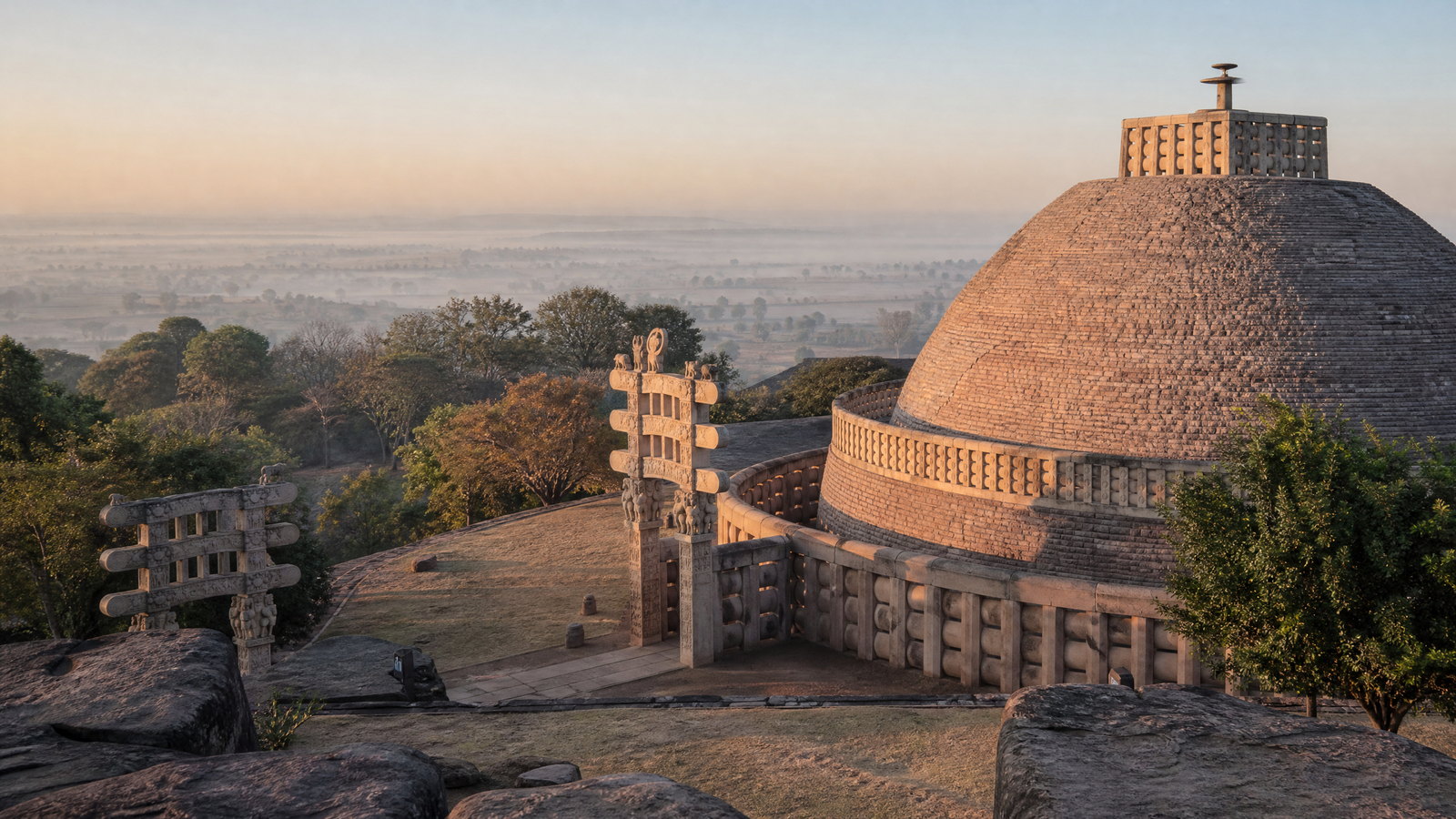
Sanchi is a hilltop ensemble of stupas, temples, monasteries and a pillar that documents Buddhist art and architecture across many centuries. Its Great Stupa and carved gateways are not isolated sculptures: the broader site shows how a sacred centre evolved from the Mauryan period through later dynasties. Reliefs use symbols and narrative scenes with remarkable economy, rewarding slow looking. The open plateau setting and continuing Buddhist reverence give the complex both spatial and living dimensions. Near Bhopal, Sanchi is essential for visitors interested in early religious architecture, archaeology and the movement of artistic ideas.
Why this place matters
Go to Sanchi for an unusually clear encounter with early Buddhist monumental form and visual storytelling. Gateways, railings, stupas and monastic remains let visitors compare ritual movement, structure and image-making in one compact landscape. It pairs well with Bhopal’s museums, which supply wider cultural context. The hill asks for walking and open-path sun tolerance, so cooler hours are best. Sanchi is a fine alternative to dense temple towns for travellers seeking a quieter archaeological setting. Respect its continuing pilgrimage importance and the restrictions that protect stone surfaces and the surrounding landscape.
prehistoric rock-art cultural landscape · Raisen district, south-east of Bhopal
Bhimbetka Rock Shelters
Bhimbetka lies among sandstone outcrops in the Vindhyan foothills, where natural shelters preserve paintings from the Mesolithic through historical periods. The experience is as much landscape as image: rocks, forest and shelter arrangement explain why it is recognised as a cultural landscape. Human and animal figures, hunts and other scenes record long visual traditions, while nearby communities retain connections that echo some represented themes. Only a managed portion is suitable for visitors, protecting fragile painted surfaces. Bhimbetka complements Sanchi by tracing a much longer relationship between people, stone, shelter and image.
Why this place matters
Visit Bhimbetka to meet prehistory in its environmental setting, not behind glass. The boulder formations remain compelling even when paintings are faint, and the visit rewards attention to scale, superimposed marks and forest context. It is a realistic excursion from Bhopal, but deserves enough time to avoid becoming a drive-by stop. Heat, rain and uneven ground are practical factors; choose footwear with grip and carry water. Accept that some shelters or views may be unavailable to protect the art. That restraint is part of what makes the visit responsible and meaningful.
medieval Hindu and Jain temple ensemble · Chhatarpur district, Bundelkhand
Khajuraho Group of Monuments
Khajuraho’s surviving temples are a concentrated expression of Chandella-period Nagara architecture and sculpture. Built largely in the tenth and eleventh centuries, the ensemble has western, eastern and southern clusters and includes Hindu and Jain monuments. Towers, elevated platforms and linked interiors form a sophisticated architectural language, while sculpted surfaces range far beyond the few erotic scenes for which the site is often reduced. Deities, musicians, dancers, domestic activity and sacred imagery create dense visual worlds. Khajuraho is not one temple photograph but a place to compare plans, stone craft, religious traditions and the moods of three distinct clusters.
Why this place matters
Go to Khajuraho for northern India’s most accomplished temple architecture and to move beyond a narrow reading of its sculpture. Time across more than one cluster reveals the balance of engineering, ritual space, ornament and narrative. It is a strong Bundelkhand base that can continue to Orchha, though a same-day dash is unwise. The complex is exposed, so early and late light improve comfort and observation. Notice the vertical rhythm of shikharas, sandstone platforms and coexistence of Hindu and Jain traditions. Respect barriers and remember that conservation includes the monuments’ setting as well as their carvings.
Bundela heritage town and pilgrimage landscape · Niwari district, Bundelkhand
Orchha
Orchha is a sixteenth-century Bundela foundation on a river corridor, where palaces, temples and cenotaphs create a distinctive skyline. Raja Mahal and Jahangir Mahal hold painted rooms and layered courts; Chaturbhuj Temple adds a monumental vertical counterpoint. Along the water, royal chhatris create a ceremonial silhouette. Orchha is also an active devotional place, especially at Ram Raja Temple, where Lord Rama is honoured as king. Protected architecture and living worship coexist here. The compact town rewards unhurried walking, yet its river, stairs, courtyards and monument groups make a full day more useful than a quick rail-connection stop.
Why this place matters
Choose Orchha for a small town that concentrates palace architecture, painted interiors, ritual life and river landscape. It is an intimate complement to Khajuraho and a fine choice for travellers interested in Bundela history. Give the palace complex and chhatris time, then let temple movement set its own pace. Uneven surfaces and worship crowds are the trade-offs, especially on major dates. The river is attractive in rains, but conditions are not automatically suitable for every activity. Ask locally about water conditions and respect all temple guidance before entering or photographing. A second night makes the heritage setting feel less compressed.
heritage town and handloom landscape · Ashoknagar district, northern Madhya Pradesh
Chanderi
Chanderi combines a hilltop fort, gates, mosques, stepwells, Jain heritage and a still-working handloom identity. Its monuments reflect a long strategic and cultural history: the fort rises above town, Badal Mahal Gate forms a memorable threshold, and baolis recall older water systems. Fabric is equally central to the present. Chanderi textiles emerge from skilled households and craft spaces that shape everyday life, while nearby Pranpur extends the relationship between village and loom. The town is most rewarding when architecture and textile practice are seen together, not when weaving is treated as anonymous souvenir production.
Why this place matters
Go to Chanderi to connect architecture with a living craft ecology. The contrast between a high fort, monumental gateways, Jain sites and fine handloom work makes it different from a temple-only destination. It is a good pause on a Bundelkhand route for visitors who want to understand how cloth is made, not merely buy it. Dispersed attractions and limited last-mile movement make an extra night helpful. Winter is easier for lanes and fort walks. In workshops and homes, ask before entering, touching textiles, recording looms or taking photographs; concentration and time are part of the craft’s value.
medieval fortified plateau city · Dhar district, Malwa
Mandu
Mandu spreads across a Vindhyan plateau as a fortified medieval landscape of gateways, lakes, mosques, tombs, audience halls and pavilions. It is a city-scale system, not a handful of isolated ruins. Jahaz Mahal appears to float between artificial lakes; Jami Masjid and Hoshang Shah’s Tomb show Sultanate-period ambition; Hindola Mahal and Roopmati Pavilion direct attention to terrain. Afghan-influenced forms and water-conscious planning belong to the escarpment setting. Monsoon mist and green valleys create one mood, while dry season brings architectural clarity. Allow enough time for the dispersed precincts to reveal their relationships.
Why this place matters
Mandu suits travellers who want ruins with topography, weather and water built into the story. Broad arches, tombs, mosques, reservoirs and gateways stretch over a plateau, unlike compact Bundelkhand towns. Its scale makes a vehicle or careful local transport useful, and it deserves more than a few hours from Indore. Visit in cooler weather for walking or in rain for landscape drama, accepting wet surfaces and changing visibility. Romantic stories are only one thread of a larger urban history. Stay on managed paths and treat weathered masonry, water edges and elevated pavilions carefully.
Narmada river town and handloom centre · Khargone district, Nimar
Maheshwar
Maheshwar rises above the Narmada, where stone ghats, temples and the Ahilyabai fort-and-palace complex shape a continuous riverfront. The town is closely associated with Ahilyabai Holkar, whose eighteenth-century rule made it an important political and cultural centre. Its living identity also rests on Maheshwari textiles, produced through skilled local weaving traditions. Daily worship, bathing and evening life make the ghats active civic-sacred space rather than scenery. Maheshwar brings fort architecture, pilgrimage, river ecology and craft together in a compact setting. Its slower rhythm suits a morning of monuments and an evening watching the changing riverfront.
Why this place matters
Choose Maheshwar for a Narmada experience that combines historic riverfront, craft and worship. The ghats place water at the centre of the visit, while the fort and temples make a strong architectural frame. It is a human-scale contrast to Mandu’s plateau monuments. Climate is the main trade-off: even winter sun can be sharp, and river steps are not uniformly accessible. Slow down, ask before photographing worship or looms, and learn why a textile’s making matters. It can pair with Omkareshwar, but separate overnight stops prevent both towns becoming rushed checklists.
Narmada island pilgrimage town · Khandwa district, Nimar
Omkareshwar
Omkareshwar is a major Hindu pilgrimage town on the Narmada, centred on an island associated with the sacred syllable Om and the Omkareshwar Jyotirlinga. River, island paths, bridges, ghats and temples make geography part of devotion. The main shrine is joined by Mamleshwar on the mainland and older temple structures that broaden the architectural story. Pilgrim movement, aarti and ritual bathing determine the pace more than a conventional sightseeing schedule. Omkareshwar works from Indore or with Maheshwar, but is best visited as an active sacred landscape where worship, queues and local directions take precedence over a rigid itinerary.
Why this place matters
Visit Omkareshwar for concentrated river pilgrimage and temple-town geography. Crossings, ghats and paths frame the Narmada rather than merely delivering a temple interior. It contrasts well with Maheshwar’s craft-led riverfront and Ujjain’s larger sacred urbanism. Leave margin for crowds, security controls and worship timings, particularly in devotional periods. Heat is strong on exposed approaches and wet steps need care in rain. Travellers who value living practice will find more than visitors seeking silent ruins. Follow temple staff directions and choose only permitted river-edge activities.
historic pilgrimage city · Ujjain district, Malwa
Ujjain
Ujjain is an ancient city on the Shipra whose identity is shaped by temple worship, pilgrimage, astronomy and festival movement. Mahakaleshwar anchors the sacred core, while Ram Ghat, Harsiddhi, Kal Bhairav and other shrines extend a dense ritual map. The eighteenth-century observatory adds an intellectual dimension through architectural instruments for celestial observation. Ujjain periodically hosts Simhastha, an immense river-centred gathering that changes city scale and logistics. Its temple streets are active, not museum-like: sound, offerings, security and crowd flow belong to the experience. Visit as a living pilgrimage city with modest dress, patience and adaptable timing.
Why this place matters
Go to Ujjain to understand sacred urbanism at full intensity. A visit can move from a major Shiva temple to measured astronomical instruments and daily ritual along the Shipra. It shifts a Malwa route from Mandu’s historic ruins and Maheshwar’s river craft to a dense city of worship. Crowding is the key trade-off: important dates, Mondays and festival seasons affect entry, traffic and even short distances. Avoid a tightly timed temple circuit. Select a few sites, leave room for queues and observe local practice. Respectful conduct directly improves the experience for both pilgrims and residents.
tiger reserve and forest landscape · Mandla and Balaghat districts, Maikal ranges
Kanha Tiger Reserve
Kanha Tiger Reserve is a protected forest landscape in the Maikal ranges, known for central Indian habitats and a long conservation history. Its identity is broader than one species: forest, meadows, water and prey habitat create the ecological setting, while hard-ground barasingha conservation is a defining achievement. Visits occur through regulated routes and set activity times, not open exploration. This is a place to notice forest processes—birds, ungulates, tracks, vegetation and sound—as much as large mammals. Kanha requires a gateway stay and patient itinerary. Its distance from western heritage areas makes it best treated as a destination in its own right.
Why this place matters
Choose Kanha if a structured forest experience and conservation context matter more than a guaranteed animal list. Maikal forests and grasslands make a visual contrast with temples and river towns, while barasingha recovery adds depth beyond tiger interest. Two or more nights allow room for weather, changing light and drives without headline sightings. Expect early starts, vehicle-based viewing and rules that prioritise habitat. Seasonal operations, routes and conditions can change. Treat the reserve as a protected home, not a performance: keep expectations realistic, follow staff directions and value every observation, from a bird call to a meadow’s changing grass.
tiger reserve and biosphere landscape · Narmadapuram district, Satpura ranges
Satpura Tiger Reserve
Satpura Tiger Reserve is a large protected landscape in the Satpura range, a watershed between the Narmada and Tapti systems. Terrain and vegetation drive the experience: sal occurs on plateau country, teak on lower plains, and hills, forests and water create a complex natural setting. It forms part of Madhya Pradesh’s first biosphere reserve and is managed with habitat before visitor convenience. The reserve holds rich flora and fauna, but no visit should promise a particular encounter. Satpura suits travellers able to slow down, listen to interpretation and accept regulated access as an essential conservation tool.
Why this place matters
Visit Satpura for hills, watershed geography and habitat diversity as much as animal watching. It is a strong nature counterpoint to Bhopal and works with the central cluster only when transfer time is realistic. Travellers who enjoy natural history, birdlife, vegetation and quiet will get more from it than visitors pursuing a single sighting. Terrain, heat and rain call for practical clothing, hydration and honest mobility expectations. Formats and access can change by season or management decision, so build flexibility into the plan. Leave no food, litter or noise behind, and let reserve staff set the pace.
Season and pace
Choose a date window for the experience, then keep a fallback.
October–March is the broadest comfortable window for monuments, towns and road journeys, though open stone and riverfronts still need sun protection. April–June demands a heat-first plan: early starts, water, shade and little midday walking. The monsoon, broadly June or July to September, turns Mandu, forest edges and reservoirs green, but also brings wet steps, reduced visibility, runoff and possible local disruption. Park operations and activities can follow seasonal schedules. Pilgrimage calendars can make Ujjain and Omkareshwar exceptionally crowded regardless of weather. Check the current forecast, warnings, site hours, reserve status and festival arrangements shortly before travel. A seasonal label is guidance, never a guarantee of access or conditions.
Movement and planning
Distance on a map is not the same as usable travel time.
Moving through the region
Bhopal, Indore, Jabalpur, Gwalior and Ujjain are major rail or air anchors; many heritage towns and reserve gateways still need road travel. Khajuraho has air and rail links, while Mandu, Maheshwar, Omkareshwar and Chanderi require onward ground legs. A locally arranged vehicle adds flexibility for multi-stop routes, but does not remove weather, works or traffic delays. Do not plan by kilometres alone: old-city lanes, monsoon surfaces, hill gradients and worship stops lengthen travel. Keep Bhopal–Sanchi–Bhimbetka together, Khajuraho–Orchha–Chanderi together, and Mandu–Maheshwar–Omkareshwar–Ujjain together. Reserves have separate gates and activity windows. Confirm current timings, last-mile transport and road conditions through the relevant local or official channel.
Building a workable route
Depth beats coverage. In five to seven days, pair Bhopal, Sanchi and Bhimbetka with one extension. In eight to twelve days, take either the western route through Mandu, Maheshwar, Omkareshwar and Ujjain or the Bundelkhand route through Khajuraho, Orchha and Chanderi. Add a reserve only with at least two nights close to its gateway. At monuments, work in cooler light and leave time for interpretation; at temple towns, plan around worship and queues. Ask early about accessibility: museums and promenades can be easier than ruins, ghats, uneven stairs and forest vehicles. Carry water and medicines, keep essential confirmations available offline, and reconfirm changing hours, weather warnings, ceremonies and entry procedures through the relevant local or official channel.
Travel responsibly
The regional context includes its limits.
Stay on marked paths at Bhimbetka and protected monuments; never touch paintings, carvings or fragile masonry. In temples, follow footwear, dress and photography rules, and give worshippers room. Keep soap, waste and drones away from rivers and ghats. In forests, follow guides and vehicle rules, keep distance, stay quiet and never feed wildlife; sightings are never assured. Reduce single-use plastic and use bins where collection exists. Ask before photographing people, homes, looms, ceremonies or children, and do not stage images of Adivasi life. Craft purchases should respect makers’ time and process. Access can change with weather, conservation decisions and religious events; confirm current details locally and accept restrictions as part of caring for the place.
This is an evergreen regional guide. Weather, permits, closures, transport and local rules can change; confirm material conditions through the relevant local or official channel before travel.