North India · State · HR
Haryana
Haryana is a varied North Indian state where the Delhi metropolitan edge, irrigated plains, old battle corridors, Shivalik foothills, Aravalli scrub and bird-rich wetlands meet. Its shared capital, Chandigarh, sits outside the state as a Union Territory, while Gurugram, Faridabad, Panchkula, Kurukshetra, Panipat, Hisar and Rewari reveal different travel rhythms. It suits travellers who value cultural landscapes over a single landmark: Harappan mounds at Rakhigarhi, Sultanate architecture in Hisar and Narnaul, Kurukshetra’s sacred geography, Pinjore’s Mughal-style gardens, and winter waterbird habitat near Delhi. The essential trade-off is seasonal and spatial. Winter supports wetland watching and outdoor days; late monsoon freshens the hills but can complicate roads; summer heat narrows daytime exploration. Build an itinerary around one corridor rather than treating the state as a quick detour, and let sacred sites, museums and protected areas set the pace.
Regional notebook
Begin with the shape of the region.
Haryana rewards a corridor-based visit rather than a checklist. The northern Panchkula–Yamunanagar arc brings Shivalik slopes, gardens and forest; the central Kurukshetra–Panipat line holds pilgrimage, museum interpretation and battle memory; the south and west combine National Capital Region cities, Aravalli-fringe landscapes, rail heritage, Sultanate remains and archaeological mounds. Wetlands near Gurugram and Jhajjar provide a quiet ecological counterpoint.
Chandigarh is Haryana’s shared capital with Punjab and is itself a Union Territory, so it functions as a northern gateway rather than a Haryana district. Leave time for sacred-waterfront walks, museums and dawn nature observation; the state’s depth is in those overlapping systems, not a single landmark.
Landscape
Geography changes the journey.
Terrain changes sharply from northeast to southwest. Shivalik foothills rise around Panchkula and Yamunanagar, where Kalesar has moist deciduous Sal forest. The east includes Yamuna-side floodplain environments, central districts are mostly fertile plains, and older Aravalli hills and scrub edge the south. Western tracts grow sandier and semi-arid.
A single weather expectation is misleading. Morni is cooler than the plains, while Hisar, Panipat and the southern urban corridor can be intensely hot. Wetland levels, forest access and visibility are seasonal. There is no coast or high-altitude Himalayan terrain, but hills, exposed plains and wildlife habitat still set real boundaries.
Living culture
Arrive as a guest, not an audience.
Agriculture, road connectivity and a long history as a northern gateway shape Haryana. Kurukshetra is a living Hindu pilgrimage landscape associated with the Mahabharata and Bhagavad Gita; Panipat preserves a separate early-modern battle memory. Rakhigarhi, Hisar, Narnaul and Ballabhgarh add Harappan, Sultanate and later layers.
Hindi is the main working language, Haryanvi is widely spoken, Punjabi is common in parts of the state, and English is useful in cities. At shrines, sarovars and dargahs, dress and behave respectfully. Fairs can be rewarding but crowded; reconfirm dates, entry arrangements and programming before travel.
Curated regional atlas
Places that reveal different parts of Haryana
This is a selective, geographically varied starting point rather than an exhaustive list. Use it to choose a coherent route, not to compress every place into one trip.
Hill landscape and lakes · Morni, Panchkula district
Morni and Tikkar Tal
Morni is Haryana’s only hill station, set in the lower Shivalik range above the plains. The area combines wooded slopes, broad valley views and the paired lakes known as Tikkar Tal. The lakes are separated by a hillock yet are locally noted for sharing the same water level. A small lakeside shrine, older fort remains and a landscape of pine and mixed trees give the visit cultural as well as scenic texture. At roughly 1,100 metres, Morni is a notably cooler change from nearby lowland cities, though it is not high-altitude terrain. It is best approached as a slow hill-and-water landscape rather than a rapid adventure stop.
Why this place matters
Go for Haryana’s clearest foothill contrast: soft Shivalik ridges, lakes and forest-edge birdlife within reach of the Chandigarh–Panchkula gateway. Morni works well when paired with Pinjore, especially for travellers who want gentle scenery between heritage visits. It also gives value in the rainy and post-rain months, when slopes are greener, while autumn and winter can be more comfortable for walking and views. The experience is more about atmosphere than landmark density. Early mornings reward patient observation, and the village-and-lake setting offers an antidote to the state’s busier highway corridors without requiring technical mountain travel.
Historic garden complex · Pinjore, Panchkula district
Pinjore (Yadavindra) Gardens
Pinjore’s Yadavindra Gardens are a seventeenth-century Mughal-style garden complex at the foot of the lower Shivaliks. Their terraced geometry, water features, pavilions and long axial views make them one of Haryana’s most legible examples of designed historic landscape. The state archaeology inventory also identifies the nearby Bhima Devi temple remains at Pinjore, adding an older sacred-architecture layer to the town. The gardens are not wilderness: they are a formal public space whose charm depends on changing light, planting and patient walking. Their location makes them a natural transition between the Chandigarh–Panchkula urban edge and the foothills toward Morni.
Why this place matters
Go to read architecture through landscape. Pinjore offers a measured alternative to crowded city sightseeing: the descent through terraces makes the garden’s planning easy to understand, while the Shivalik backdrop prevents it from feeling sealed off from the region. It is especially suitable for families, architecture-minded visitors and travellers needing a relatively gentle outdoor stop before hill roads. Pair it with Morni for a north Haryana nature-and-design day, or visit in the cooler months for more comfortable strolling. Seasonal horticulture and occasional public events can alter the visual experience, so the garden is worth revisiting rather than treating as static scenery.
Pilgrimage landscape and historic town · Thanesar and Kurukshetra district
Kurukshetra Sacred Landscape
Kurukshetra is a living pilgrimage landscape rather than one isolated monument. Hindu tradition associates this wider region with the Mahabharata and the delivery of the Bhagavad Gita. In Thanesar, Brahma Sarovar’s broad ceremonial waterfront anchors a cluster that includes temples, museums and interpretive sites; Jyotisar is another major devotional focus in the wider circuit. The appeal lies in observing how sacred water, public gathering, ritual practice and historical interpretation coexist. Haryana’s tourism framing of the region as a 48-kos cultural landscape is useful, but visitors should not expect every associated place to be physically close or identical in atmosphere. Allow the sacred setting to guide the pace.
Why this place matters
Go for a direct encounter with north Indian pilgrimage as lived landscape. Kurukshetra offers a richer experience than a brief photograph at a tank: walk the waterfront early, visit a museum or interpretive space, and notice the flow between ritual, local commerce and civic space. It can anchor a central Haryana itinerary with Panipat, while offering a quieter counterweight to major urban centres. Cooler months suit unhurried exploration, but major religious occasions may bring vivid ceremonies alongside crowding and traffic constraints. Travellers interested in Hindu traditions should come with curiosity and restraint; those interested in history can use the town as a base for a layered rather than purely devotional visit.
Ramsar wetland and national park · Sultanpur, Gurugram district
Sultanpur National Park
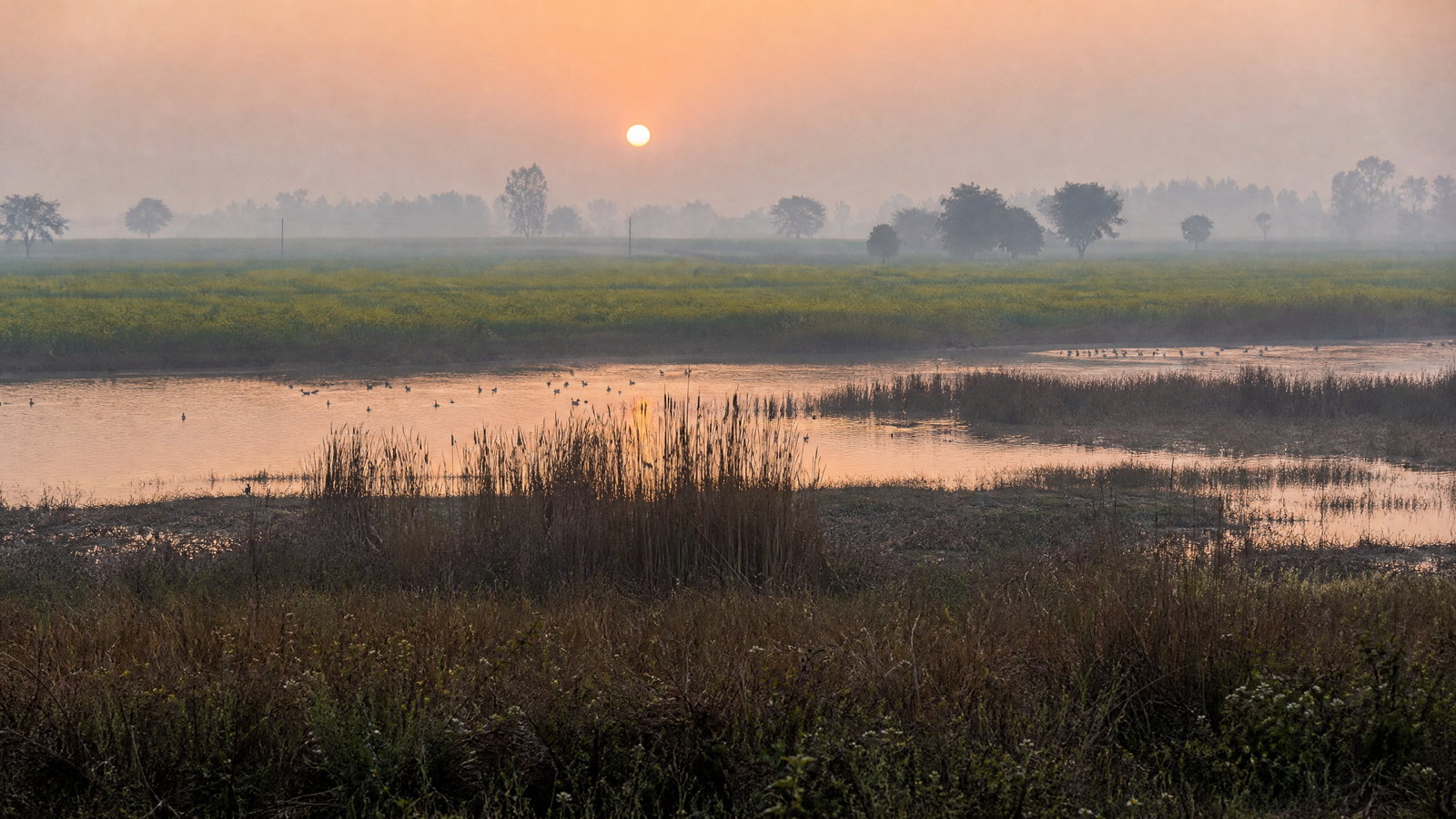
Sultanpur National Park is a compact wetland in Gurugram district and a Ramsar site of international importance. Seasonal water, grassland and scattered tree cover support resident and migratory birds on the Central Asian Flyway. The state wildlife department records more than 250 species and identifies winter migrants such as pintails, teals, geese and wigeons alongside resident birds. This is a managed, accessible birdwatching landscape close to the Delhi–Gurugram urban region, not a remote wilderness. Trails, watchtowers and interpretation features help visitors look carefully without needing to enter sensitive habitat. Its ecological value includes wetland functions beyond wildlife observation, including groundwater recharge and flood moderation.
Why this place matters
Go for high-value wetland birding without a long transfer from the National Capital Region. Sultanpur is particularly rewarding for first-time birdwatchers, photographers working from respectful distance and families who want a focused nature morning. Winter migration brings the greatest chance of variety, but the park remains a place to learn about resident species and wetland conservation outside peak season. Pair it with a quieter heritage afternoon in the Gurugram–Faridabad area instead of trying to combine it with distant northern sites in one day. The visit is strongest when you accept slow observation: sightings depend on water, weather, migration and noise, not a fixed wildlife script.
Ramsar wetland and wildlife sanctuary · Bhindawas, Jhajjar district
Bhindawas Wildlife Sanctuary
Bhindawas Wildlife Sanctuary is a human-made freshwater wetland in Jhajjar district and Haryana’s largest wetland. Protected since 1986 and later recognised as an eco-sensitive zone, it supports more than 250 bird species across the year as a resting and roosting area. Together with Sultanpur, it represents the state’s internationally recognised wetland network on the Central Asian Flyway. The experience is less formalised than a city park and should be approached as habitat first: reeds, open water, seasonal levels and quiet margins matter more than rapid species collection. Its position in the south of the state makes it a useful ecological counterpoint to Gurugram’s urban intensity and to the historic corridors farther north.
Why this place matters
Go for a broader, calmer wetland setting where the point is ecological process as much as birds. Bhindawas suits patient observers who can visit at low-noise hours and accept that the day’s view depends on season, water and movement. It complements Sultanpur rather than duplicating it: the two sites help explain why protected water bodies near a major metropolitan region matter for migratory and resident species. Choose winter for the best general birding prospects, but avoid treating any species as assured. This is also a strong place to build responsible birdwatching habits: binoculars, a soft voice and time often deliver more than moving quickly along the edge.
National park and forest corridor · Yamunanagar district
Kalesar National Park
Kalesar National Park occupies a Shivalik foothill forest in Yamunanagar district, where dense Sal woodland marks a major ecological transition between the Himalayas and the plains. Declared a national park in 2003, it forms part of a wider wildlife corridor linked to adjoining northern forests. The landscape supports leopard, deer, wild boar, smaller carnivores, birds and occasional elephant movement from neighbouring areas; wildlife presence is never a viewing guarantee. An ancient Kalesar Mahadev temple adds a religious layer, while forest tracks and viewpoints make the area useful for understanding habitat rather than seeking a staged safari. The park’s scale, forest cover and conservation role distinguish it sharply from Haryana’s urban wetlands.
Why this place matters
Go to see the wooded northern edge of Haryana and to appreciate why corridors matter. Kalesar offers a more immersive forest setting than Sultanpur or Bhindawas, with Sal stands, foothill relief and a sense of connection to larger Himalayan ecosystems. It suits birdwatchers, natural-history travellers and visitors who prefer slow landscape reading to a checklist of wildlife. October through March is broadly more comfortable, but monsoon freshness may appeal to experienced visitors if current access allows. Pair it with Yamunanagar or the northern Panchkula corridor only when time permits; the value is in giving the forest a full, unhurried day rather than squeezing it between long drives.
Historic reservoir and craft-fair grounds · Surajkund, Faridabad district
Surajkund Cultural Landscape
Surajkund is a tenth-century masonry water tank at Lakharpur in Faridabad district, shaped like a rising sun and resembling an amphitheatre. The historic reservoir, protected as a monument, preserves a valuable reminder that water architecture and sacred association were central to this Aravalli-fringe landscape. It is also the setting for the annual Surajkund International Crafts Mela, a February gathering created to showcase crafts, handlooms and cultural performance. These are connected but distinct reasons to visit: the monument is a durable heritage place, while the fair is a time-bound, high-footfall cultural event. The surrounding area is close to the Delhi–Faridabad–Gurugram urban region, so it benefits from careful timing.
Why this place matters
Go for an unusual pairing of historic water infrastructure and living craft culture. Outside the fair, Surajkund is a short, architecture-led stop that works well with Faridabad heritage and the southern Aravalli fringe. During the fair, it becomes a concentrated opportunity to encounter makers and traditions from across India; the trade-off is much heavier crowds, screening and traffic. Visitors interested in craft should focus on process, material and direct conversation with artisans rather than rushing through displays. February is the signature period but not the only time the historic tank has value. A quieter visit can make the reservoir’s form and setting easier to appreciate.
Historic city and museum landscape · Panipat, Panipat district
Panipat History Corridor
Panipat is one of north India’s defining battle-memory landscapes, a town whose historical importance comes from its position on the route between Delhi and the northwest. The Panipat Museum gives the clearest introduction, displaying archaeology, inscriptions, sculptures, arms, pottery, documents and craft objects alongside material that interprets the battles. The town also contains the Old Fort, Kabuli Shah Mosque, tombs and religious sites, but it should not be reduced to battlefield legend alone. Its working urban fabric, textile associations and layered monuments make it a useful place to examine how history is curated inside a modern industrial city. The museum is an especially valuable first stop before scattered sites.
Why this place matters
Go to put major episodes of north Indian political history into physical context. Panipat works best for travellers who begin with interpretation, then choose a small number of nearby monuments rather than attempting every historic reference in a few hours. The museum’s mix of artefacts and visual material helps connect archaeology, art and warfare, while the town demonstrates that a historical corridor remains a living city. It pairs logically with Kurukshetra on a central-north itinerary, though both deserve unhurried time. Cooler months make walking and exterior viewing more comfortable. In summer, use the museum as an airier midday anchor and reserve outdoor sites for gentler light.
Harappan archaeological site · Rakhigarhi village, Hansi tehsil, Hisar district
Rakhigarhi Archaeological Landscape
Rakhigarhi is a nationally protected archaeological landscape near Hansi, formed by interconnected mounds associated with the Harappan civilisation. Official tourism material identifies it as one of the subcontinent’s largest known Harappan townships and dates its protected cultural horizon broadly to about 2600–1800 BCE. Excavations have revealed planned settlement features, mud- and burnt-brick construction, drainage, ceramics, seals, beads and other material evidence. This is not an outdoor theme park: its importance lies in the fragile, often subtle relationship between mounds, excavation research, village setting and museum-style interpretation. For visitors, the most meaningful approach is to understand the site’s research significance while recognising that active archaeology and conservation can limit what is visible.
Why this place matters
Go for one of Haryana’s deepest historical perspectives. Rakhigarhi lets visitors move beyond epic and medieval narratives toward an urban civilisation of the third millennium BCE, while also confronting the practical reality that archaeology is incomplete and evolving. It is particularly compelling for travellers interested in settlement planning, material culture and how archaeological knowledge is made. Pair it with Hisar’s later Sultanate architecture to see the temporal breadth of the region, but do not make the mound a rushed roadside stop. A guide or interpretive material, where officially available, can be more valuable than access to every area. The site rewards attention, restraint and intellectual curiosity.
Sultanate palace complex · Hisar city, Hisar district
Firoz Shah’s Palace and Tahkhanas
Firoz Shah’s Palace and Tahkhanas in Hisar are a protected fourteenth-century Sultanate complex associated with Firoz Shah Tughlaq. Built in rubble masonry with lime plaster, the palace contains an open courtyard, two- and three-storeyed elements, pillared spaces, rooms, cells, bastions and a stair passage within its western wall. Its arches rest on carved sandstone pillars that may have been reused from earlier temple material, a feature that needs to be observed as architectural evidence rather than romanticised. The palace stands within a busy city setting near other historic references, including the citadel area. Its corridors and layered levels convey both ceremonial design and defensive or controlled movement through a medieval complex.
Why this place matters
Go for one of Haryana’s most substantial Sultanate architectural encounters. The palace reveals a different state history from the Harappan remains near Rakhigarhi: built space, courtly organisation and military-administrative presence are legible in the halls, walls and passages. It suits visitors who enjoy studying masonry and circulation rather than seeking restored grandeur. Hisar can support a rewarding full day when combined with a carefully chosen nearby monument or museum context, but avoid overloading the day in hot weather. The complex also helps correct the idea that Haryana’s heritage is only epic tradition or battlefields. Here, medieval urban authority is the central story.
Historic town and monument cluster · Narnaul, Mahendragarh district
Narnaul Historic Ensemble
Narnaul is a southern Haryana town whose heritage survives as a dispersed ensemble rather than a single ticketed attraction. The state archaeology inventory lists the Tripolia Gateway, Tomb of Shah Nizam, Chor Gumbad, Shobha Sarovar, Chhatta Rai Balmukund Dass, Mirza Alijan’s Takhat and Baoli, tomb-and-mosque sites, and later stepwells among its protected monuments. This density makes the town valuable for reading water structures, gateways, tomb architecture and civic form across different periods. Many elements are compact and embedded in everyday streets, so spatial orientation matters as much as distance. Narnaul is a particularly good choice for travellers willing to exchange landmark polish for a layered, locally rooted heritage walk.
Why this place matters
Go to explore an under-read chapter of Haryana’s architectural history. Narnaul has none of the single-site scale of a major fort, but its concentration of tombs, gateways, tanks and baolis offers a more intimate lesson in how a historic town worked. It is best for architecture enthusiasts, careful photographers and visitors who enjoy joining small sites into a coherent urban story. The southern location makes it a sensible extension from Rewari or Mahendragarh rather than a detour from Kurukshetra. Cooler months help with exposed lanes and monument exteriors. Build in time to find sites slowly, and accept that conservation work or local access conditions may alter what can be entered.
Railway heritage museum · Rewari city, Rewari district
Rewari Railway Heritage Museum
Rewari Railway Heritage Museum occupies the historic steam-locomotive-shed setting near Rewari station. District information identifies the former Rewari Steam Locomotive Shed as a nineteenth-century railway museum and the only surviving steam locomotive shed in India. It is associated with preserved locomotives, including the restored Fairy Queen train. The museum’s strength is industrial heritage: rather than presenting rail as an abstract national story, it foregrounds the maintenance, engineering and material culture of steam. Rewari itself is a practical southern Haryana rail node, making the museum an accessible stop within a wider itinerary linking Delhi-side travel, Narnaul and the state’s older trade and transport corridors.
Why this place matters
Go for a focused, tangible encounter with India’s railway past. Rewari rewards visitors who enjoy engineering history, workshop architecture and the scale of steam locomotives, while offering a useful contrast to Haryana’s archaeological and sacred sites. It is a compact cultural stop that can work well on a transfer day, especially when linked with Narnaul’s historic ensemble or the southern National Capital Region. The museum experience depends on collection display and operational arrangements, so treat the locomotive context as the core value rather than expecting a particular train movement. Families and first-time heritage visitors may find it one of the state’s most immediately readable museums.
Season and pace
Choose a date window for the experience, then keep a fallback.
October through March is the all-round window for heritage circuits and migratory birds. Winter mornings can be foggy, reducing road visibility. Spring heats quickly; April through June can bring severe dry heat, so schedule outdoor exploration early and late and carry water.
The broader July–September monsoon greens Morni and forest edges but can bring humid heat, storms, slippery trails and changing water levels. Check current heat, rain and air-quality conditions through the relevant local or official channel, rather than relying only on a seasonal calendar.
Movement and planning
Distance on a map is not the same as usable travel time.
Moving through the region
Major rail and road corridors connect Haryana’s larger towns, and state buses link rural and urban areas. Rail is useful for nodes such as Kurukshetra, Panipat, Rewari, Hisar and the northern gateway. Last-mile travel to wetlands, Morni, Kalesar, Rakhigarhi and dispersed monuments is uneven and may need a pre-arranged vehicle.
Do not turn mapped distance into a promised journey time. Congestion, winter fog, monsoon rain, event traffic and protected-area procedures can change plans. Confirm step-free access, washrooms and vehicle restrictions before committing to uneven mounds, hill trails or crowded grounds.
Building a workable route
Pair places by geography: Panchkula, Morni and Pinjore; Kurukshetra and Panipat; or Gurugram-side wetlands with Surajkund, Rewari and southern heritage. A longer circuit can add Rakhigarhi and Hisar before Kalesar. Start birding near dawn and heritage walks early or late.
Verify current opening days, security screening, photography rules, trail status, festival schedules and transport through the relevant local or official channel. Carry water, sun protection and a charged phone. In summer, plan an indoor midday stop rather than treating it as optional.
Travel responsibly
The regional context includes its limits.
Wetlands and forest corridors are working ecosystems. Observe from designated paths, keep voices low, never feed wildlife and do not pursue birds for photographs. Water and migration vary naturally, so sightings are never assured. At archaeological mounds, do not climb unstable edges, collect fragments or enter closed excavations.
At temples, sarovars, dargahs and fairs, follow site-specific dress, footwear, queue and photography customs. Refill water where safe, reduce single-use waste and keep litter out of drains and ponds. Adapt to official advice on heat, poor air quality, thunderstorms and fog.
This is an evergreen regional guide. Weather, permits, closures, transport and local rules can change; confirm material conditions through the relevant local or official channel before travel.