North India · Union territory · DL
Delhi
Delhi is India’s National Capital Territory, a dense metropolis where imperial capitals, colonial planning, national institutions and living neighbourhoods share a compact plain. Its strongest visit is a sequence of contrasting districts: early Indo-Islamic stonework at Mehrauli; Mughal Shahjahanabad; the garden-tomb and Sufi precinct at Nizamuddin; and the ordered avenues of New Delhi. Ridge woodland and restored Yamuna floodplain parks offer ecological counterpoints, though not wilderness. Delhi rewards unhurried mornings, short district-based days and indoor pauses between monuments. Its heat, monsoon disruption, traffic and seasonal air quality make realistic pacing more valuable than trying to cover the territory in one sweep. It is a capital experienced through layers, not a single cityscape.
Regional notebook
Begin with the shape of the region.
Delhi is the seat of India’s national government, but not a uniform city. New Delhi is its planned administrative core within a far wider territory of older settlements, suburbs and institutions. A historical map is therefore more useful than a simple city map: Mehrauli records early Sultanate rule, Shahjahanabad Mughal urbanism, Nizamuddin a shrine-and-garden district, and New Delhi twentieth-century capital planning. Build visits by district rather than chasing landmarks across town.
Landscape
Geography changes the journey.
Delhi lies on the Indo-Gangetic plain, with the Yamuna along its eastern edge and northern Aravalli outliers shaping the west and south. The Delhi Ridge, quarry-scarred hills, parkland and floodplain interrupt a predominantly urban lowland. Mehrauli and Asola-Bhatti feel stonier and more open; central Delhi is intensely built; Wazirabad retains wetland restoration. Altitude is not limiting here: heat, dust, uneven pavements and monsoon waterlogging are the practical variables.
Living culture
Arrive as a guest, not an audience.
Successive courts, migration, commerce, religious institutions and national-capital functions give Delhi its plural character. Indo-Islamic design runs from Qutb to Mughal tombs and Shahjahanabad; British-era planning frames the civic core; museums convene material traditions from across India. Shrines, mosques, gurdwaras and craft centres are active settings, not displays. Hindi and English ease daily communication, with Urdu and Punjabi enriching speech and cultural life. Adapt dress and conduct to each setting.
Curated regional atlas
Places that reveal different parts of Delhi
This is a selective, geographically varied starting point rather than an exhaustive list. Use it to choose a coherent route, not to compress every place into one trip.
World Heritage palace-fort · Shahjahanabad, Old Delhi
Red Fort Complex
The Red Fort is the palace-fort built for Shah Jahan’s new capital of Shahjahanabad, its massive red sandstone walls enclosing a carefully ordered Mughal courtly landscape. UNESCO identifies the adjacent 1546 Salimgarh fort as part of the same complex, and describes the private pavilions as linked by the Nahr-i-Behisht, the Stream of Paradise. The ensemble expresses a refined fusion of Islamic, Persian, Timurid and Hindu traditions rather than a single visual language. Its value is also political: the fort has remained a national symbol through Mughal rule, British military occupation and Indian independence. It is an architectural anchor for understanding Old Delhi, not merely a standalone façade.
Why this place matters
Go to read Mughal palace planning at an urban scale: defensive walls give way to ceremonial routes, pavilions, water architecture and garden ideas. The fort’s World Heritage interpretation adds useful context for how imperial design travelled beyond Delhi. It pairs naturally with a slower exploration of Shahjahanabad, but deserves its own unhurried visit rather than being squeezed between markets. Morning light and lower temperatures can make the large open spaces more manageable. The trade-off is that a major national monument involves visitor flows, screening and occasional conservation-related restrictions. Focus on the surviving spatial sequence and the relationship between fort, former river setting and dense city, rather than expecting a fully intact palace interior.
World Heritage archaeological complex · Mehrauli, South Delhi
Qutb Minar and its Monuments
At Delhi’s southern historic edge, the Qutb complex gathers a minar, mosque, tombs, gateways and later ambitions in one archaeological precinct. Its red and buff sandstone Qutb Minar rises 72.5 metres; around it are the Quwwatu’l-Islam mosque, the Iron Pillar, Iltutmish’s tomb, Alai Darwaza and the unfinished Alai Minar. UNESCO frames the ensemble as testimony to the early Islamic rulers who established power on the subcontinent, while also noting the incorporation of temple elements in the mosque’s carved pillars and cladding. The site is therefore best understood as a layered record of conquest, adaptation, patronage and evolving architectural practice, not as an isolated tower.
Why this place matters
Go for Delhi’s clearest concentrated lesson in early Indo-Islamic architecture and for the contrast between exceptionally finished carving and the monumental incompletion of Alai Minar. The complex works well with nearby Mehrauli because the wider area makes visible how monuments outlast and shape settlements. It is especially rewarding for visitors who slow down to compare materials, inscriptions, arches, courtyards and funerary forms. The trade-off is popularity and exposure: midday heat, school groups and uneven movement around stonework can reduce the experience. It is not a place for climbing or seeking restricted angles; the main insight comes from careful observation at ground level.
World Heritage garden-tomb complex · Nizamuddin East, New Delhi
Humayun’s Tomb
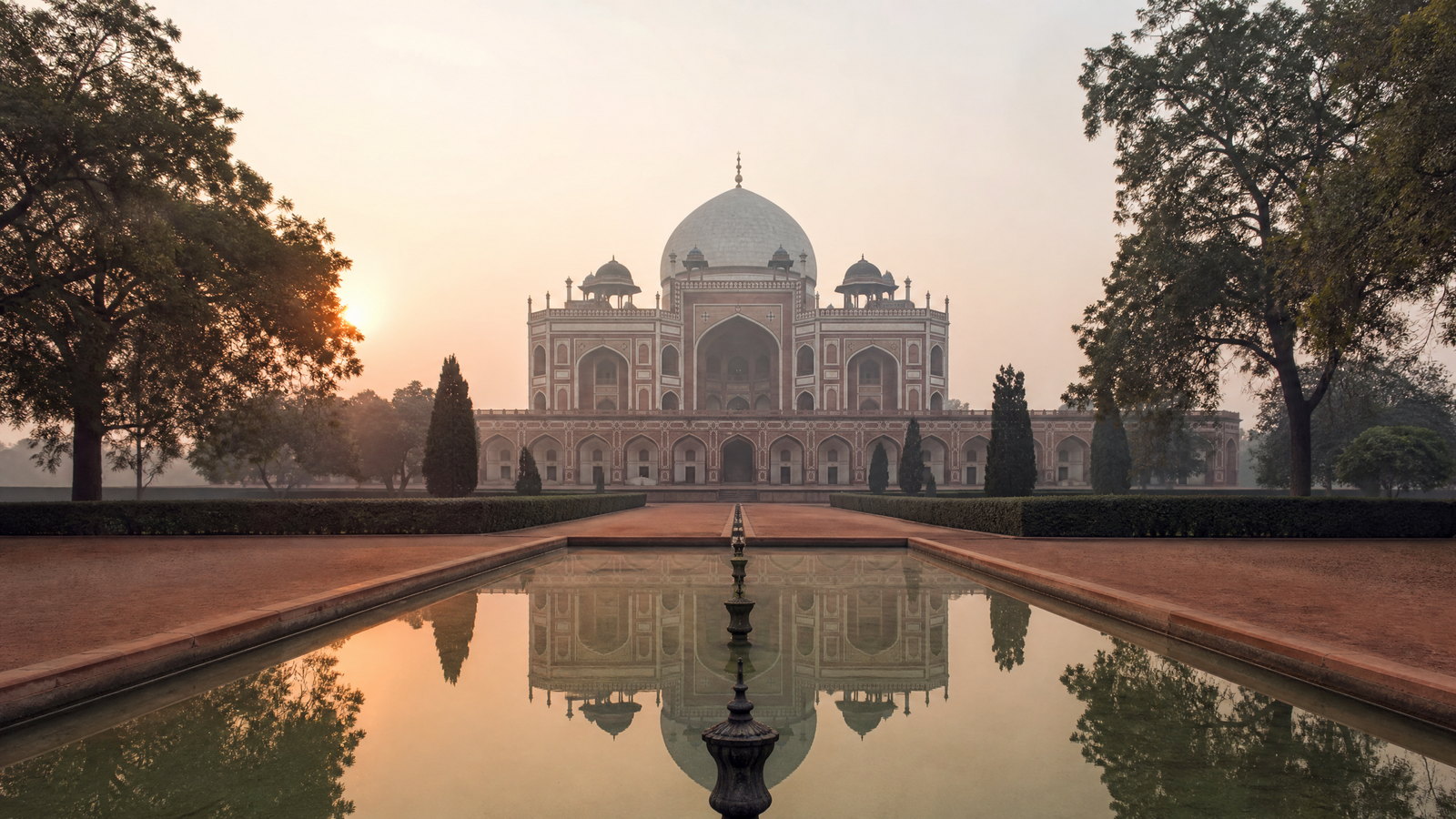
Humayun’s Tomb is the subcontinent’s first grand garden-tomb, completed in 1570 and set in a charbagh landscape of quadrants, water channels and pools. Its high red sandstone structure, marble details and double dome established an imperial vocabulary that later reached its most famous expression at the Taj Mahal. The World Heritage property is more than the central mausoleum: it includes contemporary sixteenth-century garden tombs, gateways and associated structures, while the wider Nizamuddin setting holds a dense concentration of medieval Islamic buildings. Persian and Indian craftsmen worked together on a building whose materials, garden design and monumental scale are inseparable from its significance.
Why this place matters
Go to see how architecture, hydrology and garden geometry make a coherent Mughal landscape. Unlike a monument read only from outside, the complex rewards a slow circuit through its gateways, ancillary tombs and restored water axis. It also gives a useful bridge between courtly Mughal culture and the nearby Sufi and residential precinct of Nizamuddin. Choose an early slot for softer light and a calmer walk, then reserve time for the garden rather than concentrating only on the main dome. The trade-off is its popularity and the amount of walking over stone and garden paths; some parts may be under conservation or have controlled access.
living Sufi heritage precinct and historic garden · Hazrat Nizamuddin, New Delhi
Nizamuddin Dargah and Sunder Nursery
The Nizamuddin precinct connects the shrine neighbourhood of the Sufi saint Hazrat Nizamuddin Auliya, the World Heritage setting of Humayun’s Tomb and the restored landscape of Sunder Nursery. An urban-renewal programme describes this as a historic district where a seven-century-old settlement, a public garden, Mughal tombs and social infrastructure have been brought into closer relationship. It is one of Delhi’s most useful places for seeing conservation as a living urban practice: traditional craft skills, religious culture, public space and resident livelihoods intersect rather than sit in separate zones. The lanes near the dargah remain a functioning residential and devotional environment.
Why this place matters
Go for the contrast between intimate shrine lanes and the composed calm of Sunder Nursery, and to understand why heritage conservation must include community life. The area can turn a visit to Humayun’s Tomb into a fuller half-day of Mughal landscape, Sufi memory and contemporary urban repair. Visitors interested in music, poetry or religious culture should approach with attentiveness rather than treating rituals as performances. The trade-off is density: the dargah approach has narrow lanes, crowding and variable access during worship or events, while gardens and monuments have their own controlled areas. A respectful, flexible visit is more rewarding than a tightly timed one.
congregational mosque and historic urban precinct · Old Delhi
Jama Masjid and Shahjahanabad
Jama Masjid rises above the compact commercial and residential fabric of Shahjahanabad, Shah Jahan’s seventeenth-century capital. Delhi Tourism includes the mosque among the territory’s principal monuments, and its setting is as significant as its red sandstone and marble architecture: lanes, bazaars, homes, food traditions, religious institutions and transport all share a very limited street space. The mosque is a congregational place of worship, not a museum enclosure, so its rhythms respond to prayer, festival and community use. Together with the Red Fort, it gives the clearest introduction to Mughal-era Old Delhi, but the precinct also reflects many later layers of migration, commerce and city making.
Why this place matters
Go to experience architecture within a living historic city rather than in an isolated garden. The mosque’s broad courtyard and elevated setting offer a spatial counterpoint to the compressed streets below, while a careful walk in Shahjahanabad reveals how trade, worship and domestic life coexist. It is best for travellers comfortable with sensory intensity and patient navigation, not those seeking a silent monument circuit. The trade-off is real: crowding, traffic, uneven paving, narrow lanes and worship-time restrictions can make access slower than expected. Early daytime exploration and a modest itinerary leave room for respectful observation without obstructing local movement.
archaeological landscape and urban park · Mehrauli, South Delhi
Mehrauli Archaeological Park
Mehrauli Archaeological Park extends the story of the Qutb complex into a greener, dispersed landscape of tombs, water structures, ruins and later colonial reuse. The park’s recently restored Dilkusha complex records how Thomas Metcalf adapted older structures in the 1840s as a retreat, adding a boat house, guest house, circular dining room and follies around earlier tombs. Restoration work has also revived a water body and improved interpretation around these layers. This is not a single neatly bounded monument: it is a walking landscape in which medieval, Mughal, colonial and contemporary conservation interventions remain visibly adjacent. Its value lies in the connections between fragments.
Why this place matters
Go when you want a slower, more exploratory complement to the formal Qutb complex. The park makes clear that Delhi’s past survives in networks of structures, slopes and water systems, not only in headline monuments. It is rewarding for architecture and landscape readers who can accept partial ruins, variable surfaces and a less scripted route. The restored Metcalf layer introduces a useful colonial afterlife to the older archaeology. The trade-off is that wayfinding, shade and accessibility can be less consistent than at a major ticketed monument, and some areas may be undergoing work. Avoid trying to cover every structure; choose a modest loop and allow time to look.
historic public garden · Lodhi Road, New Delhi
Lodhi Garden
Lodhi Garden is a central public landscape where fifteenth-century tomb architecture is encountered through everyday park use rather than behind a monumental enclosure. The garden holds the tombs associated with the Sayyid and Lodi periods, water features, lawns and mature planting, providing a quieter counterweight to Delhi’s dense historic precincts. Delhi Tourism lists the Lodi Tomb among its principal monuments, placing the park within the city’s broad heritage network. Its importance for an atlas record is experiential as well as architectural: walkers, families and readers use the same green space that contains substantial medieval structures. The result is a living civic garden rather than a controlled archaeological museum.
Why this place matters
Go to reset the scale of a Delhi itinerary without leaving history behind. The tombs are compact enough to reward close observation, while the garden offers shade, benches and room to absorb the contrast between Lodi-period forms and the surrounding modern city. It pairs well with central New Delhi or a museum afternoon and is useful on a first day when jet lag or heat makes a large monument difficult. The trade-off is that it is a public park, not a comprehensive interpretation centre: peace varies by time of day, and visitors should not expect detailed signage at every structure. Dawn is generally the most contemplative period.
civic architecture and national history museum · Raisina Hill, New Delhi
Rashtrapati Bhavan Museum and Central Vista
Raisina Hill and the Central Vista express the planned capital built around national institutions, broad ceremonial avenues and formal government architecture. The Rashtrapati Bhavan Museum offers an accessible entry point into this landscape through event-based storytelling, original collections and technology-supported displays about the presidency and constitutional history. The museum occupies an underground space designed to preserve the architectural setting above it, while the surrounding district must be read from public areas subject to security arrangements. This is Delhi at a different scale from Shahjahanabad: axial, spacious and administrative, with the visual language of the former imperial capital reworked for the republic. It gives essential balance to a Mughal-focused itinerary.
Why this place matters
Go to understand Delhi as India’s current political capital, and to contrast formal twentieth-century planning with the organic density of Old Delhi. The museum is particularly useful in heat, rain or poor outdoor conditions because it turns national history into a contained, interpretive visit. Follow it with a measured public walk around the central district, keeping distances and security boundaries in mind. The trade-off is controlled access: this is an active government zone, so entry methods, identity requirements, permitted routes and photography restrictions can change without notice. Do not plan around an assumption that every building or garden will be open; treat the public realm and museum as the dependable core.
craft museum and demonstration centre · Pragati Maidan, New Delhi
National Crafts Museum and Hastkala Academy
The National Crafts Museum and Hastkala Academy provides a focused route into India’s material cultures within Delhi. Its galleries include traditional textiles and ritual-linked objects, while the village complex and craft demonstrations foreground architectural settings, processes, tools and the work of artisans and weavers. This makes it more than a display of finished objects: visitors can consider how regional craft knowledge is made, transmitted and interpreted in a national institution. Located near Pragati Maidan, it is a useful indoor counterpoint to monument-heavy days and helps prevent Delhi from being represented only through dynastic architecture. Its programme and demonstrations may vary, so the museum should be approached as a cultural visit with changing layers.
Why this place matters
Go to encounter craft as living knowledge rather than souvenir material. The textile displays, ritual objects, reconstructed settings and potential maker demonstrations can sharpen a traveller’s understanding of materials, labour and regional difference across India. It is especially valuable for families, design-minded visitors and anyone seeking respite from exposure during hot or wet weather. The trade-off is that displays and programmes can be unevenly available, and no single visit can stand in for the communities where traditions are practised. Give the galleries time and ask respectfully when a craftsperson is working. The museum pairs well with central cultural institutions, not with a rushed Old Delhi circuit.
Bahá’í house of worship and modern architecture · Kalkaji, South Delhi
Lotus Temple
The Lotus Temple is a modern Bahá’í house of worship distinguished by its white-marble lotus form and nine surrounding water pools. Delhi Tourism identifies its setting near Kalkaji and notes that its architect chose the lotus as a symbol shared across several Indian religious traditions. The building’s significance lies in its contemplative purpose as well as its image: it is a place of worship, so the visit should be approached quietly and within house rules. It offers a sharp chronological contrast with Delhi’s stone forts and tombs, showing how the city’s sacred architecture continued to evolve in the late twentieth century. The open approach also makes light, weather and crowd levels part of the experience.
Why this place matters
Go for a concise encounter with contemporary sacred architecture and a moment of stillness amid southern Delhi’s density. The lotus geometry, pale marble and water setting make the building legible from outside before the interior’s silence changes the pace. It works well as an accessible thematic counterpoint to older Islamic, Sikh or Hindu sites, provided visitors do not treat religious differences as spectacle. The trade-off is demand: queues, security procedures and photography restrictions can shape the visit, and the building’s quiet atmosphere depends on collective restraint. Give it a short, flexible slot instead of building a whole day around a single view, particularly in warm weather.
urban wildlife sanctuary · Tughlakabad–Asola, South Delhi
Asola-Bhatti Wildlife Sanctuary
Asola-Bhatti is Delhi’s only wildlife sanctuary and protects roughly 32 square kilometres of the northeastern Aravalli outliers along the Delhi–Haryana edge. Its semi-arid, open-canopy landscape is a necessary corrective to the idea that Delhi is only built form. The sanctuary authority describes curated nature walks, a butterfly park, forest interpretation, birding trails and a range of habitats that can support peafowl, raptors, nilgai and other native fauna. The protected landscape also bears the marks of quarry history and urban pressure, making it an instructive conservation site rather than a remote national park. Wildlife sightings are always contingent, and the chief value is the Aravalli ecology itself.
Why this place matters
Go to experience the landform beneath southern Delhi and to understand why the ridge and Aravalli fragments matter for an urban region. Marked walks can reveal dry-forest plants, butterflies and birds without requiring a specialist expedition, while the sanctuary’s interpretation gives ecological context to a city otherwise dominated by monuments. Visit with realistic expectations: a sanctuary is not a zoo, and the chance of seeing any particular animal cannot be promised. The trade-off is exposure and rules. Trails vary in length and difficulty, summer heat is serious, and vehicle movement or deeper access may need permission. A short designated walk is often more responsible and satisfying than pursuing distant sightings.
urban biodiversity park and wetland restoration landscape · Wazirabad–Jagatpur, North Delhi
Yamuna Biodiversity Park
On the western bank of the Yamuna near Wazirabad, the Yamuna Biodiversity Park is an approximately 457-acre restoration and learning landscape. The Delhi Biodiversity Foundation describes wetlands, grasslands, forest communities, fruit conservatories, medicinal plants and habitat for native flora and fauna, with visitor and nature-reserve zones kept distinct. Trails introduce a bambusetum, interpretation facilities, wetland views, a butterfly conservatory and miniature representations of ecosystems along the Yamuna basin. Its purpose is not a manicured riverfront image but ecological recovery and public understanding of a river-edge landscape. The park is an important counterweight to Delhi’s monumental past, though the active Yamuna floodplain demands practical caution.
Why this place matters
Go to see ecological restoration inside a megacity and to broaden a Delhi visit beyond stone architecture. The park makes landscape processes visible through wetlands, grasslands, native plant collections and interpretation, offering a gentle half-day for birders, families and travellers interested in urban ecology. Its strongest lesson is the relationship between biodiversity, water and public stewardship, not a guarantee of dramatic wildlife. The trade-off is seasonality and river risk: bird activity varies, heat limits comfort, and heavy rain or flood conditions can change access. Keep expectations flexible, respect the separation of visitor areas from the nature reserve, and allow time for quiet observation rather than a quick photographic stop.
Season and pace
Choose a date window for the experience, then keep a fallback.
October to March usually favours walking. December and January can be cold and foggy, with poor air quality possible; travellers sensitive to pollution should retain flexible plans. April–June can bring temperatures around 45°C, so start outdoor visits at opening and avoid exposed midday routes. The monsoon broadly spans late June or July to September, bringing humidity, heavy rain and waterlogging. Yamuna access can change during flood conditions. Every season carries a trade-off.
Movement and planning
Distance on a map is not the same as usable travel time.
Moving through the region
Airport, major rail terminals and metro services make Delhi accessible, but transfer times are often underestimated. Airport rail links differ by terminal and services can change; verify arrangements on the day. Use metro for longer cross-city moves, then allow last-mile time. Old Delhi rewards walking but has traffic, tight lanes and uneven paving; the central vista is spacious but distances are long. Historic sites and station exits offer uneven step-free access. Avoid multiple north–south crossings in one day.
Building a workable route
Allow four to six days and organise them by district. Pair Red Fort with Shahjahanabad, Humayun’s Tomb with Nizamuddin, and Qutb with Mehrauli; reserve central New Delhi for civic architecture and museums. Asola-Bhatti and Yamuna Biodiversity Park are ecological half-days, not guaranteed wildlife experiences. Confirm current hours, closures, ticketing, security, photography, prayer-time etiquette, restoration work and accessible entrances through the relevant local or official channel. During alerts, substitute indoor sites for exposed or riverside plans.
Travel responsibly
The regional context includes its limits.
Stay on marked routes, do not climb or touch historic fabric, and accept conservation or security restrictions. At sacred sites, dress modestly, follow footwear and entry directions, and ask before photographing worshippers or residents. Value makers’ labour when buying crafts and keep market lanes clear. Reduce single-use plastic and take litter away. At ecological sites, remain on permitted trails, avoid feeding wildlife and respect reserve boundaries. Check current air, heat, weather and flood advisories; change plans rather than entering waterlogged or closed areas.
This is an evergreen regional guide. Weather, permits, closures, transport and local rules can change; confirm material conditions through the relevant local or official channel before travel.