North India · Union territory · CH
Chandigarh
Chandigarh is India’s compact Union Territory and the shared capital of Punjab and Haryana, set where the Shivalik foothills meet the northern plains. It is unusually legible as a destination: a mid-twentieth-century planned city whose sector grid, shaded avenues, gardens, civic precincts and cultural institutions form one connected urban landscape. The Capitol Complex offers the monumental, civic scale of Le Corbusier’s plan; Sector 17 and the Leisure Valley show its everyday pedestrian and green-space logic; and the Rock Garden gives the city a more improvised, handmade counterpoint. Sukhna Lake, the forested sanctuary and Sarangpur Botanical Garden widen the visit from architecture into water, bird habitat and the fragile foothill edge. Chandigarh works especially well for a two- or three-day, low-transfer itinerary built around walking and short local rides. It is not a hill station or a vast historic city: summer heat, monsoon downpours and access controls at protected areas shape the experience. The most rewarding approach is to pair architecture and museums with gardens and the lake, while leaving space for the city’s lived public realm.
Regional notebook
Begin with the shape of the region.
Chandigarh is a designed capital rather than a checklist of isolated monuments. Conceived after Partition as the new capital for East Punjab and later made a Union Territory and shared capital of Punjab and Haryana, it combines a political role with a coherent modern form. Le Corbusier’s plan organized the city around the Capitol, Sector 17, cultural precincts, and an extensive system of parks and greens. The lake, gardens, museum campus and everyday public life soften that formal structure.
An overnight stop can cover the lake, Rock Garden and Sector 17, but two days better reveal the relationship between Capitol, museum collections and Leisure Valley. A third day allows for the sanctuary only if permission and conditions align.
Landscape
Geography changes the journey.
The Union Territory covers about 114 square kilometres at roughly 304–365 metres above mean sea level. It lies where Shivalik foothills meet Kandi or Bhabhar terrain in the north-east and Tarai and alluvial plains elsewhere. The Sukhna Choe drains the east and Patiala-ki-Rao the west.
Sukhna Lake is a rain-fed reservoir formed by damming the Sukhna Choe, while the sanctuary protects much of the northern foothill landscape. This contrast—regulated city, lake catchment and Shivalik edge—is the region’s key geographic diversity. Built sectors are largely level, but garden surfaces and nature trails may be uneven; during heavy rain, outdoor access can change quickly.
Living culture
Arrive as a guest, not an audience.
Chandigarh’s culture is shaped by migration, administration, education and its position between Punjab, Haryana and the Himalayan gateway. Hindi, Punjabi and English are widely useful in public life. Its founding story is inseparable from post-Partition displacement and resettlement; the Government Museum and Art Gallery preserves part of the art collection divided from Lahore’s former Central Museum.
Modernist civic architecture is a living cultural landscape. The Capitol’s symbols, sector system, market plazas and green corridors retain public and administrative roles. The Rock Garden offers a contrasting local authorship: Nek Chand transformed discarded materials into an immersive art environment. Visit memorials quietly and leave time for ordinary sector life.
Curated regional atlas
Places that reveal different parts of Chandigarh
This is a selective, geographically varied starting point rather than an exhaustive list. Use it to choose a coherent route, not to compress every place into one trip.
modernist civic architecture and World Heritage ensemble · Sector 1, Chandigarh
Capitol Complex
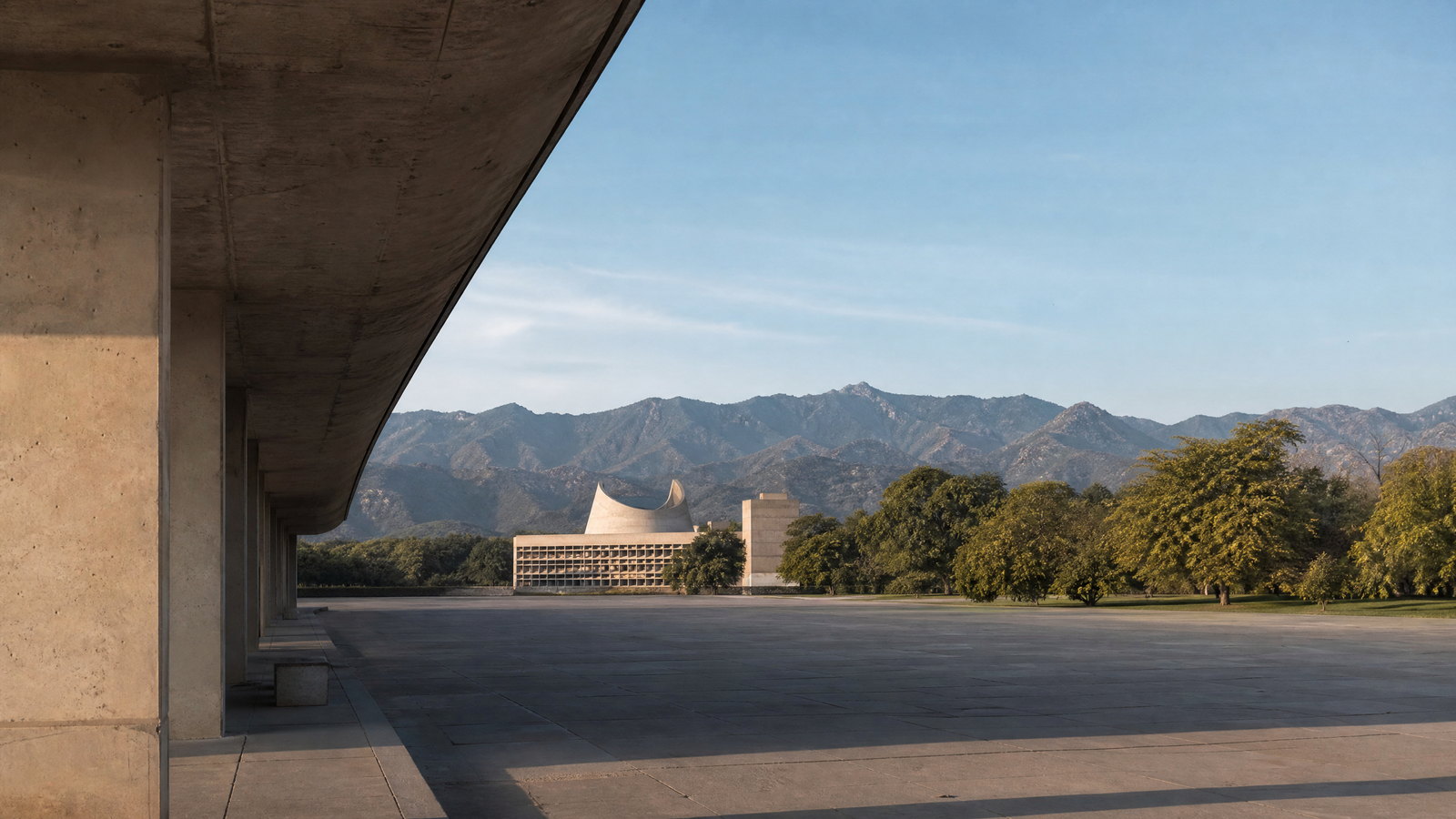
At Chandigarh’s northern ‘head’, the Capitol Complex is the monumental civic ensemble conceived by Le Corbusier against the Shivalik backdrop. Its three principal concrete buildings—the High Court, Secretariat and Legislative Assembly—stand across large piazzas with the Open Hand, Tower of Shadows, Geometric Hill and Martyrs’ Memorial. The complex is part of the transnational World Heritage inscription for Le Corbusier’s architectural work. Its scale, raw concrete, deep sun-control devices and carefully framed open space make more sense as a composition than as a collection of façades. It remains a working governmental setting, so boundaries and the relationship between public viewing areas and official functions matter.
Why this place matters
This is the clearest place to read Chandigarh’s founding ambition: a democratic capital planned as landscape, climate response and symbol. The Open Hand’s idea of being open to give and receive gives a useful interpretive thread, while the Tower of Shadows makes the city’s intense sun an architectural subject rather than an inconvenience. The reward is strongest for travellers who slow down to compare shade, proportion, views and circulation with the quieter sector city beyond. It is also the essential counterweight to the playful Rock Garden, revealing the formal, institutional side of the same post-independence city.
urban reservoir and lakeside landscape · Sector 1 edge, Chandigarh
Sukhna Lake
Sukhna Lake is a rain-fed reservoir at the Shivalik foothills, created in 1958 by damming the seasonal Sukhna Choe. It is Chandigarh’s most direct meeting point of water, city and hills: a broad open edge beside the Rock Garden and near the Capitol precinct, rather than a remote wilderness lake. The lake’s catchment and silt-management story are as important as its promenade. Forest conservation works in the territory aim to reduce silt inflow, underscoring why the lake should be read as part of a wider seasonal drainage system. Light, water levels, bird activity and crowding change substantially through the year.
Why this place matters
Go for orientation and atmosphere rather than a single monument. A quiet morning or late-afternoon walk connects the city’s green planning to the Shivalik horizon and offers a useful pause between the Capitol and Rock Garden. It is particularly good for understanding how Chandigarh turns a seasonal stream into civic landscape, while still depending on catchment care beyond the built sectors. The lake is a strong choice for travellers with limited time, but nature-minded visitors should keep expectations urban: the sanctuary, not the promenade, is the appropriate setting for a protected-habitat experience.
outsider-art sculpture garden · Sector 1, Chandigarh
Nek Chand’s Rock Garden
Nek Chand’s Rock Garden is Chandigarh’s handmade counterpoint to its official modernism. Begun secretly by government official Nek Chand in 1957, the garden developed into a roughly 40-acre environment of courts, passages, waterfalls and sculptural figures made from discarded industrial and household materials, notably recycled ceramic. Its significance is not only visual: the work transforms material surplus into an immersive civic art landscape and preserves an unusually personal act of making within a planned capital. The sequence of narrow paths and changing levels creates a different spatial rhythm from Chandigarh’s wide roads and monumental piazzas. Crowding can affect the experience.
Why this place matters
The garden supplies the emotional and material contrast that makes a Chandigarh itinerary memorable. Where the Capitol speaks in axial concrete and state symbolism, the Rock Garden speaks through mosaic fragments, repetition, surprise and reuse. It rewards close observation of texture and craft more than rushing for a single viewpoint. Families, design travellers and visitors interested in environmental imagination will find it compelling, but it is equally useful as a lesson in how unofficial creativity can inhabit a rigorously planned city. Pair it with the lake, not with another packed indoor stop, so the garden’s maze-like pace can breathe.
linear urban park system · Sector 1 to Sector 53, Chandigarh
Leisure Valley
Leisure Valley is Chandigarh’s long green spine: a linear park made from an eroded seasonal-rivulet valley retained in the original plan and shaped into a continuum of themed gardens. It extends for more than eight kilometres from Sector 1 toward the city’s southern edge. Rather than treating parkland as leftover space, the plan made it part of the city’s ‘lungs’, linking open areas, garden experiences and local movement across sectors. A visitor need not attempt its full length. Its value lies in choosing a manageable segment and noticing how vegetation, bridges, paths, drainage and adjacent sectors work together to temper the city’s broad urban geometry.
Why this place matters
This is the best place to grasp Chandigarh as a landscape plan. The valley makes visible the relationship between seasonal water, green infrastructure and everyday recreation, which can be missed when visiting only isolated gardens. It is also a flexible, low-cost way to connect cultural stops: a short section can complement the Rose Garden, museum area or Sector 17. Travellers looking for dramatic wilderness should choose the sanctuary instead; Leisure Valley is an urban ecological corridor, valued for continuity and civic use. Choose cool hours and a defined route, since the full corridor is longer than it appears on a map.
botanical garden · Sector 16, Chandigarh
Zakir Hussain Rose Garden
Zakir Hussain Rose Garden is a 30-acre botanical garden in Sector 16, reported by the district administration to contain about 50,000 rose bushes across 1,600 varieties. It is one of Chandigarh’s most concentrated examples of the planting strategy that threads through roads, sectors and large parks. The garden is not merely a flower display: its open lawns, paths and mature landscape make it a useful pause within the central cultural zone, near the Government Museum and Art Gallery. Rose condition is naturally seasonal and weather-dependent, so its horticultural peak should not be treated as guaranteed on a particular date.
Why this place matters
Go to experience the softer, cultivated side of a city often reduced to concrete modernism. In favourable flowering conditions, the density of varieties gives a clear reason to linger; outside peak bloom, the garden still functions as a spacious public landscape and a good contrast with nearby museums. It works particularly well for a slow morning before an indoor collection visit, or as a restorative interval after architecture-focused touring. It is less suitable as a stand-alone day trip than as part of a central-sector circuit. Photography is most rewarding when it respects gardeners and other visitors’ shared use of the space.
art and archaeology museum · Museum Complex, Sector 10-C, Chandigarh
Government Museum and Art Gallery
The Government Museum and Art Gallery holds a nationally important collection shaped by Partition. After the 1947 division of the former Central Museum in Lahore, the share received by India included Gandharan sculpture, Indian miniature paintings and decorative arts; it moved through several north Indian cities before reaching Chandigarh. The museum building, inaugurated in 1968, was designed by Le Corbusier and stands within a campus that also includes specialised museums and cultural facilities. This makes the visit twofold: a chance to see art histories that reach well beyond Chandigarh and to examine a major modernist museum building in its intended landscape setting.
Why this place matters
This is the strongest indoor anchor for understanding the cultural history behind Chandigarh’s post-Partition foundation. The Gandharan and miniature-painting collections expand the trip beyond urban design, while the building itself demonstrates how Le Corbusier approached light, circulation and a public institution. It suits hot afternoons, winter fog or monsoon showers especially well, and gives intellectual weight to a visit otherwise centred on parks and monumental exteriors. Allow enough time to move slowly through the galleries rather than using it as a brief shelter stop. Its Sector 10 setting pairs naturally with the Architecture Museum and Rose Garden.
architecture archive and museum · Museum Complex, Sector 10-C, Chandigarh
Chandigarh Architecture Museum
Established in 1997, Chandigarh Architecture Museum documents the making of the city through rare plans, drawings, sketches, photographs and archival material. Its sculptural building, designed by S. D. Sharma, adapts a structure associated with a Le Corbusier exhibition pavilion design. The collection follows the city from Partition and the earlier Mayer plan through Corbusier and his team, the master plan, Capitol, monuments and later Chandigarh. It is a compact but unusually direct record of urban planning as a negotiated process rather than a finished image. Within the museum complex, it helps translate the real city outside into documents and decisions.
Why this place matters
Visit before or after the Capitol Complex if you want to move from visual admiration to informed reading. The museum clarifies why the sectors, green corridors, road hierarchy and civic axis are arranged as they are, and it gives appropriate attention to the planners and collaborators behind the familiar headline name. It is especially worthwhile for architecture, design and city-making travellers, though anyone spending more than a day benefits from the context. Pairing it with the Government Museum creates a satisfying contrast: one traces Chandigarh’s creation, the other carries deeper north Indian art and Partition histories.
protected foothill sanctuary · Northern and north-eastern Chandigarh
Sukhna Wildlife Sanctuary
Sukhna Wildlife Sanctuary protects 2,610.99 hectares of Chandigarh’s northern foothill landscape, forming the largest component of the territory’s forest area. It is an ecological counterweight to the planned city: forest, seasonal drainage, habitat restoration and soil-conservation work are closely tied to the health of Sukhna Lake downstream. The sanctuary has entry gates associated with Kansal and Nepli areas, but it is not an open urban park. The administration limits daily visitors and requires prior entry permission, with conservation taking precedence over recreation. Its value is the Shivalik-edge ecosystem and the discipline of visiting it on its terms, not a guaranteed wildlife encounter.
Why this place matters
For a small territory, the transition from sector city to protected foothill habitat is striking. A sanctioned visit can show why Chandigarh’s lake, forests and drainage cannot be separated from its architecture and gardens. It is the right choice for travellers who value quiet, habitat awareness and low-impact walking more than a packed sightseeing schedule. The sanctuary also supplies an essential corrective to the image of Chandigarh as entirely manicured. However, access uncertainty is real: do not build an inflexible itinerary around it, and do not treat it as a place for loud groups, picnics, off-route exploration or close approaches to animals.
botanical garden and ecological landscape · Near Sarangpur, Lahora and Dhanas, Chandigarh
Botanical Garden, Sarangpur
Chandigarh’s Botanical Garden occupies approximately 176 acres near the villages of Sarangpur, Lahora and Dhanas. Established by the administration and opened to the public in 2007, it was developed with nursery work, plantations, shrubs, lawns, land shaping and check dams, alongside multiple botanical sections intended to support ecological awareness. Its scale and semi-peripheral setting distinguish it from the ornamental gardens of central sectors. The garden belongs to the territory’s broader effort to increase green cover, manage soil and water, and connect urban residents with planted landscapes. Conditions can vary by section, season and ongoing horticultural work.
Why this place matters
Choose Sarangpur for breadth and ecological context rather than a quick flower display. It helps explain that Chandigarh’s green identity includes restoration, nursery practice and water-sensitive land management as well as formal avenues and roses. The open setting can be a refreshing contrast after dense museum and Capitol visiting, especially for travellers interested in plants, landscape design or quieter walking. It is most rewarding when paired with realistic expectations: it is not a polished central promenade, and garden sections may be at different stages of development. Give it unhurried time and keep a weather-aware backup plan.
planned city centre and pedestrian commercial precinct · Sector 17, Chandigarh
Sector 17 Plaza
Sector 17 is the planned city centre and the ‘heart’ in Le Corbusier’s metaphor for Chandigarh. Four-storey concrete buildings frame wide pedestrian concourses, with offices and commercial activity arranged around open piazzas, fountains and the Neelam area. The broader sector also connects to the inter-state bus terminus, parade ground and district courts, which explains why it feels more like an operating civic-commercial centre than a heritage set piece. Its importance lies in the everyday test of the master plan: how a self-conscious modern city accommodates strolling, work, shopping, waiting and meeting in a large public precinct.
Why this place matters
Sector 17 offers the most useful everyday perspective on Chandigarh’s planning. After seeing the Capitol’s monumental order and the museums’ archival evidence, the plaza shows how generous pedestrian space and sector-scale organization work in daily life. It is a good place to orient yourself, observe the relationship of shade to concrete, and take a break between cultural clusters. The experience is strongest in the cooler part of the day, when the open concourses are more comfortable. It is not a substitute for the city’s green spaces; pair it with a Leisure Valley section to see the plan’s commercial and ecological sides together.
post-independence military memorial · Bougainvillea Garden, Sector 3, Chandigarh
War Memorial
Set within Bougainvillea Garden, Chandigarh’s War Memorial commemorates service members of the Army, Air Force and Navy who died after 1947. Inaugurated in 2006, it records nearly 8,459 names on black granite and uses pink sandstone walls around a central 22-foot sculpture and terraced seating. The district administration describes it as the country’s largest post-independence war memorial. Its garden setting and open-air form relate it to Chandigarh’s network of public landscapes, but the names and commemorative purpose make it a place for reflection rather than a casual photo stop. It can be combined naturally with the Capitol and nearby northern-sector green spaces.
Why this place matters
The memorial adds a human and national layer to a city frequently interpreted through architecture alone. Its setting shows how Chandigarh places commemoration within landscape rather than behind a museum threshold, while the scale of the name walls resists abstract readings of service and loss. Visitors interested in civic memory, public art and post-independence history will find it meaningful; others may value it as a quiet, brief pause during a Sector 3 itinerary. The essential experience is respectful observation, not extensive sightseeing. Leave enough time to read the space slowly and avoid interrupting any ceremony or family remembrance.
Season and pace
Choose a date window for the experience, then keep a fallback.
Chandigarh has a cold, dry winter; a long hot season; a humid southwest monsoon; and a shorter post-monsoon transition. Outdoor comfort is generally best from October through March. January mornings can be chilly and fog may affect visibility and transport; late February and early March often suit gardens, though flowering varies. Late March through June brings severe heat, with May and June mean daily maxima around 37°C and much higher extremes possible. Use early starts, shade, water and indoor museum time.
Monsoon conditions generally run from late June to September, bringing intense showers and humidity. October through November offers clearer light; December through February suits architectural walks with layers. These are planning ranges, not forecasts: review current warnings, heat, fog and rainfall before travel and keep an indoor alternative.
Movement and planning
Distance on a map is not the same as usable travel time.
Moving through the region
Chandigarh’s grid makes orientation easier than in many Indian cities, but distances between sectors remain meaningful in heat. Walk within a single precinct—Capitol and lake edge, Sector 10 museums and Rose Garden, or Sector 17 and Leisure Valley—rather than across the territory at midday.
Air, rail and inter-city road links serve the city, but arrival points sit outside core sightseeing clusters. Local buses, auto-rickshaws and taxis shorten cross-sector trips, though routes and availability change. Public buildings and protected landscapes can have separate gates, security screening or timed access; use current transport information and allow a departure buffer.
Building a workable route
Build around two clusters. In the north-east, pair Capitol Complex, Rock Garden and Sukhna Lake, with a shaded or indoor pause at midday. Centrally, combine the Government Museum and Art Gallery, Chandigarh Architecture Museum, Zakir Hussain Rose Garden, War Memorial and a Leisure Valley segment. Sector 17 is best used for orientation and public-realm observation. Sarangpur Botanical Garden and Sukhna Wildlife Sanctuary deserve separate time.
For access needs, ask ahead about step-free entrances, ramps, seating, accessible toilets and wheelchair availability; the museum complex reports a wheelchair on request, but arrangements can change. The Capitol may involve long sun-exposed approaches. Gardens are generally gentler than the sanctuary, which is not an accessible nature-walk substitute. Confirm current opening days, security, photography rules, transport and weather closures through the relevant local or official channel.
Travel responsibly
The regional context includes its limits.
Keep lake edges, gardens and Leisure Valley litter-free; do not disturb planting, sculptures or water-management features. At the Rock Garden, do not climb, touch or remove components. At the Capitol, respect barriers, security directions and working institutions. At the War Memorial, remain quiet.
The sanctuary requires particular care: entry is controlled, daily numbers are limited and conservation comes first. Do not assume a permit, gate or trail will be available. Stay on approved routes, remain quiet, never feed animals or light fires, and carry all waste out. Turn back in storms or extreme heat. Use legitimate services, give pedestrians space, and ask before photographing people, staff or sensitive civic settings.
This is an evergreen regional guide. Weather, permits, closures, transport and local rules can change; confirm material conditions through the relevant local or official channel before travel.